Science & TechnologyS


Info

Ancient DNA reveals Europe's dynamic genetic history

DNA
© lily/FotoliaAncient DNA recovered from a series of skeletons in central Germany up to 7,500 years old has been used to reconstruct the first detailed genetic history of modern Europe.
Ancient DNA recovered from a series of skeletons in central Germany up to 7,500 years old has been used to reconstruct the first detailed genetic history of modern Europe.

The study, published today in Nature Communications, reveals a dramatic series of events including major migrations from both Western Europe and Eurasia, and signs of an unexplained genetic turnover about 4,000 to 5,000 years ago.

The research was performed at the University of Adelaide's Australian Centre for Ancient DNA (ACAD). Researchers used DNA extracted from bone and teeth samples from prehistoric human skeletons to sequence a group of maternal genetic lineages that are now carried by up to 45% of Europeans.

The international team also included the University of Mainz in Germany and the National Geographic Society's Genographic Project.

"This is the first high-resolution genetic record of these lineages through time, and it is fascinating that we can directly observe both human DNA evolving in 'real-time', and the dramatic population changes that have taken place in Europe," says joint lead author Dr Wolfgang Haak of ACAD.

"We can follow over 4,000 years of prehistory, from the earliest farmers through the early Bronze Age to modern times."

Jupiter

Jupiter's atmosphere still contains water supplied by the Shoemaker-Levy 9 impact

Jupiter and SL9
© NASA, ESA, H. Weaver and E. Smith (STScI) and J. Trauger and R. Evans (Jet Propulsion Laboratory)Hubble composite image of Jupiter and comet SL9.
Astronomy & Astrophysics is publishing Herschel observations of water in Jupiter's stratosphere. It is a clear remnant of the Shoemaker-Levy 9 impact on Jupiter nearly twenty years ago.

In July 1994, the comet Shoemaker-Levy 9 (SL9) hit Jupiter and left visible scars on the Jovian disk for weeks. This spectacular event was the first direct observation of an extraterrestrial collision in the solar system, and it was followed worldwide by professional and amateur astronomers.

SL9 was discovered orbiting Jupiter by astronomers David Levy and Carolyn and Eugene M. Shoemaker on March 24, 1993. It was the first comet observed orbiting a planet rather than the Sun.

SL9 was found to be composed of 21 fragments. Soon after that, orbital studies showed that the comet had passed within Jupiter's Roche limit in July 1992.

Inside this limit, the planet's tidal forces are strong enough to disintegrate a body held together by its own gravity, thus explaining SL9's fragmentation.

Even more interestingly, the studies showed that SL9's orbit would pass within Jupiter in July 1994 and that the comet would then collide with the planet, with impacts in the southern hemisphere near 44°S latitude.

Info

Physicist proposes new way to think about intelligence

Causal Entropic Forces
© Alexander Wissner-GrossThese diagrams show how software that harnesses "causal entropic forces" emulates the intelligent behavior required to walk upright or use tools.
A single equation grounded in basic physics principles could describe intelligence and stimulate new insights in fields as diverse as finance and robotics, according to new research.

Alexander Wissner-Gross, a physicist at Harvard University and the Massachusetts Institute of Technology, and Cameron Freer, a mathematician at the University of Hawaii at Manoa, developed an equation that they say describes many intelligent or cognitive behaviors, such as upright walking and tool use.

The researchers suggest that intelligent behavior stems from the impulse to seize control of future events in the environment. This is the exact opposite of the classic science-fiction scenario in which computers or robots become intelligent, then set their sights on taking over the world.

The findings describe a mathematical relationship that can "spontaneously induce remarkably sophisticated behaviors associated with the human 'cognitive niche,' including tool use and social cooperation, in simple physical systems," the researchers wrote in a paper published today in the journal Physical Review Letters.

"It's a provocative paper," said Simon DeDeo, a research fellow at the Santa Fe Institute, who studies biological and social systems. "It's not science as usual."

Wissner-Gross, a physicist, said the research was "very ambitious" and cited developments in multiple fields as the major inspirations.

Eye 1

Boston police chief: facial recognition technology failed to help find bombing suspects

Facial recognition
© The Daily Telegraph Facial recognition expers say few people realise that their features are being recorded
While the whole country is relieved that this past week's Boston Marathon bombing ordeal and subsequent lockdown of the city is finally over, Boston Police Commissioner Edward Davis told the Washington Post that the department's facial recognition system "did not identify" the two bombing suspects.

"The technology came up empty even though both Tsarnaevs' images exist in official databases: Dzhokhar had a Massachusetts driver's license; the brothers had legally immigrated; and Tamerlan had been the subject of some FBI investigation," the Post reported on Saturday.

Facial recognition systems can have limited utility when a grainy, low-resolution image captured at a distance from a cellphone camera or surveillance video is compared with a known, high-quality image. Meanwhile, the FBI is expected to release a large-scale facial recognition apparatus "next year for members of the Western Identification Network, a consortium of police agencies in California and eight other Western states," according to the San Jose Mercury News.

Comment: Irrespective of its actual usefulness, increased funding and further development of surveillance technology are clear benefactors of false flag terrorism.


Blue Planet

Trees call for help - and now scientists can understand

A tree stands alone in the drought-stricken Salmon-Challis National Forest
© Pete Ryan, National GeographicA tree stands alone in the drought-stricken Salmon-Challis National Forest, Idaho, in an undated picture.

When drought hits, trees can suffer - a process that makes sounds. Now, scientists may have found the key to understanding these cries for help.

In the lab, a team of French scientists has captured the ultrasonic noise made by bubbles forming inside water-stressed trees. Because trees also make noises that aren't related to drought impacts, scientists hadn't before been able to discern which sounds are most worrisome. (Watch a video: Drought 101.)

"With this experiment we start to understand the origin of acoustic events in trees," said Alexandre Ponomarenko, a physicist at Grenoble University in France, whose team conducted the research.

This discovery could help scientists figure out when trees are parched and need emergency watering, added Ponomarenko, who presented his team's results last month at an American Physical Society meeting in Baltimore, Maryland.

Telephone

Texas A&M researcher helps discover an "almost psychic" photonless communication

Future Comms
© iStockInspired by recent developments in quantum cryptography, Texas A&M quantum physicist Suhail Zubairy and collaborators in Saudi Arabia have discovered a possible new form of direct particle-less information exchange that could one day have major applications for optical communication, particularly information and communications security.
College Station - In the bizarre world of quantum physics, objects can be in more than one place at a time and future events can change the past. New research involving a Texas A&M University professor makes that microscopic realm even a bit stranger.

Quantum physicist M. Suhail Zubairy, along with a post-doctoral fellow and Saudi researchers, have discovered a form of "almost psychic communication" in which information can be exchanged between two parties without any physical particles traveling between them.

The research, to be published in the April 26 edition of the prestigious journal Physical Review Letters and reviewed earlier this week in Physics World, could one day have major applications in the field of optical communication, particularly for communications security.

In recent years, this field has made major improvements in allowing for the secure transfer of credit-card information between consumer and vendor. With this new research, it could go a tantalizing step further: There simply wouldn't be any data to steal in the first place within the communication channel.

Zubairy, however, is careful not to make any claims about applicability of the discovery just yet.

"Right now, this is a new, beautiful idea," said Zubairy, a professor in the Department of Physics and Astronomy and holder of the Munnerlyn-Heep Chair in Quantum Optics. "I'm looking at it like a painter or poet looks at art or poetry. Could there be use? Yes, but our main goal right now was simply to understand the basic science first. Who knows what kinds of applications could be envisioned in the future."

Zubairy and the researchers use the example of "Alice" and "Bob" to illustrate their findings, which are detailed in a paper titled "Protocol for Direct Counterfactual Quantum Communication."

Comet 2

Comet ISON meteor shower?


Comet

New Comet: C/2013 G9 (TENAGRA)

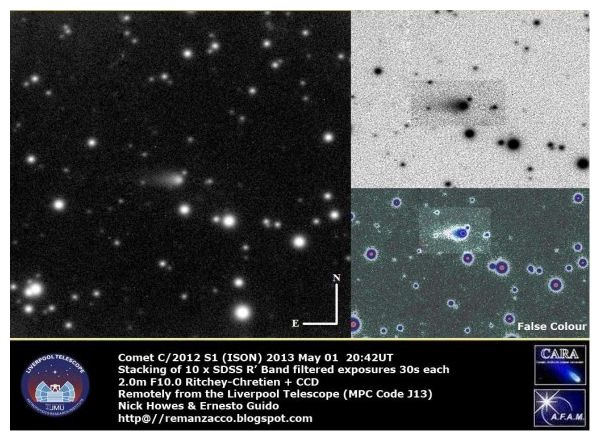
Cbet nr. 3478, issued on 2013, April 19, announces the discovery of a apparently asteroidal object (discovery magnitude ~19.6) by M. Schwartz and P. R. Holvorcem on CCD images obtained with the Tenagra II 0.41-m f/3.75 astrograph located near Nogales, AZ, U.S.A.

After posting on the Minor Planet Center's NEOCP webpage, this apparently asteroidal object as been found to show cometary features by our team.

Stacking of 12 R-filtered exposures, 50-sec each, obtained remotely from Haleakala-Faulkes Telescope North on 2013, April 18.4, through a 2.0-m f/10.0 Ritchey-Chretien + CCD (operated by LCOGT), shows that this object is a comet: compact coma about 5" in diameter elongated toward PA 110

The new comet has been designated Comet C/2013 G9 (TENAGRA). Below you can see our image.
C/2013 G9 (Tenagra)
© Remanzacco ObservatoryImages of C/2013 G9 (TENAGRA) taken in collaboration with the Faulkes Project and Horbury Academy - Paul Campbell.

Info

TEDx flirts with scientism and materialistic world view

Image
Recent developments within the TEDx conference (Technology, Entertainment, and Design) community of organizers are indicative of a rising tide of intolerance in the world of science. Historically, TED has provided an influential forum for cutting edge ideas that may not otherwise have had a fair hearing in the public arena. Recent events, however, should cause one to question the credibility of TED and are a reflection of the increasingly polarized debate between science and religion in American culture.

Responding to charges that TEDx conferences were booking speakers who were not representative of its mission statement, the organization sent a memo to the TEDx community of organizers regarding the need to be aware of and vigilant against would-be promoters of "bad science" (full memo here). TED's knee jerk response to the potential diminution of its reputation has been to circle the wagons against all forms of "pseudoscience" and "health hoaxes."

Reality Sandwich's Ken Jordan addressed a respectfully written letter (full text here) of concern to TED conference curator, Chris Anderson, asking if the organization hadn't overreacted, especially regarding speakers who had presented topics related to the concept of non-locality and the brain/consciousness question. My own interest here is to pick up on this theme of intolerance as it pertains to alternative forms of medicine and holistic forms of healing. Forgive me if my comments may not seem as kind as Ken Jordan's. I believe that the only solution to this dualistic dilemma is to lift the veil of authority and sanctimony that hides the underlying imperialistic impulses of contemporary science.

In my estimation, a good deal of confusion arises from a lack of understanding as to what constitutes good science, bad science, and pseudoscience. The TEDx memo states with a good bit of authority what it believes the differences to be, and I must add, it does so very poorly. In fact, the memo serves as a perfect example of scientism masquerading as science. Perhaps if we define some terms it will help shed some light on this sad situation.

Comment: The field of science has been increasingly dominated by those espousing a fundamental materialist world view. For more information on how this has corrupted science, read:
Book Review: The Science Delusion by Rupert Sheldrake
The Corruption of Science in America
It's Time For Science to Move On from Materialism


Butterfly

Bats, butterflies, roaches, mosquitoes, and birds: The coming micro-drone revolution

insect drone
© unknownMosquito Drone
"[Drones are a] game-changing technology, akin to gunpowder, the steam engine, the atomic bomb - opening up possibilities that were fiction a generation earlier but also opening up perils that were unknown a generation ago." - Peter Singer, senior fellow at the Brookings Institution
America will never be a "no drone zone."

That must be acknowledged from the outset. There is too much money to be made on drones, for one, and too many special interest groups - from the defense sector to law enforcement to the so-called "research" groups that are in it for purely "academic" reasons - who have a vested interest in ensuring that drones are here to stay.

At one time, there was a small glimmer of hope that these aerial threats to privacy would not come home to roost, but that all ended when Barack Obama took office and made drones the cornerstone of his war efforts. By the time President Obama signed the FAA Reauthorization Act into law in 2012, there was no turning back. The FAA opened the door for drones, once confined to the battlefields over Iraq and Afghanistan, to be used domestically for a wide range of functions, both public and private, governmental and corporate. It is expected that at least 30,000 drones will occupy U.S. airspace by 2020, ushering in a $30 billion per year industry.

Those looking to the skies in search of Predator drones will be in for a surprise, however, because when the drones finally descend en masse on America, they will not be the massive aerial assault vehicles favored by the Obama administration in their overseas war efforts. Rather, the drones coming to a neighborhood near you will be small, some nano in size, capable of flying through city streets and buildings almost undetected, while hovering over cityscapes and public events for long periods of time, providing a means of 24/7 surveillance.