Science & Technology
Engineers at Sandia National Laboratories have invented a bullet that guides itself to the target.
Sandia has wide expertise at miniature technology, and the bullet works like a tiny guided missile.
The patented design doesn't shoot straight. Instead of a spiral rotation, the bullet twists and turns to guide itself towards a laser directed point. It can make up to thirty corrections per second while in the air.
Jim Jones, distinguished member of technical staff, and his team of engineers at Sandia Labs think the .50-caliber bullets would work well with military machine guns so soldiers could hit their mark faster and with precision.
We need a new mind-body paradigm, a map that acknowledges the many kinds of things there are in the world and the continuity of evolution. We must somehow find different, more realistic ways of understanding human beings - and indeed other animals - as the active wholes that they are, rather than pretending to see them as meaningless consignments of chemicals.
Rupert Sheldrake, who has long called for this development, spells out this need forcibly in his new book. He shows how materialism has gradually hardened into a kind of anti-Christian faith, an ideology rather than a scientific principle, claiming authority to dictate theories and to veto inquiries on topics that don't suit it, such as unorthodox medicine, let alone religion. He shows how completely alien this static materialism is to modern physics, where matter is dynamic. And, to mark the strange dilemmas that this perverse fashion poses for us, he ends each chapter with some very intriguing "Questions for Materialists", questions such as "Have you been programmed to believe in materialism?", "If there are no purposes in nature, how can you have purposes yourself?", "How do you explain the placebo response?" and so on.

Some scientists are challenging conventional interpretations and proposing top-down, holistic explanations.
Werner Heisenberg, one of the founding fathers of quantum physics, once observed that history could be divided into periods according to what people of the time made of matter. In his book Physics and Philosophy, published in the early 60s, he argued that at the beginning of the 20th century we entered a new period. It was then that quantum physics threw off the materialism that dominated the natural sciences of the 19th century.
Of materialism, he wrote:
"[This] frame was so narrow and rigid that it was difficult to find a place in it for many concepts of our language that had always belonged to its very substance, for instance, the concept of mind, of the human soul or of life. Mind could be introduced into the general picture only as a kind of mirror of the material world."Today we live in the 21st century, and it seems that we are still stuck with this narrow and rigid view of the things. As Rupert Sheldrake puts it in his new book, published this week, The Science Delusion: "The belief system that governs conventional scientific thinking is an act of faith, grounded in a 19th-century ideology."
Quasicrystals are patterns that fill all of a space but do not have the translational symmetry that is characteristic of true crystals. In two dimensions this means that sliding an exact copy of the pattern over itself will never produce an exact match, though rotating the copy will often produce a match. They were first described mathematically by the British academic Roger Penrose in the guise of the famous Penrose tiles. About 10 years later Danny Schechtman of Israel's Technion University showed that the positions of atoms in a metallic alloy had a quasicrystalline structure. Since then, hundreds of different quasicrystals have been discovered in nature.
Mesmerizing patterns
Various people from both scientific and design fields have noted the similarity between quasicrystal structures and certain forms of Islamic decorative art. These mesmerizing geometric patterns, often located in places of worship, comprise repetitive patterns that reveal different features depending on whether you look at small sections or larger regions of the design.

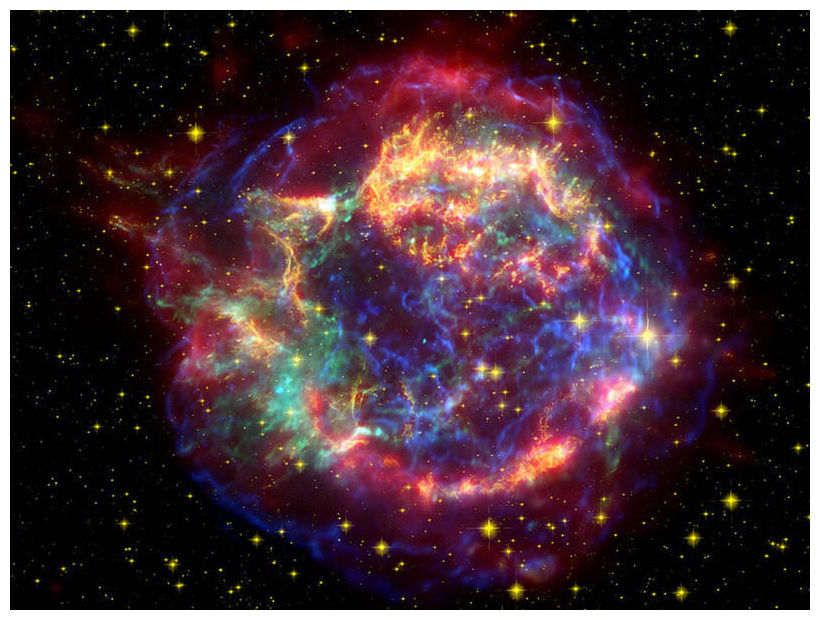
A Hubble Space Telescope picture of the Crab Nebula, a cloud of dust and gas left over from a supernova.
For the first time, a NASA spacecraft has directly observed "alien" particles that came from beyond our solar system, astronomers announced today.
The discovery not only gives us a glimpse of what exists in the so-called interstellar medium - the matter between stars - but also offers clues to the anatomy of our local galactic neighborhood.
Orbiting Earth some 200,000 miles (322,000 kilometers) away, the Interstellar Boundary Explorer (IBEX) spacecraft was able to snag samples of hydrogen, oxygen, and neon that came from interstellar space.
"It's exciting to be able to have these first observations of alien matter - stuff that didn't come from our sun or the planets, but came from the outside of our solar system, from other parts of the galaxy," David McComas, team leader for the IBEX program, said during a NASA news conference Tuesday.
"We think these are really important measurements, because these elements are the fundamental building blocks of stars, planets, and people."

Santorini Volcano in the Aegean Sea, seen in this NASA satellite image, was the site of one of the largest eruptions in the last 10,000 years. The explosion of the volcano removed so much magma from below the Earth that the volcano collapsed, producing a large crater, or caldera.
Each of the world's roughly one dozen super-volcanoes is capable of spewing out thousands of times more magma and ash than any eruption ever recorded in human history.
For instance, when Mount Toba on the Indonesian island of Sumatra erupted some 74,000 years ago, a staggering 700 cubic miles (2,800 cubic kilometers) of magma and a thick layer of ash were released over South Asia. In comparison, the explosion of the Indonesian island of Krakatoa in 1883, one of the largest eruptions in recorded history, released about 3 cubic miles (12 cubic km) of material.
"These are catastrophic eruptions," said researcher Tim Druitt, a volcanologist at the University of Blaise Pascal in France, who with his colleagues examined crystals from the Greek island of Santorini to try to learn about the behavior of the magma reservoir beneath a powerful volcano.
"There's a lot of wonderful information locked up in video, and 40 million security cameras in the U.S. collecting it, but it's data that's not been available," says Steve Russell, cofounder and CEO of Prism, based in San Francisco. "We want to free up that information."
Prism's software can count people that come into a business, measure the length of the line at checkout, and produce static or animated visualizations showing how people moved around a store. It is designed so that it cannot identify or track individuals. One national wireless carrier is already using Prism's technology to generate heat maps of where visitors go in their showrooms, to compare the level of interest in different devices - valuable data to them and to the device makers.
The new data, which shed light on the cost of operating Facebook's massive server infrastructure, emerges as the company is said to be prepping papers for an initial public offering, which would include additional details about the company's operations. The Oregon disclosures are part of Facebook's effort to reinforce the benefits of its data center to the local economy, amid a dispute over property taxes and questions from some Prineville residents about the impact of data centers on the small community in central Oregon.
For Prineville, Facebook is a big business operation - a fact reflected in the power required to operate the first phase of the data center. The 28 megawatts of utility power for the 300,000 square foot first phase isn't extraordinary for a data center of that size. But it stands out in Crook County, where all the homes and business other than Facebook use 30 megawatts of power.

Roku and Hex are two of the three chimera monkeys that contain genetic information from six monkey embryos.
Three chimera monkeys were born in a lab at the Oregon National Primate Research Center recently. To create these chimera primates, scientists inserted a combination of genes from several monkey embryos into a new embryo, accomplishing a feat that had been previously only demonstrated in less complex species.
Previously, knockout mice have become powerful tools for scientists studying genetic diseases including Parkinson's and obesity, but the techniques were not applicable to primates. Knockout mice are created by fusing together mouse embryonic stem cells in a lab dish and then culturing those cells into a mouse embryo. But with the more complicated primate embryo, the cultured stem cells do not integrate so easily.
"So far, scientists studied human and monkey embryonic stem cells in vitro, in a Petri dish, and thought that since they came initially from embryos, they retain the ability to develop into mature and functional tissues and organs, just like normal stem cells in developing embryos," said study author Shoukhrat Mitalipov of the Oregon National Primate Research Centre at Oregon Health and Science University.
This so-called interstellar material was spotted by NASA's Interstellar Boundary Explorer (IBEX), a spacecraft that is studying the edge of the solar system from its orbit about 200,000 miles (322,000 kilometers) above Earth.
"This alien interstellar material is really the stuff that stars and planets and people are made of - it's really important to be measuring it," David McComas, IBEX principal investigator and assistant vice president of the Space Science and Engineering Division at Southwest Research Institute in San Antonio, said in a news briefing today from NASA Headquarters in Washington, D.C.
An international team of scientists presented new findings from IBEX, which included the first detection of alien particles of hydrogen, oxygen and neon, in addition to the confirmation of previously detected helium.
These atoms are remnants of older stars that have ended their lives in violent explosions, called supernovas, which dispersed the elements throughout the galaxy. As interstellar wind blows these charged and neutral particles through the Milky Way, the IBEX probe is able to create a census of the elements that are present.


Comment: For more information on the corruption of science read:
Dark Ages and Inquisitions, Ancient and Modern - Or Why Things are Such a Mess On Our Planet and Humanity is on the Verge of Extinction