Science & TechnologyS


Fireball

Lyrid meteor shower peaks this weekend

Image
© NASA/JSC/D. PettitOn the night of April 21, the 2012 Lyrid meteor shower peaked in the skies over Earth. While NASA allsky cameras were looking up at the night skies, astronaut Don Pettit aboard the International Space Station trained his video camera on Earth below. This image was taken on April 22, 2012.
An annual meteor shower is set to peak this weekend, but the showing likely won't be as strong as it has been in years past.

The Lyrid meteor shower should give skywatchers in darkened parts of the world a decent show late Sunday night (April 21) and early Monday morning (April 22), but the glare from a nearly full moon will probably impede the view for many stargazers.

"The Lyrid meteor shower will be best seen in the early morning hours of April 22," officials from the Space Telescope Science Institute said in a video. "Moonlight will interfere with this year's display, but away from city lights, you might see up to 20 meteors per hour."

NASA meteor scientist Bill Cooke was a bit more pessimistic, telling SPACE.com via email that viewers under dark skies can expect to see about 10 meteors per hour during the peak, which is just three days before the April 25 full moon.

Newspaper

Anonymous set to establish news website after successful fundraiser

Anonymous
© Reuters/Wolfgang Rattay
An online donations-pledge drive on behalf of online hacktivist group Anonymous easily surpassed its initial goal, ushering forward a project by one of its largest Twitter subset groups to establish a news website run by and for the organization.

Since its early days Anonymous has been largely based off of social media activity, with much of its activity taking place on 4chan, Twitter and Tumblr, though more central players are also regulars on online chatrooms hosted by IRC.

The group, which is really a loose collective of online hacktivists that join forces for various focused projects, has generally avoided establishing permanent sites, though the @YourAnonNews (YAN) account has now begun a public campaign to raise funds for a new online home.

Mars

Applications opening imminently for one-way trip to Mars

Mars
© NASA
Want to go to Mars? Dutch organisation Mars One says it will open applications imminently. It would be a one-way trip, and the company hopes to build a community of settlers on the planet.

Uncharted waters, mountains or far away lands have always drawn explorers. History books show that desire for adventure, even in the face of extreme danger, did not deter the likes of Columbus or Magellan.

So it is perhaps not surprising that Mars One has already received thousands of prospective applicants. But there is no return - unlike the mission which hopes to fly to Mars and back in 2018.

Hiliter

Computer algorithm better at writing news than human reporter?

Image
© Mark Allen Miller
Had Narrative Science - a company that trains computers to write news stories - created this piece, it probably would not mention that the company's Chicago headquarters lie only a long baseball toss from the Tribune newspaper building. Nor would it dwell on the fact that this potentially job-killing technology was incubated in part at Northwestern's Medill School of Journalism, Media, Integrated Marketing Communications. Those ironies are obvious to a human. But not to a computer.

At least not yet.

For now consider this: Every 30 seconds or so, the algorithmic bull pen of Narrative Science, a 30-person company occupying a large room on the fringes of the Chicago Loop, extrudes a story whose very byline is a question of philosophical inquiry. The computer-written product could be a pennant-waving second-half update of a Big Ten basketball contest, a sober preview of a corporate earnings statement, or a blithe summary of the presidential horse race drawn from Twitter posts. The articles run on the websites of respected publishers like Forbes, as well as other Internet media powers (many of which are keeping their identities private). Niche news services hire Narrative Science to write updates for their subscribers, be they sports fans, small-cap investors, or fast-food franchise owners.

Comet 2

New Comet: C/2013 G7 (McNAUGHT)

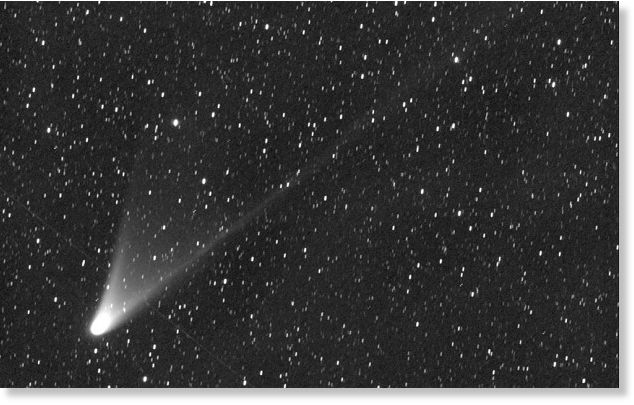
Cbet nr. 3476, issued on 2013, April 16, announces the discovery of a new comet (discovery magnitude ~18) by R. H. McNaught on CCD images obtained with the 0.5-m Uppsala Schmidt telescope at Siding Spring on april 13.6. The new comet has been designated C/2013 G7 (McNAUGHT).

We performed follow-up measurements of this object, while it was still on the neocp. Stacking of 17 R-filtered exposures, 40-sec each, obtained remotely from Haleakala-Faulkes Telescope North on 2013, April 15.4, through a 2.0-m f/10.0 Ritchey-Chretien + CCD (operated by Las Cumbres Observatory Global Telescope Network), shows that this object is a comet: compact coma about 6" in diameter.

Below you can see our image.
C/2013 G7
© Remanzacco ObservatoryImages of C/2013 G7 (McNAUGHT) taken in collaboration with the Faulkes Project and Shooters Hill Post 16 Campus - Errol Simpson.
M.P.E.C. 2013-H10 assigns the following preliminary parabolic orbital elements to comet C/2013 G7: T 2014 Apr. 20.34; e= 1.0; Peri. = 225.32; q = 4.38; Incl.= 104.11.

Info

Cosmic explosion left imprint in fossil record

Crab Nebula
© NASA, ESA, J. Hester and A. Loll (Arizona State UniversityAncient iron-loving bacteria may have collected particles from a supernova that exploded about 2.2 million years ago. The Crab Nebula, shown here in this image from NASA’s Hubble Space Telescope, is much younger having exploded in 1054.
Ancient iron-loving bacteria may have scooped up evidence of a nearby supernova explosion 2.2 million years ago, leaving an extraterrestrial iron signature in the fossil record, according to German researchers presenting their findings at a recent meeting of the American Physical Society.

In 2004, German scientists reported finding an isotope of iron in a core sample from the Pacific Ocean that does not form on Earth. The scientists calculated the decay rate of the radioactive isotope iron-60 and determined that the source was from a nearby supernova about 2 million years ago.

The blast, they say, was close enough to Earth to seriously damage the ozone layer and may have contributed to a marine extinction at the Pliocene-Pleistocene geologic boundary.

Mr. Potato

Programming the news: The future of reporting is algorithms

Image
© Mark Allen Miller
This may seem like the sort of statement usually delivered by an overblown narrator as rockets and lasers go zooming* by, but here goes: In the world of journalism, the future is now! Granted, it's the kind of future that often makes waves in the present and raises at least as many questions as it answers, but if you wanted a bright, problem-free future, you'd have to travel back to the divergence point somewhere between Philip K. Dick and The Jetsons... and then eliminate the dystopians.

*Yes, I realize lasers don't make noise or "zoom" by, but that hasn't prevented George Lucas from becoming insanely rich, has it?

But you can't, so here we are, discussing journalism... by robots! [INS FANFARE/LASER NOISES]
Journalist Ken Schwencke has occasionally awakened in the morning to find his byline atop a news story he didn't write.

No, it's not that his employer, The Los Angeles Times, is accidentally putting his name atop other writers' articles. Instead, it's a reflection that Schwencke, digital editor at the respected U.S. newspaper, wrote an algorithm - that then wrote the story for him.

Instead of personally composing the pieces, Schwencke developed a set of step-by-step instructions that can take a stream of data - this particular algorithm works with earthquake statistics, since he lives in California - compile the data into a pre-determined structure, then format it for publication.

His fingers never have to touch a keyboard; he doesn't have to look at a computer screen. He can be sleeping soundly when the story writes itself.

Robot

The robot journalist: An apocalypse for the news industry?

Image
© AlamyStories generated by Narrative Science will not be winning many Pulitzers, but will pass the Turing test of making one unsure whether they are written by person or machine
A set of algorithms which take data and turn it into words began as an experimental lab, but now appear on Forbes.com

Visit the website of Forbes.com and read the earnings forecasts for the New York Times Company, and you will notice the byline "By Narrative Science". Normally you have to open a copy of Wallpaper* to find someone with such a florid monicker. Except of course Narrative Science is not a person but a robot journalist - actually a set of algorithms which take data and turn it into words.

What started as an experimental lab at Northwestern University with journalists and technologists working together is now a fully-fledged business that turns data into stories of a type which will not be winning many Pulitzers, but which certainly pass the Turing test of making one unsure whether they were written by a person or machine. The lovable "stats monkey", which came from the same series of research experiments, does the same for sports stories, without the attendant vet bills, bananas and spelling errors associated with employing a real monkey.

Although this algorithmic approach to compiling stories is by no means new - the lab which spawned Narrative Science was conducting and publishing work a number of years ago - the ultimate ramifications of what the approach symbolises seem to be taking a long time to sink into most newsgathering organisations.

Airplane

American Airlines grounds entire fleet: Computer glitch

American Airlines
© BoeingAmerican Airlines 737-800 Eco Demonstrator in Flight
American Airlines has resumed at least some flights after a computer glitch forced it to ground all of its flights for several hours this afternoon (April 16).

The carrier resumed some flights right around 5 p.m. ET, but warned "we expect continued flight delays and cancellations throughout the remainder of the day."

More than 730 flights on American and regional affiliate American Eagle had been canceled as of 4:15 p.m. ET, according to flight-tracking service FlightAware. An additional 738 American flights were delayed today because of the glitch.

"This is a major outage for American and is the longest flight disruption as a result of a failure of an airline's back-end technology in recent history," FlightAware CEO Daniel Baker says to Today in the Sky. "It is likely to affect over 125,000 travelers today and tomorrow. United had a few similar outages last year, some as a result of the Continental/United merger and related technology fallout, but none were nearly as long as this" problem, which lasted more than 5 hours.

Info

Business suit turns transparent when wearer lies

Designer and innovator Daan Roosegaarde is known for his exciting projects such as the glow-in-the-dark Smart Highway and the Intimacy project, the interactive dress that becomes transparent in response to social encounters. In a recent interview at Design Indaba, Roosegaarde revealed that his company is taking the Intimacy project to a new direction.

Studio Roosegaarde will be working on business suits for men that turn transparent when they lie. The studio will work with high-end fashion designers to create new products for this new line of Intimacy.

Watch this interview of Daan Roosegaarde as he talks about his studio's latest projects.