Science & TechnologyS


Comet

Will Comet Ison survive its close encounter with the sun?

Image
© Unknown.All eyes will be firmly on the skies this Thursday as the 'star-grazer' brushes the sun's corona

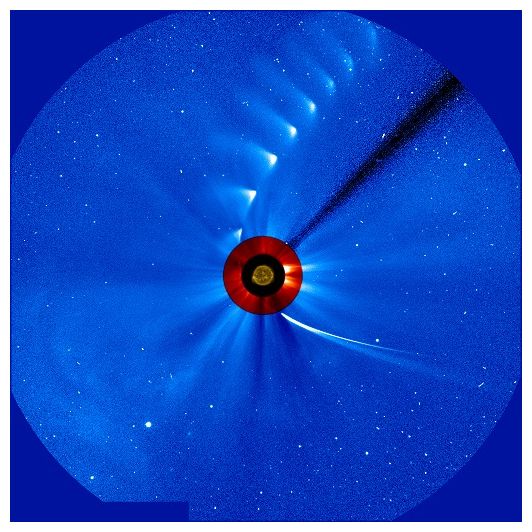
This week will see the moment of truth for Comet Ison, the much-awaited "comet of the century" that could be about to put on one of the greatest celestial light shows in living memory.

For the past year scientists have been tracking Ison's movement as it hurtles towards the inner solar system, and on Thursday it is set to pass through the corona of the sun itself.

The comet is around 4.6 billion years old - forming at the very beginning of the solar system, and has been sitting quietly in the outer reaches of the sun's gravitational field for almost all that time.

Relatively recently, Ison was knocked out of the distant Oort cloud and began its journey towards the sun. That light-year-long trip is very nearly at an end, and astronomers still don't know if it is one that it will survive.

Info

Twice as much methane escaping Arctic seafloor

Methane Bubbles
© Igor Semiletov, University of Alaska Fairbanks, © Science/AAASThe sea surface above the East Siberian Arctic Shelf is full of ice and bubbles.
The Arctic methane time bomb is bigger than scientists once thought and primed to blow, according to a study published today (Nov. 24) in the journal Nature Geoscience.

About 17 teragrams of methane, a potent greenhouse gas, escapes each year from a broad, shallow underwater platform called the East Siberian Arctic Shelf, said Natalia Shakova, lead study author and a biogeochemist at the University of Alaska, Fairbanks. A teragram is equal to about 1.1 million tons; the world emits about 500 million tons of methane every year from manmade and natural sources. The new measurement more than doubles the team's earlier estimate of Siberian methane release, published in 2010 in the journal Science.

"We believe that release of methane from the Arctic, in particular, from the East Siberian Arctic Shelf, could impact the entire globe, not just the Arctic alone," Shakova told LiveScience. "The picture that we are trying to understand is what is the actual contribution of the [shelf] to the global methane budget and how it will change over time."

Info

Spanish team grows fake skin using stem cells from umbilical cord

Fake Skin
© Thinkstock
Scientists from the University of Granada in Spain have announced the development of artificial skin, grown from umbilical cord stem cells. The development could be a massive step forward for the treatment of burn victims or other patients who have suffered severe skin damage.

According to a report, published in the journal Stem Cells Translational Medicine, the research team wrote that they were able to use stem cells derived from the umbilical cord, also known as Wharton stem cells, to generate oral-mucosa or epithelia, two types of tissues needed to treat skin injuries.

The researchers said their novel technique is an improvement on conventional methods that can take weeks to generate artificial skin. To grow the artificial tissue, the study team used a biomaterial made of fibrin and agarose that they had previously designed and developed.

"Creating this new type of skin using stem cells, which can be stored in tissue banks, means that it can be used instantly when injuries are caused, and which would bring the application of artificial skin forward many weeks," said study author Antonio Campos, professor of Histology at the University of Granada.

Bug

Giant ant colony excavated, you won't believe what they build underground!


This abandoned ant colony revealed how genius these tiny creatures are. Ants live underground - we usually see a relatively small exit on the surface.

Recycle

Epic fail: The skillful predictions of climate science

Image
In 2007, a team of climate scientists from the UK Met Office led by Doug Smith wrote a paper "Improved Surface Temperature Prediction for the Coming Decade from a Global Climate Model", published in the journal Science. Although published in 2007, the paper made predictions for the decade 2004-2014. (Presumably the work was started around 2004 and it took some time for the paper to be published). The paper made claims about the "skill" of the model, for example "Having established the predictive skill of DePreSys..."

The Smith et al paper made the following specific predictions:
There would be 0.3°C warming over the decade 2004-2014
At least half of the years after 2009 would be warmer than the record year of 1998.
Note that at that time, 2007, the warmest year was thought to be 1998; subsequent adjustments to the method made 2005 warmer than 1998.

The predictions were spread far and wide. They were included in a Met Office Press release, and a glossy brochure on "Informing Government policy into the future", with the almost obligatory scaremongering background pictures of black clouds and people wearing facemasks. Vicky Pope gave a talk on these predictions, saying that "these are very strong statements about what will happen over the next 10 years."

And of course the faithful media reported the story without questioning it.

Satellite

European Space Agency satellite swarm launch to map Earth's magnetism

Image
© Unknown.The Swarm mission to map the Earth's global magnetic field in unprecedented detail has launched from Russia.
The trio of European Space Agency (ESA) satellites left the Plesetsk Cosmodrome at 12:02 GMT, riding a Rockot vehicle.

They are expected to be deployed at an altitude of 490km, in a polar orbit, shortly after 13:30 GMT.

Swarm's data should help scientists understand better how the field is generated, and why it appears to be weakening.

The strength has fallen by some 15% in the past two centuries. The movement of the north geomagnetic pole has also accelerated.

Researchers have speculated that Earth may be on the cusp of a polarity reversal, which would see the direction of the field flip end to end. North would become south, and vice versa.

This has not happened for 780,000 years, but the phenomenon has nonetheless been a regular occurrence through geological time.

Galaxy

Icy telescope detects neutrinos from beyond our Solar System

IceCube Laboratory
© Sven Lidstrom, IceCube/NSFThe IceCube Laboratory at the Amundsen-Scott South Pole Station in Antarctica.
A mammoth neutrino experiment near the South Pole has, for the first time, detected high-energy neutrinos from beyond our solar system. The 28 neutrinos captured by the IceCube detector had a billion times more energy than the neutrinos generated by an exploding star, hinting at an astronomical source beyond our galaxy of unfathomable power.

The neutrinos mark the beginning of an exciting new field of high-energy neutrino astrophysics. "I cannot predict the future but I hope that this may someday be as successful as all the other times when we found new ways to study the universe, like radio astronomy and X-ray astronomy," says University of Wisconsin physicist Francis Halzen, principal investigator on the experiment.

Laptop

Do we live in the Matrix?

Matrix
© Discover Magazine
In the 1999 sci-fi film classic The Matrix, the protagonist, Neo, is stunned to see people defying the laws of physics, running up walls and vanishing suddenly. These superhuman violations of the rules of the universe are possible because, unbeknownst to him, Neo's consciousness is embedded in the Matrix, a virtual-reality simulation created by sentient machines.

The action really begins when Neo is given a fateful choice: Take the blue pill and return to his oblivious, virtual existence, or take the red pill to learn the truth about the Matrix and find out "how deep the rabbit hole goes."

Physicists can now offer us the same choice, the ability to test whether we live in our own virtual Matrix, by studying radiation from space. As fanciful as it sounds, some philosophers have long argued that we're actually more likely to be artificial intelligences trapped in a fake universe than we are organic minds in the "real" one.

But if that were true, the very laws of physics that allow us to devise such reality-checking technology may have little to do with the fundamental rules that govern the meta-universe inhabited by our simulators. To us, these programmers would be gods, able to twist reality on a whim.

So should we say yes to the offer to take the red pill and learn the truth - or are the implications too disturbing?

Comet

Comets ISON and Lovejoy flare spectacularly

Image
© Michael JaegerComet ISON on Nov. 17 with a tail nearly 8 degrees long streaming from a small, strongly condensed coma. Click to enlarge.
Wonderful photos of Comets ISON and Lovejoy with their swollen comas and developing tails have appeared on these pages, but recently, amateur and professional astronomers have probed deeper to discover fascinating dust structures emanating from their very cores. Most comets possess a fuzzy, starlike pseudo-nucleus glowing near the center of the coma. Hidden within this minute luminous cocoon of haze and gas lies the true comet nucleus, a dark, icy body that typically spans from a few to 10 kilometers wide. Comet ISON's nucleus could be as large as several kilometers and hefty enough (we hope!) to survive its close call with the sun on Nov. 28.

Image
© Bob King/Luc ArnoldSketch using Photoshop of the inner region of Comet Lovejoy’s coma showing the false nucleus and the curious dust fountain observed on Nov. 13 in a 15-inch (37-cm) telescope. At right the same plume photographed on Nov. 12 with north up and east to the left.

Comment: Take a good look at that spiralling motion produced by Comet Hale-Bopp in 1997.

This is pretty much the same spiral motion we've seen in countless videos of comets that were taken from the ground (which CorpGov's media tells us are man-made missiles, and indeed, perhaps some of them are).

If nothing else, this tells us that, in the case of incoming or approaching comets or comet fragments, it's not their interaction with the planet that causes them to spiral - they do that in deep space too.

Take note for the next time you see one of these and the media tells you, "Nothing to see here, folks, it's only the separation of booster rockets from a previously unplanned rocket launch"...


Airplane

Super-stealth flying car prototype seen outside Google HQ

Zee.Aero's mysterious prototype aircraft
© Greg Espiritu/SF ChronicleIt looks real, but does it work? Zee.Aero's mysterious prototype aircraft
Forget self-driving cars. How about flying ones? Reports have emerged of what appears to be a mysterious airborne vehicle being developed by a stealth company operating near Google's Mountain View headquarters.

On Wednesday, the San Francisco Chronicle reported on patent filings by a hush-hush outfit called Zee.Aero that describe a "personal aircraft" with unique characteristics.

The proposed vehicle's design is so unusual that it looks like something out of science fiction. But a later article revealed that more than one snoop has managed to capture photographs of a real-life aircraft bearing a striking resemblance to the illustrations in Zee.Aero's patents.