Science & TechnologyS


Eye 1

Naked body scanners and TSA-style groping expand across UK airports

naked scanner
© The Guardian
Eleven more airports across Britain, including Stansted, Luton and Liverpool, are to be required to screen passengers with new generation full-body scanners, the transport secretary, Patrick McLoughlin, has announced.

But he has ordered that a ban on flying for passengers who refuse to go through the controversial scanners should be lifted from Friday as long as they agree to undergo an alternative private hand-search.

The full-body scanners are already in use at 10 of Britain's largest airports.

Comment: To support his case, the transport secretary alludes to a supposedly 'small minority' who are opposed to naked scanning. In the US, a recent poll found 61% opposed similar expansions of the use of full-body image scanners.


Cassiopaea

Brightest explosion in the universe ever seen defies astronomy theories

Image
© NASA/Swift/Cruz deWildeAn unusually bright gamma-ray burst produced a jet that emerged at nearly the speed of light.
A mysterious blast of light spotted earlier this year near the constellation Leo was actually the brightest gamma-ray burst ever recorded, and was triggered by an extremely powerful stellar explosion, new research reports.

On April 27, several satellites - including NASA's Swift satellite and Fermi Gamma-ray Space Telescope - observed an unusually bright burst of gamma radiation. The explosion unleashed an energetic jet of particles that traveled at nearly the speed of light, researchers said.

"We suddenly saw a gamma-ray burst that was extremely bright - a monster gamma-ray burst," study co-author Daniele Malesani, an astrophysicist at the Niels Bohr Institute at the University of Copenhagen in Denmark, said in a statement. "This [was] one of the most powerful gamma-ray bursts we have ever observed with the Swift satellite." [Top 10 Strangest Things in Space]

The gamma-ray burst was described in a series of studies published online today (Nov. 21) in the journal Science.

Gamma-ray bursts, or GRBs, are the most powerful type of explosions in the universe and typically mark the destruction of a massive star. The original stars are too faint to be seen, but the supernova explosions that signal a star's death throes can cause violent bursts of gamma radiation, researchers said.

Question

Strange Discovery: Giant dust ring found near Venus orbit

Dust Ring
© M.H.Jones/The Open UniversityA huge but diffuse ring of dust near the orbit of Venus is revealed in this surface brightness map compiled using data gathered by NASA's STEREO-A probe in June 2009. Venus' orbit is indicated by the black dots; brighter areas show up as red and dimmer ones as blue.
Scientists have found a huge, diffuse ring of dust near the orbit of Venus, marking the second time such a structure has been discovered in our solar system.

The dust ring stretches about 137 million miles (220 million kilometers) from end to end, though it's just 10 percent denser than the background cloud that pervades interplanetary space and produces the glow known as zodiacal light, researchers said.

"If we could see it unaided from Earth (which of course we can't because it is far too faint), it would stretch 45 degrees either side of the sun," study lead author Mark Jones, of The Open University in the United Kingdom, told SPACE.com via email.

A similar ring was detected near Earth's orbit about 20 years ago, Jones added.

"So we have added to our knowledge of the 'geography' of the solar system," he said.

Telescope

Flashback Electric Universe: Comet Elenin - the Debate that Never Happened


Comment: In light of the news that Comet ISON is flaring spectacularly - something NASA scientists can't explain with their backwards theories about comets being 'dirty snowballs' and 'dust jets' - we're re-running this 2011 article on Electric Comets by David Talbott of Thunderbolts.

Check out the most recent photos of ISON... this comet's got wings!
Image
Image
Image

The comet Elenin, a subject of intense Internet discussion for several months, seems to have disappointed everyone. I speak here not just of the doomsayers, who were awaiting a frightful specter in recent weeks. You might think these folks would be happy that the celebrated intruder faded fast just when it was supposed to be reaching maximum activity. But in these strange times, Doomsday seems a lot more fun than a minor distraction in our cosmic neighborhood.

Also disappointed are the many scientists who expected a more impressive display from Elenin. That expectation seemed well founded based on the growing coma of Elenin in the months following its discovery in December, 2010. And prior space probes sent to comets helped to feed an illusion about the comet's size. The estimates appear to have missed the mark completely.

Strangely, the popular scientific media, insofar as they've shown any interest in Elenin, are satisfied to simply expose the lunacy of Internet fear-mongering. But is that really all we should be discussing here? Elenin has only one connection to "Doomsday." Like every comet, it reminds us of ancient memories of a truly terrifying and destructive Great Comet, the true source of comet fears and Doomsday anxiety - a verifiable cultural conditioning that has persisted for thousands of years. With every appearance of a comet the ancient fear resurfaces, but this fact adds nothing to scientific discussion of Elenin and its fate.

Comet

ISON begins flaring - Is comet about to repeat Holmes' electrifying 2007 performance?

Image
© Wendelstein Observatory of the LMU/MPS / November 19, 2013This image taken Nov. 16 shows ISON's atmosphere with two wing-like features resembling the letter U. For orientation, the comet's nucleus position is shown as a bright spot in the center.
Two wing-shaped features in the thin atmosphere around the head of Comet ISON were detected earlier this week by scientists from the Max Planck Institute for Solar System Research (MPS) in Germany. You can see them in the image above -- it looks almost like a cartoon angel gliding through the night sky.

The wings in the image were not immediately visible to the naked eye, however. They were revealed after the researchers eliminated the uniformly bright background of the comet's atmosphere in the image, uncovering the fainter structures that it was outshining.

The researchers did the same futzing with two images of the comet -- one taken Nov. 14 and one taken Nov. 16. While the wings were faintly detectable on Nov. 14, they dominate the Nov. 16 image, according to a news release from the institute.

Scientists at MPS suggest that the wings are a result of the comet fragmenting.

"Features like these typically occur after individual fragments break off the nucleus," Hermann Böhnhardt of the MPS said in a statement.

Comment: Looks like ISON could be starting to act similarly to Comet Holmes in 2007. Read the following article that describes it:

Electric Universe: Comet Elenin - the Debate that Never Happened

And check out this image of Holmes flaring:

Comet Holmes on November 4, 2007
© Ivan EderComet Holmes on November 4, 2007, showing the blue ion tail on the right,taken from Hungary.


Comet

Comet swarm incoming! Comet Nevski joins ISON, Lovejoy, LINEAR and Encke as FIVE comets flare brightly for northern hemisphere observers

Comet Nevski
© Ernesto Guido, Nick Howes & Martino NicoliniCapture of Comet Nevski shortly after discovery using the ITelescope Observatory in New Mexico.
Is 2013 truly the "Year of the Comet?" Perhaps "Comets" might be a better term, as no less than five comets brighter than +10th magnitude grace the pre-dawn sky for northern hemisphere observers.

Comet C/2013 V3 Nevski has just brightened up 6 magnitudes - just over a 250-fold increase in brightness - and now sits at around magnitude +8.8. Comet Nevski was just recently discovered by Vitali Nevski using a 0.4 metre reflecting telescope 12 days ago on November 8th. If that name sounds familiar, it's because Nevski discovered the comet from the Kislovodsk observatory located near Kislovodsk, Russia which is part of the International Scientific Optical Network survey which located comet ISON last year. In fact, there was some brief controversy early on in its discovery that Comet C/2012 S1 ISON should have had the moniker Comet Nevski-Novichonok.

At the time of discovery, Comet Nevski appeared to be nothing special: shining at magnitude +15.1, it was well below our +10 magnitude limit for consideration as "interesting," and was projected to linger there for the duration of its passage through the inner solar system. About a dozen odd such comet discoveries crop up per year, most of which give astronomers a brief pause as the orbit and size of the comet become better known, only to discern that they're most likely to be nothing extraordinary.

Comment: Yeh, it is tempting to imagine that all of these comets are somehow related because there are clearly a whole lot of them heading this way all at once!

We've been saying it for years, but we'll say it again...

Something Wicked This Way Comes


Comet 2

Comet ISON - Another Outburst?

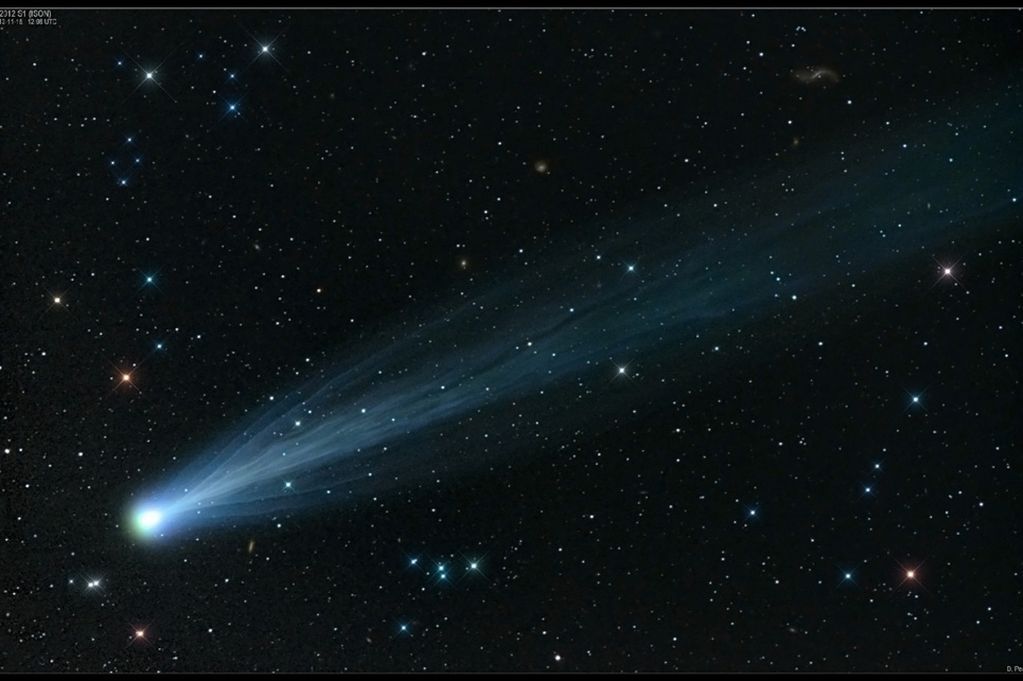
Astronomers working with the TRAPPIST telescope at ESO's La Silla Observatory report that Comet ISON's production of gas and dust surged another six-fold during the early hours of Nov. 19th. This marks the second outburst since Nov. 13th. Experienced observers put the comet's rising magnitude near +4.0, well above the threshold of naked-eye visibility. The problem is, ISON is approaching the sun and becoming increasingly difficult to observe. Shahrin Ahmad of Kuala Lumpur, Malaysia, photographed the comet's green core framed by twilight blue on the morning of Nov. 19th:
Comet ISON
© Shahrin Ahmad
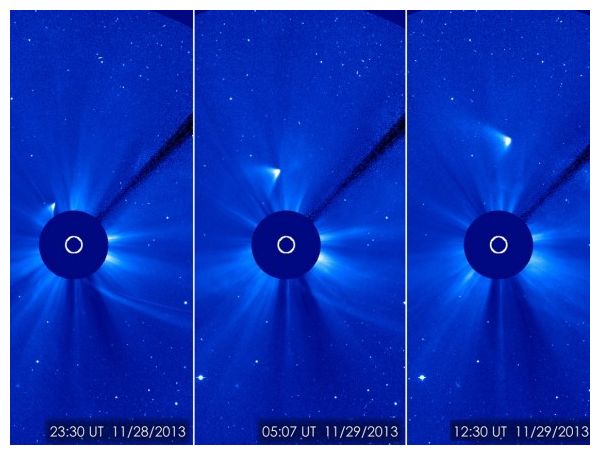
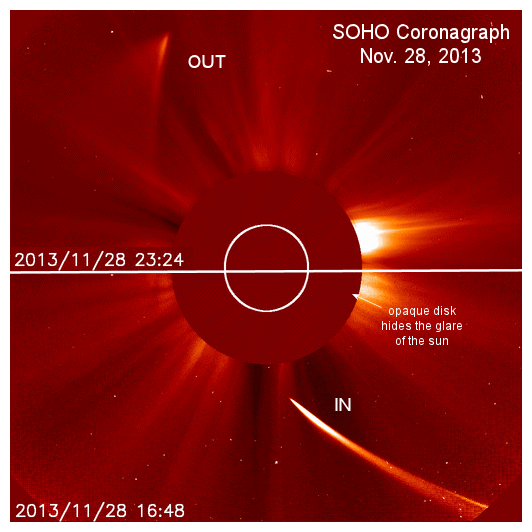
The situation is only going to worsen as the comet plunges toward its Nov. 28th close encounter with the sun. Amateur photography of the comet will be possible for a few more days and, soon, only NASA's fleet of solar observatories will be able to track the sundiver.

Cell Phone

Never forget that wireless carriers are evil

cell phones
© smileu34/photobucket

In today's edition of "U.S. wireless carriers are dicks", we're going to look at the latest in how carriers and the CTIA are protecting valuable revenue streams by blocking features that would curb smartphone theft.

Over 1.6 million U.S. consumers had a smartphone stolen in 2012. One in three thefts within the U.S. involved a mobile gadget. Speaking to CBS This Morning today, San Francisco's Attorney General stated that 50% of their robberies and thefts involved a smartphone. It's an epidemic and wireless carriers are dismissing the solution.

According to New York Attorney General Eric Schneiderman, officials from in New York, San Francisco, London and Philadelphia called on the wireless industry to present a solution. Samsung did just that earlier this year for its own devices, but the five largest U.S. wireless carriers denied it their customers.

According to emails obtained by CBS, AT&T, Verizon, T-Mobile, Sprint, and U.S. Cellular, all decided to not include the feature in the Samsung handsets sold by each carrier. Meanwhile, the CTIA, the trade association for wireless carriers, helped the FCC and certain police departments create online databases for stolen phones.

In theory, this list - compiled for, managed by, and unique to each wireless carrier - would prevent stolen smartphones from being reactivated. But it doesn't protect against data theft, and is largely useless if the phone is shipped out of the country. A kill switch is needed and placed in the hands of smartphone owners.

Info

U.S. Army will have its Iron Man suits in four years

Iron Man
© Josh Nizzi
This is not the first time that the US Army Research, Development and Engineering Command (RDECOM) has talked about their desire to get a real life version of Iron Man's suit for soldiers, but now it's giving a very specific timeframe: "The goal is to have a contract in place by next fall and have suits ready for full field testing in about four years."

While the Army's Iron Man suit - officially called Tactical Assault Light Operator Suit (TALOS) - will not have flying capability, little missiles, or repulsors, the feature list is still extremely impressive.

RDECOM wants TALOS to have ballistic and shock protection - using an armor that will get from flexible soft surface to hard metal solid, capable of repelling ammo when applying an electric current. Oh, and fire-retardant capability. The Army also wants the suit to "store and release energy to prevent injuries and increase performance."

Fireball

Now they tell us...Hazardous asteroids may be colliding with the planet 10 times more often than scientists have previously believed

Image
© NASAChelyabinsk rock
There are scads of building-size, potentially hazardous asteroids lurking in Earth's immediate neighborhood, and they may be colliding with the planet 10 times more often than scientists have previously believed, according to a new study published Wednesday that examined the airburst of a 25-million-pound asteroid earlier this year near the Russian city of Chelyabinsk.

Three studies released Wednesday, two in the journal Nature and one in the journal Science, have provided the most detailed description and analysis of the dramatic event on the morning of Feb. 15. Scientists now estimate the diameter of the object at just a hair under 20 meters, or about 65 feet. Undetected by astronomers, the rock came out of the glare of the sun and hit the atmosphere at 43,000 miles per hour.

As it descended through the atmosphere, it broke into fragments, creating a series of explosions with the combined energy of about 500 kilotons of TNT, making it more than 30 times more powerful than the atom bomb that destroyed Hiroshima in 1945, although the energy in this case was spread out over a much broader area.

The shock wave blew out windows in nearly half the buildings in Chelyabinsk. It knocked people off their feet; dozens were sunburned by the blinding flash, which at its peak was 30 times brighter than the sun. About 1,200 people were hurt, most by broken and flying glass, but no one was killed.

Comment: Here's a great book that sheds even more light on this 'ongoing problem', Laura Knight-Jadczyk's latest:

Comets and the Horns of Moses