
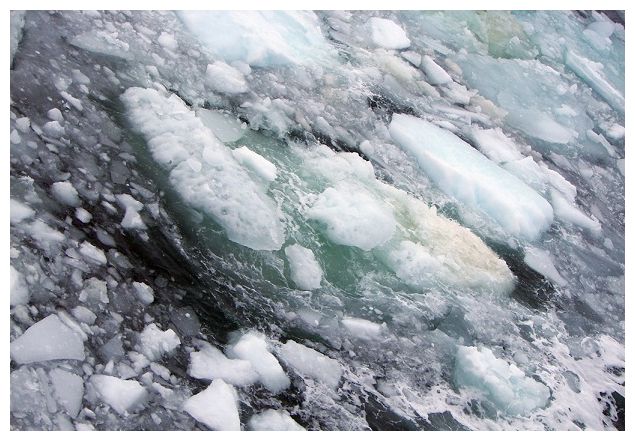
© Igor Semiletov, University of Alaska Fairbanks, © Science/AAASThe sea surface above the East Siberian Arctic Shelf is full of ice and bubbles.
About 17 teragrams of methane, a potent greenhouse gas, escapes each year from a broad, shallow underwater platform called the East Siberian Arctic Shelf, said Natalia Shakova, lead study author and a biogeochemist at the University of Alaska, Fairbanks. A teragram is equal to about 1.1 million tons; the world emits about 500 million tons of methane every year from manmade and natural sources. The new measurement more than doubles the team's earlier estimate of Siberian methane release, published in 2010 in the journal Science.
"We believe that release of methane from the Arctic, in particular, from the East Siberian Arctic Shelf, could impact the entire globe, not just the Arctic alone," Shakova told LiveScience. "The picture that we are trying to understand is what is the actual contribution of the [shelf] to the global methane budget and how it will change over time."








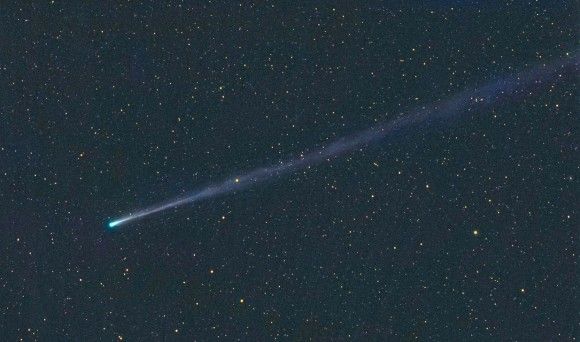
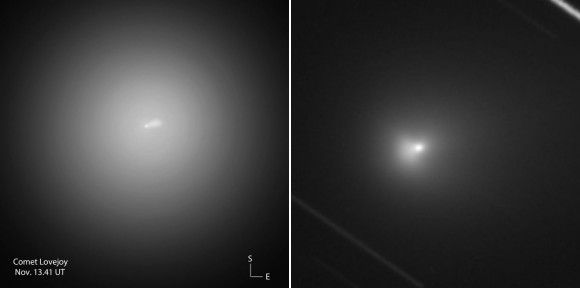






Comment: Take a good look at that spiralling motion produced by Comet Hale-Bopp in 1997.
This is pretty much the same spiral motion we've seen in countless videos of comets that were taken from the ground (which CorpGov's media tells us are man-made missiles, and indeed, perhaps some of them are).
If nothing else, this tells us that, in the case of incoming or approaching comets or comet fragments, it's not their interaction with the planet that causes them to spiral - they do that in deep space too.
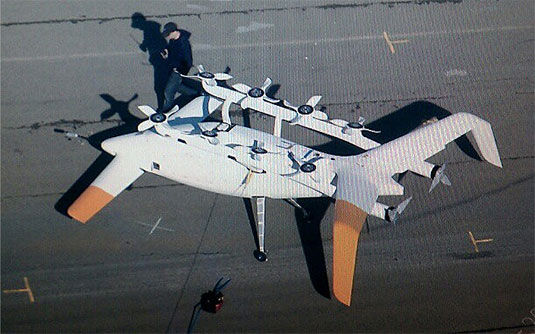
Take note for the next time you see one of these and the media tells you, "Nothing to see here, folks, it's only the separation of booster rockets from a previously unplanned rocket launch"...