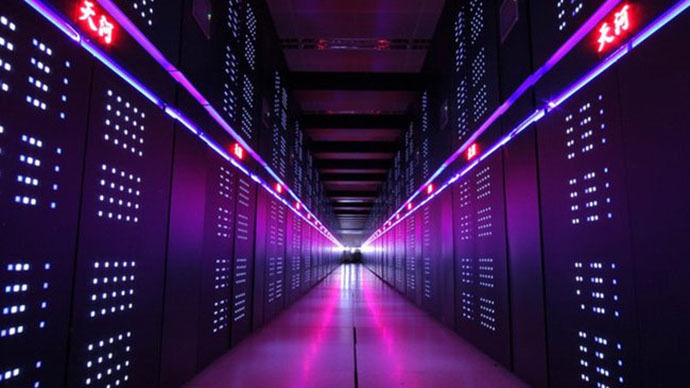
© netlib.orgThe Tianhe-2 supercomputer.
Tianhe-2, which means 'Milkyway 2,' can execute 33.86 petaflops per second. This is equivalent to 33,863 trillion calculations per second. The device, which uses US-designed Intel microchips, was turned on earlier this year and is being run by Guangzhou's city government.
The internationally recognized Top500 ranking, which is twice-yearly compiled by scientists at the University of Mannheim, gives computers a specific type of mathematical equation which allows for direct comparison, known as the 'Linpack benchmark.'
China's National University of Defense Technology (NUDT) says that Tianhe-2 was developed for government security applications, various simulations, and analysis. Packed with 16,000 computer nodes, it has 3,120,000 cores. The total CPU plus coprocessor memory is 1,375 terabytes.
The interconnect system, operating system, front-end processors, and software were all developed by Chinese scientists. The system is the most energy-efficient configuration in the top 10, with 2.33 megawatts consumption of power that delivers 2.7 Gigaflops-per-watt of performance.