Science & TechnologyS


Comet 2

Near-Earth Object 2013 US10 (Catalina) turns out to be yet another comet entering the solar system!

While initial reports from the Minor Planet Center in Cambridge, Mass., categorized object 2013 US10 as a very large near-Earth asteroid, new observations now indicate that it is, in fact, a long-period comet, and it is now designated C/2013 US10 (Catalina). The comet was discovered by the Catalina Sky Survey near Tucson, Ariz., on Oct. 31, 2013, and linked to earlier pre-discovery Catalina observations made on Sept. 12. The initial orbit suggested this object is a large, short period, near-Earth asteroid, as reported here yesterday.

Image
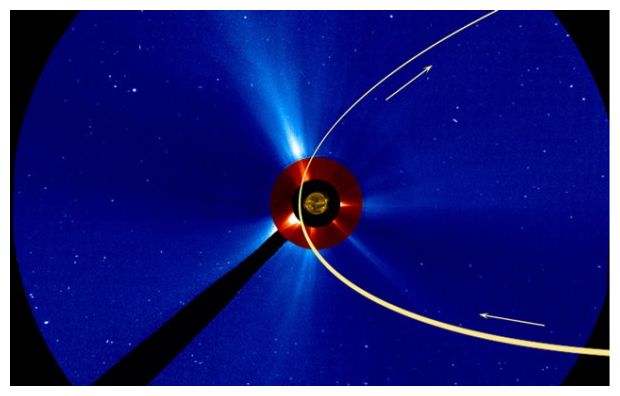
© NASA/JPL-Caltech The orbits of 2013 UQ4, 2013 US10 and 2013 UP8 are shown as viewed from within the plane of the solar system (ecliptic plane), which makes clear their highly inclined orbits relative to Earth's orbit.

Calculator

Chinese supercomputer twice as fast as closest U.S. rival

Super computer Tianhe-2
© netlib.orgThe Tianhe-2 supercomputer.
China's showpiece Tianhe-2 computer is almost twice as fast as its nearest rival, according to a new ranking. But the simple benchmark used to rate the powerful "research and education tool" may not effectively measure the supercomputer's true usefulness.

Tianhe-2, which means 'Milkyway 2,' can execute 33.86 petaflops per second. This is equivalent to 33,863 trillion calculations per second. The device, which uses US-designed Intel microchips, was turned on earlier this year and is being run by Guangzhou's city government.

The internationally recognized Top500 ranking, which is twice-yearly compiled by scientists at the University of Mannheim, gives computers a specific type of mathematical equation which allows for direct comparison, known as the 'Linpack benchmark.'

China's National University of Defense Technology (NUDT) says that Tianhe-2 was developed for government security applications, various simulations, and analysis. Packed with 16,000 computer nodes, it has 3,120,000 cores. The total CPU plus coprocessor memory is 1,375 terabytes.

The interconnect system, operating system, front-end processors, and software were all developed by Chinese scientists. The system is the most energy-efficient configuration in the top 10, with 2.33 megawatts consumption of power that delivers 2.7 Gigaflops-per-watt of performance.

Info

Satellites to probe Earth's strange shield

Satellite Probes
© The Nation, Pakistan
Paris - Europe next week will launch a trio of hi-tech satellites to explore something that may seem utterly mundane: Earth's magnetic field. After all, magnetism has been with us for billions of years.

We harness it in innumerable ways, in navigation and electrical devices. What's new? Well, plenty, actually.

If all goes well, the 230-million-euro ($276-million) Swarm mission will explain some of the weird things happening to the planet's magnetism. And they are more than just curiosities.

"Earth's magnetic field is a very important thing. It makes life possible on Earth by providing shelter against radiation from space," said Albert Zaglauer, project manager at Astrium, which made the three satellites.

"The magnetic pole is changing, and the magnetic field is changing too. Why?"

Info

Fossil amber reveals secrets of Earth's ancient atmosphere

Ancient Foliage
© Ryan C. McKellar The team analyzed amber samples from almost all well-known amber deposits worldwide. This amber originates from the Cretaceous period, an inclusion of foliage of the extinct conifer tree Parataxodium sp. from the Foremost Formation at Grassy Lake, Alberta, Canada. It is approximately 77 million years old.
Elevated levels of oxygen in the atmosphere may have caused dinosaurs, insects and other organisms to grow to gigantic sizes millions of years ago, according to prevailing theories.

If a new study from scientists at the Universities of Kansas and Alberta is correct, then the atmosphere of the Cretaceous had a relatively low oxygen content - making the high-oxygen theories severely flawed.

"We do not want to negate the influence of oxygen for the evolution of life in general with our study, but the gigantism of dinosaurs cannot be explained by those theories," said study author Ralf Tappert, from the University of Alberta.

In the study, which was published in the journal Geochimica et Cosmochimica Acta, an international team recreated the makeup of the Earth's atmosphere during the last 220 million years by analyzing modern and fossilized plant resins. Fossilized resins, like amber, are just a few of the organic materials capable of holding reliable data on the Earth's geological history over millions of years.

"Compared to other organic matter, amber has the advantage that it remains chemically and isotopically almost unchanged over long periods of geological time," Tappert explained. "During photosynthesis plants bind atmospheric carbon, whose isotopic composition is preserved in resins over millions of years, and from this, we can infer atmospheric oxygen concentrations."

Laptop

Apple and Microsoft join forces to sue Google and derail Android operating system.

Apple vs android
© liveconnexion.net
If you write about or work in tech as I do, you hear a lot about progress. It's kind of our mantra. We're making the world a better place. We're making progress.

But there are also forces opposed to progress. You could call this the anti-progress movement. Ironically, some of the biggest contributors to this movement are tech companies.

One example: Comcast has been donating money to defeat the mayor of Seattle, because he's been a proponent of installing high-speed fiber at lower costs than what incumbent providers charge. That's anti-progress. Comcast is actually spending money (that it got from customers) to hurt customers.

But a better and far bigger example of anti-progress comes from Apple and Microsoft, which have joined forces and invested billions of dollars to create a shell company. The sole purpose of this venture is to sue Google and derail its Android operating system.

Sneaky? Yes. Not to mention selfish, ignoble, disgusting, cowardly, craven, and anti-competitive. But worst of all, it's anti-progress.

Info

Bacteria can integrate degraded DNA

Mammoth
© Wikimedia/Flying Puffin
Bacteria are known to take in long fragments of DNA, discarded by the dead cells of other organisms, and incorporate them into their own genomes. Results published today (November 18) in Proceedings of the National Academy of Sciences show that bacteria can also integrate short and damaged stretches of DNA, even 43,000-year-old fragments extracted from a woolly mammoth bone.

Short, degraded DNA is abundant in the environment, "and if that can be used for transformation or mutagenesis, that suggests it has a much larger evolution-driving role than previously ever realized," said Hank Seifert, a microbiologist at Northwestern University who was not involved in the study.

Natural genetic transformation, a form of horizontal gene transfer, is the process of gobbling up chunks of other organisms' DNA present in the environment. This genetic appropriation is thought to be important in bacterial evolution and antibiotic resistance, and recent evidence has suggested bacteria may be able to transfer DNA to human host genomes.

"It's been an assumption that short, degraded DNA is not relevant" to natural transformation, said Søren Overballe-Petersen, a postdoctoral researcher at the University of Copenhagen and the study's lead author. But longer fragments - say, a kilobase in length - don't last very long in the environment, limiting the opportunities for bacteria to take them in. Shorter stretches of DNA, however - tens of base pairs (bp) long - can persist for hundreds of thousands of years. The researchers wanted to see whether these, too, might have some relevance in natural transformation."What are the odds of nothing happening?" asked Overballe-Petersen.

Ice Cube

Volcano discovered smoldering under a kilometer of ice in West Antarctica

From the Washington University in St. Louis

Its heat may increase the rate of ice loss from one of the continent's major ice streams

Mount Sidley
© Doug WiensMount Sidley, at the leading edge of the Executive Committee Range in Marie Byrd Land is the last volcano in the chain that rises above the surface of the ice. But a group of seismologists has detected new volcanic activity under the ice about 30 miles ahead of Mount Sidley in the direction of the range’s migration. The new finding suggests that the source of magma is moving beyond the chain beneath the crust and the Antarctic Ice Sheet.
It wasn't what they were looking for but that only made the discovery all the more exciting.

In January 2010 a team of scientists had set up two crossing lines of seismographs across Marie Byrd Land in West Antarctica. It was the first time the scientists had deployed many instruments in the interior of the continent that could operate year-round even in the coldest parts of Antarctica.

Like a giant CT machine, the seismograph array used disturbances created by distant earthquakes to make images of the ice and rock deep within West Antarctica.

There were big questions to be asked and answered. The goal, says Doug Wiens, professor of earth and planetary science at Washington University in St. Louis and one of the project's principle investigators, was essentially to weigh the ice sheet to help reconstruct Antarctica's climate history. But to do this accurately the scientists had to know how the earth's mantle would respond to an ice burden, and that depended on whether it was hot and fluid or cool and viscous. The seismic data would allow them to map the mantle's properties.

In the meantime, automated-event-detection software was put to work to comb the data for anything unusual.

Info

Neanderthal virus DNA spotted hiding in modern humans

Neanderthal virus
© James Whitaker/GettyHow many people carry a Neanderthal virus?
The DNA of ancient viruses first spotted in the Neanderthal genome have now been identified in modern humans - although whether they cause disease is not yet clear.

In 2010, researchers unveiled the genomes of two extinct groups of human - the Neanderthals and the Denisovans. This revealed that some humans share a few per cent of their DNA with their extinct cousins. Ever since, geneticists have been poring over the ancient DNA sequences for an insight into Stone Age life.

Last year, Jack Lenz's team at the Albert Einstein College of Medicine in New York began looking for signs of endogenous retroviruses in the ancient genomes, a class of virus that not only invades cells but worms its way into DNA. These retroviral gene sequences make up about 8 per cent of the human genome, and are part of what is sometimes called "junk" or non-coding DNA because they don't contain genetic instructions to make proteins.

Lenz found 14 retroviral gene sequences in the Neanderthal and Denisovan DNA. When he compared this to the human genome used as a standard reference, he found that none of the sequences overlapped - in other words, it seemed that modern humans did not share this endogenous retroviral DNA with their extinct cousins.

Fireball 5

Asteroid to make 'close' pass to Earth on Monday

2001 AV43
© NASA/JPLThe orbit of asteroid 2001 AV43, a space rock about the same size as the one that created Meteor Crater in Arizona, can be viewed here.
Astronomers are hoping to get a close look at an asteroid Monday as it makes a relatively close pass to Earth.

The space rock, known as 2001 AV43, will approach within 650,000 miles, or 2.7 times the distance from the Earth to the moon. That is considered an eyelash width in cosmic terms.

The rapidly spinning asteroid, discovered on Jan. 5, 2001, by MIT's Lincoln Laboratory, is flying by at a relative velocity of 8,000 mph and has an estimated diameter of between 100 and 230 feet.

That makes it about the same size as the rock that created mile-wide, 550-feet deep Meteor Crater in Arizona about 50,000 years ago. That one was 165 feet in diameter and exploded with the equivalent force of 10 megatons of TNT.

The angle of approach of 2001 AV43 makes it a good radar target for the Goldstone Deep Space Network in California's Mojave Desert and the Arecibo Observatory in Puerto Rico, scientists say.

Meanwhile, astronomers using observatories in Hawaii are gathering information on two recently discovered and surprisingly large near-Earth asteroids.

Info

Ice age bones discovered at Indiana Caverns

Iceage Bones
© ABC LocalWorkers at some caverns in southern Indiana say they've discovered bones from creatures that haven't walked the earth in 40,000 years.
Corydon -- Workers at some caverns in southern Indiana say they've discovered bones from creatures that haven't walked the earth in 40,000 years.

Thousands of ice age bones were found at Indiana Caverns in Corydon, Indiana.

That's close to the Kentucky border near Louisville.

Cavern officials say the bones belong to a bear, pigeons, porcupines, snakes and other animals.

The rare discovery is attracting the attention of scientists from across the country.

"In fact one of the paleontologists said this may end up being the most significant bone-finding in United States history and possibly in the Midwest," said Rob Houchens, Indiana Caverns.

More excavations are planned at the site.

Indiana caverns stretch for more than 38 miles underground.

Less than one mile of that is open to the public for tours.