
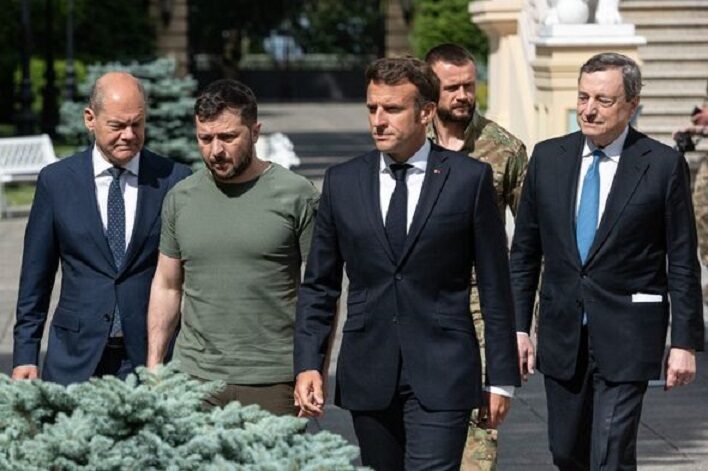
© GettyFILE PHOTO: The Baltic states, Poland and Slovakia are said to oppose the suggestion that Russia should be given security guarantees
Latvia, Lithuania, Estonia, Poland and Slovakia have lodged a formal protest against Macron's suggestion, according to Reuters.
Citing diplomatic sources, the news agency reported that the Czech Republic, which now holds the EU Council presidency, had assisted in preparing the demarche, which was delivered to the French foreign ministry. However, it is not clear whether Prague itself, or any other nations, backed the document, the report adds.
According to the report, the draft demarche distributed by the Czech Republic to EU member states last week argued that Russia's previous efforts with respect to European security architecture sought to divide and weaken Europe.
On December 3, Macron told the French TF1 TV channel: "We need to prepare what we are ready to do, how we protect our allies and member states, and how to give guarantees to Russia the day it returns to the negotiating table."
Macron added that one of the "essential points" NATO had to address is Russia's concern that the military bloc "comes right up to its doors, and the deployment of weapons that could threaten Russia."
Comment: What exactly are the Baltic states objecting to? Every country needs to have certain security guarantees, and Macron rightly highlights Russia's needs aren't unreasonable. That they would object to even the most basic of requests is rather revealing as to the irrational, belligerent, and dangerous, stance that these nations are taking.
His suggestion quickly came under fire from Ukraine and the Baltic states.
Polish Deputy Foreign Minister Pawel Jablonski, for his part, told reporters that Russia had no right to "expect security guarantees from anyone."
Comment: That attitude will obviously guarantee little more than perpetual conflict, because Russia is not going anywhere - despite what the FM might wish.
He also warned those thinking otherwise that they were making a "strategic mistake."
French diplomats tried to downplay the comment, insisting that it was taken "out of context."
Meanwhile, Macron himself urged European allies not to "create controversy where there is none."
West facing 'existential choice' - Moscow
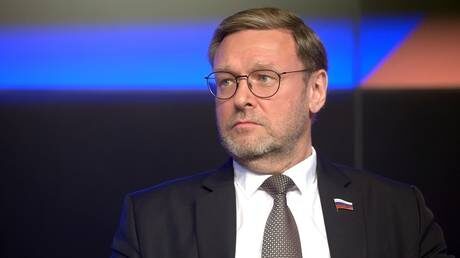
© Sputnik/Ilya PitalevVice-Speaker of the Federation Council of the Russian Federation Konstantin Kosachev said the West can either address the security concerns of other nations, or stick to a "suicidal" egocentric attitude
Writing on Telegram, Kosachev, who also chairs the Foreign Affairs Committee of the Federation Council, said that "sooner or later, the West will have to make an existential choice" between catering for only its own interests, "or admitting that this suicidal strategy has exhausted itself."
Comment: That Western economies have been trying to go even further with their failing anti-Russia sanctions, and so there's not much hope that its leaders will see reason anytime soon.
In addition, the recent revelations from Germany's former Chancellor Angela Merkel who admitted that the West never was serious about the Minsk peace agreements, they were instead using it as cover to get weapons into Ukraine, readying the Nazi-aligned military for the conflict that they knew Russia would be forced into.
The senator noted that a return to the principle of "indivisibility of security architecture" was the only path forward. Kosachev explained that this means a "deliberate refusal to ensure one's own security at the expense" of other countries, adding that it serves "as a cornerstone" for all complex diplomatic arrangements.
Comment: Indeed, and this has been the case for decades, at least in theory.
The vice speaker also claimed that there is a rift between Western countries on this issue. He pointed to the statements made by French President Emmanuel Macron and German Chancellor Olaf Scholz on the need for a new security framework after the Ukraine conflict ends.
According to Kosachev, these remarks "suggest that there are still remnants of common sense and a sense of self-preservation in France and Germany, which are behaving more responsibly." That sentiment, however, is not shared by a number of other EU countries, including the Baltic nations and Poland, he stated.
Earlier this month, Macron expressed the view that NATO should prepare security guarantees for Russia after the Ukraine conflict is settled. Around the same time, Scholz noted that peace in Europe depends on the revival of post-Cold War security arrangements with Russia.



Reader Comments