
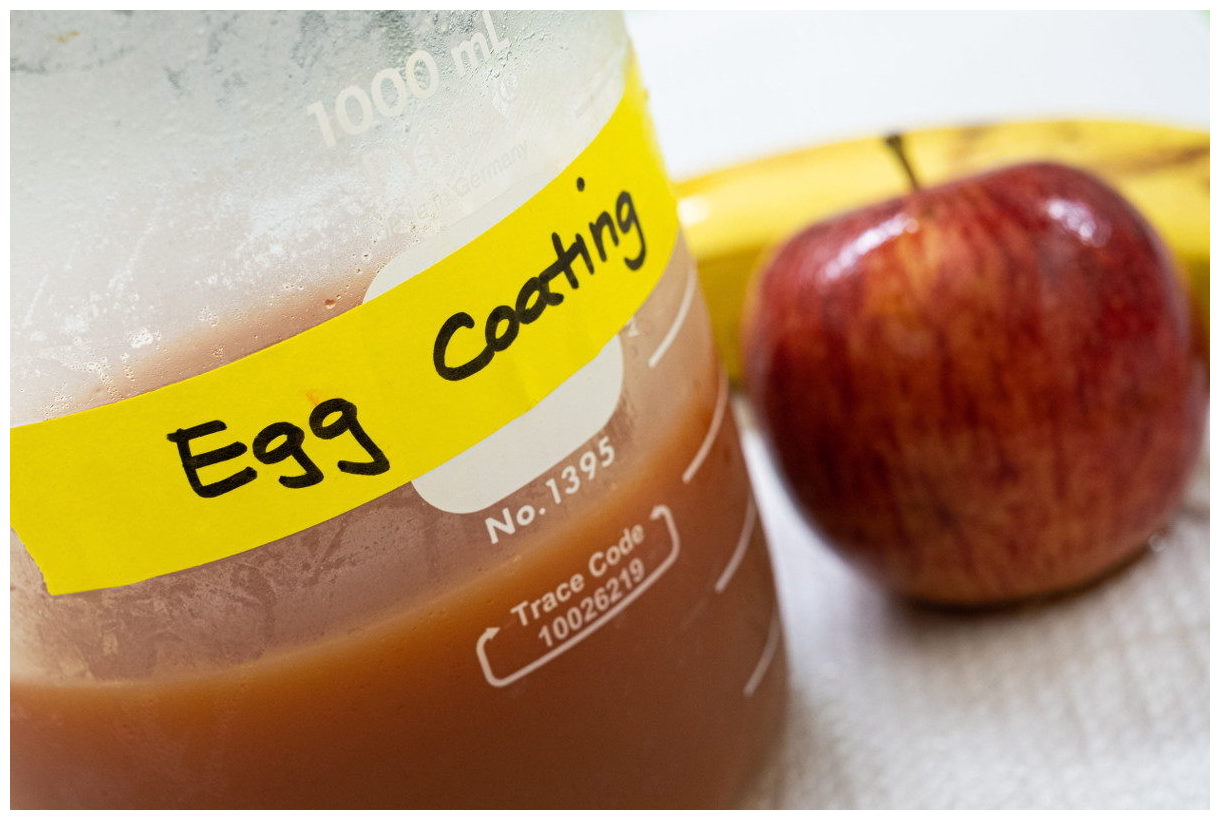
© Jeff FitlowEggs that would otherwise be wasted can be used as the base of an inexpensive coating to protect fruits and vegetables, according to Rice University researchers.
The Brown School of Engineering lab of materials scientist Pulickel Ajayan and colleagues have developed a micron-thick coating that solves problems both for the produce and its consumers, as well as for the environment.
When the coating was applied to produce by spraying or dipping, it showed a remarkable ability to resist rotting for an extended period comparable to standard coatings like wax but without some of the inherent problems.
The work by Rice undergraduate students Seohui (Sylvia) Jung and Yufei (Nancy) Cui is detailed in Advanced Materials.
The coating relies on eggs that never reach the market. As the United States produces more than 7 billion eggs a year and manufacturers reject 3% of them, the researchers estimate more than 200 million eggs end up in landfills.
Even before the impact of the new coronavirus, the world wasted a third of the food produced around the globe, the researchers wrote.
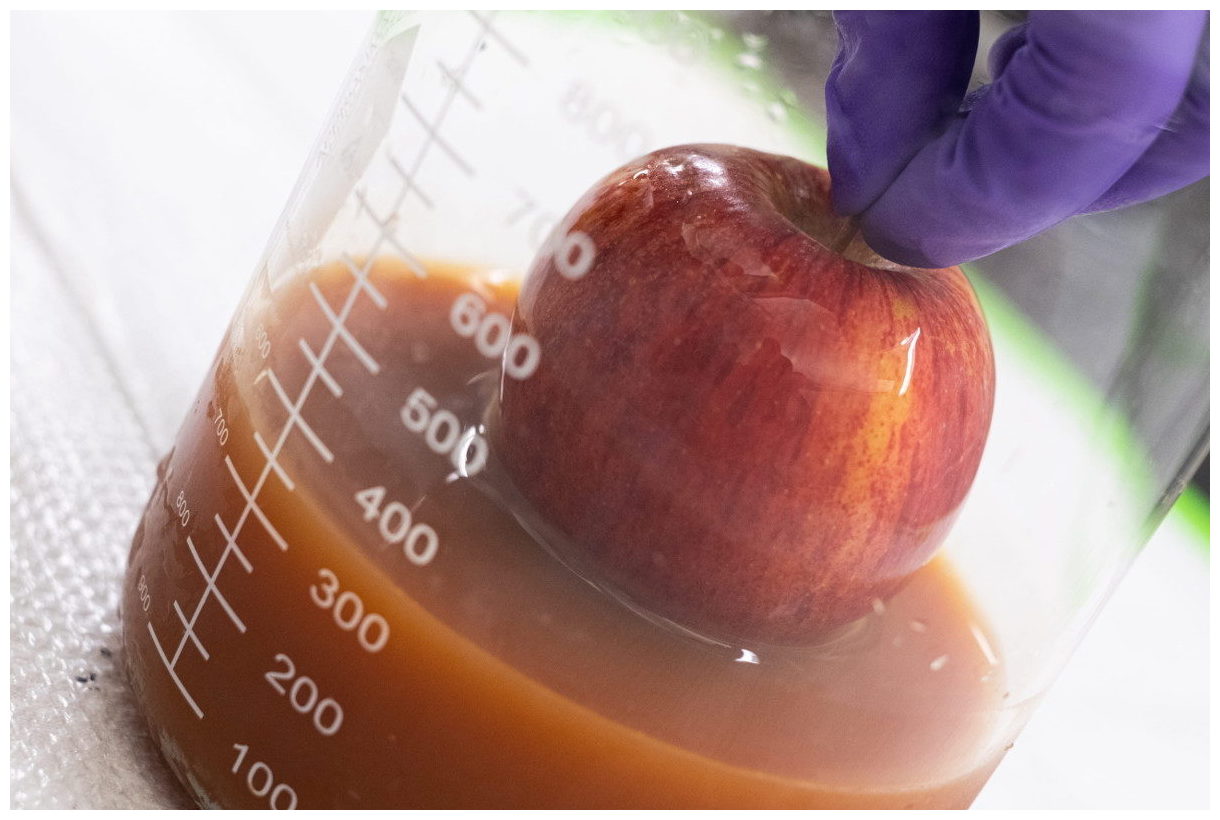
© Jeff FitlowA coating developed at Rice University made primarily with protein from eggs that would otherwise be wasted can be used to extend the freshness of produce.
Along with being edible, the multifunctional coating retards dehydration, provides antimicrobial protection and is largely impermeable both to water vapor to retard dehydration and to gas to prevent premature ripening. The coating is all-natural and washes off with water.
"If anyone is sensitive to the coating or has an egg allergy, they can easily eliminate it," Jung said.
Egg whites (aka albumen) and yolks account for nearly 70 percent of the coating. Most of the rest consists of nanoscale cellulose extracted from wood, which serves as a barrier to water and keeps produce from shriveling, a small amount of curcumin for its antimicrobial powers and a splash of glycerol to add elasticity.
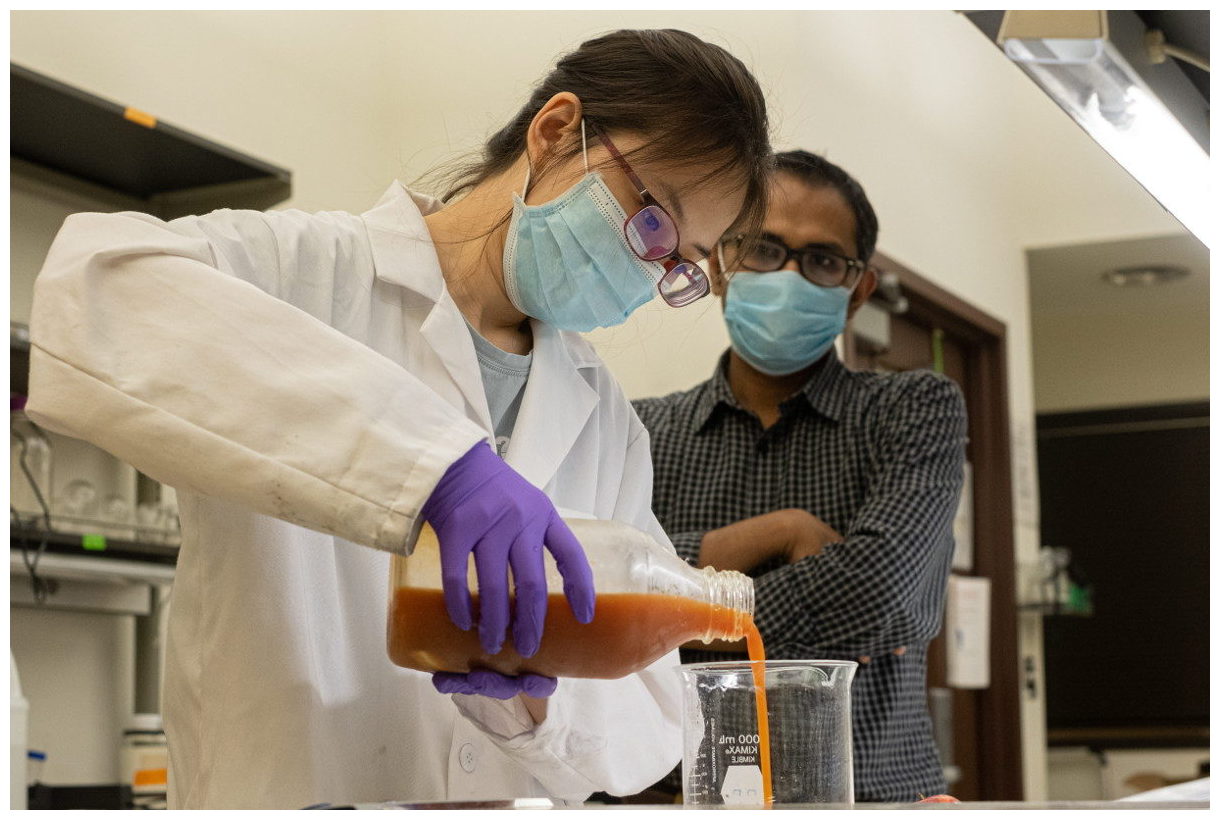
© Jeff FitlowRice University undergraduate student Yufei (Nancy) Cui prepares a solution based on protein from wasted eggs. The solution can be used as a coating that extends the freshness of fruit and vegetables. With her is Rice research scientist and mentor Muhammad Rahman.
An analysis of freestanding films of the coating showed it to be extremely flexible and able to resist cracking, allowing better protection of the produce. Tests of the film's tensile properties showed it to be just as tough as other products, including synthetic films used in produce packaging. Further tests proved the coating to be nontoxic, and solubility tests showed a thicker-than-usual film is washable. Rinsing in water for a couple of minutes can completely disintegrate it, Ajayan said.
The researchers continue to refine the coating's composition and are considering other source materials. "We chose egg proteins because there are lots of eggs wasted, but it doesn't mean we can't use others," said co-corresponding author Muhammad Rahman, a research scientist in Ajayan's Rice lab, who mentored and led the team.
Jung noted the team is testing proteins that could be extracted from plants rather than animal produce to make coatings.
Co-authors of the paper are Rice graduate students Morgan Barnes, Aparna Adumbumkulath, Onur Sahin, Seyed Sajadi and Lucas Sassi; Rice research scientist Corwin Miller; Rice postdoctoral research associate Soumyabrata Roy; Matthew Bennett, an associate professor of biosciences at Rice; Rafael Verduzco, an associate professor of chemical and biomolecular engineering and of materials science and nanoengineering at Rice; Robert Vajtai, a research professor in materials science and nanoengineering at Rice; Reaz Chowdhury, a graduate research assistant, and Jeffrey Youngblood, a professor of materials engineering, at Purdue University; graduate student Jefferson Friguglietti and Fatima Merchant, an associate professor of computer engineering technology and computational health informatics, at the University of Houston; graduate research assistant Chinmay Satam, graduate student Yue Ji and J. Carson Meredith, a professor, James Harris Faculty Fellow and executive director of the Renewable Bioproducts Institute at the Georgia Institute of Technology; and postdoctoral researcher Shenxiang Zhang, Miao Yu, an associate professor of chemical and biological engineering, and Nikhil Koratkar, a professor of mechanical, aerospace and nuclear engineering, at Rensselaer Polytechnic Institute.
Ajayan is chair of Rice's Department of Materials Science and NanoEngineering, the Benjamin M. and Mary Greenwood Anderson Professor in Engineering and a professor of chemistry.
The Robert A. Welch Foundation and the Brazilian Ministry of Education's Coordination for the Improvement of Higher Education Personnel program supported the research.
Reference: Multifunctional Bio‐Nanocomposite Coatings for Perishable Fruits



Reader Comments
Don't believe the part about rejected eggs - if the coating is a success, the eggs which could be used as a food would be diverted for this purpose.
And since vegetables and fruits are also very expensive, it would make even more sense to use some protection for them, even if it is made from now more expensive eggs. By the way, there is one product made from eggs which is already too expensive for normal customers - lecithin. It's almost impossible to buy egg lecithin for personal use in poorer markets.
Id say it is blatantly obvious. And since we cant match their weapons and technology we can only use our counsciousness and creativity. Some of us are done with creating bad karma Ofcourse, I can speak only for myself
To keep our freedoms we must exercise them. To keep our "peace of mind" we must opt out of the mainstream narrative. To live in a better world we must create it and it always starts and is happening in the NOW.
If we reach a critical mass of individuals that managed to transcend we can kickstart a true evolution of the human mind on this planet. And if we dont we jave atleast done it for ourselves. No matter how you look at it it is a winning mindset
[Link]
If you're obliged to buy a whole bag of carrots, they can be kept fresh for 3 weeks by packing them in water in a large bottling jar, changing the water water every 2 or 3 days.