
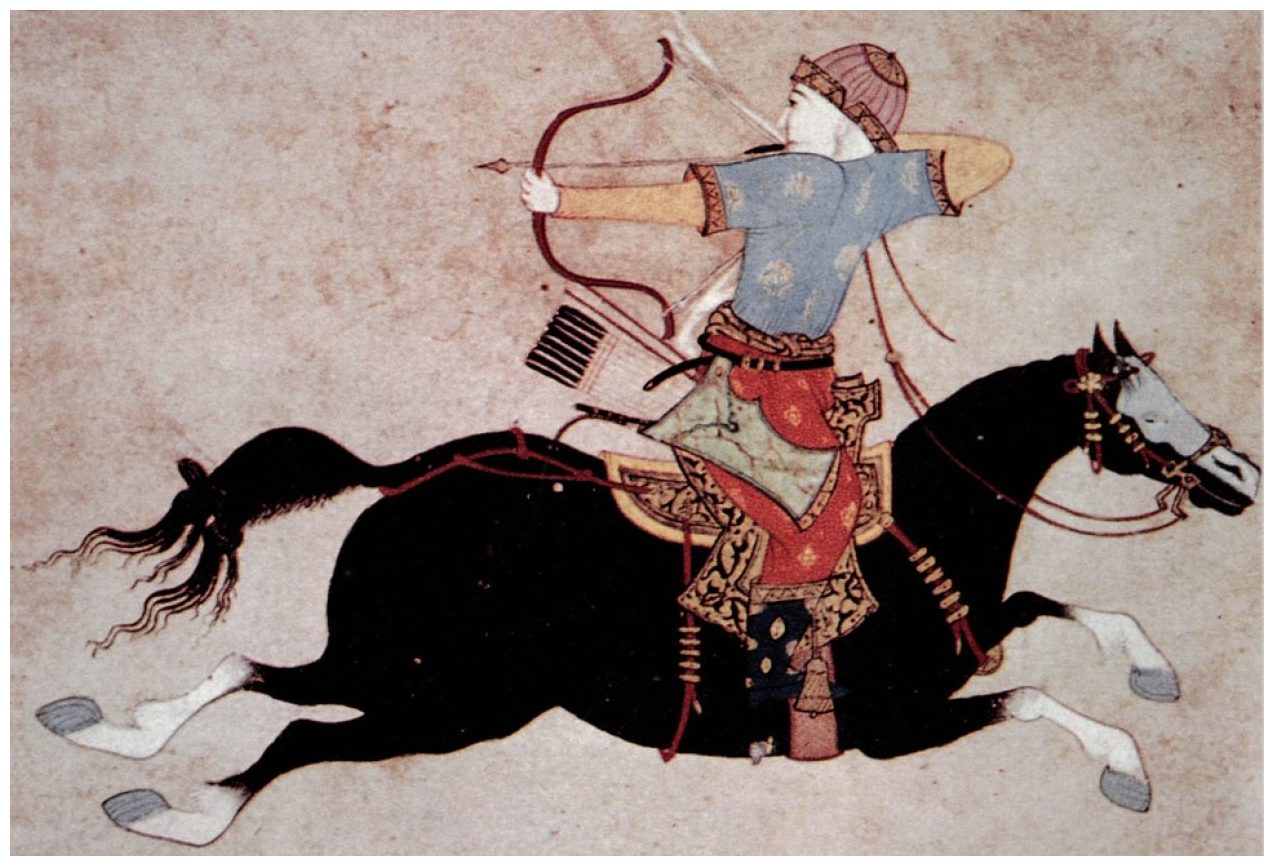
© Ars TechnicaStanding in his stirrups, a Mongolian soldier could shoot even while retreating. This was a revolutionary battle tactic at the time.
No one knows when the stirrup was first invented, but it was a boon to any military that used it. Even the simplest of stirrups, a leather loop, let mounted soldiers ride longer distances and stay mounted on their horses during battle. The military success of the forebears of the Cossacks is often attributed to two loops of leather. Same with the Goths and the Huns. Some believe the stirrup even shifted the balance of power in Europe from foot soldiers to mounted knights, dubbed the "armored tanks" of the medieval world by historian Roman Johann Jarymowycz.
The Mongols took things further. Historians think they not only had leather stirrups, but metal ones as well. In 2016, archaeologists at the Center of Cultural Heritage of Mongolia unearthed the remains of a Mongolian woman dating back to the 10th century AD. Along with sturdy leather boots and some changes of clothes, she was buried with a saddle and metal stirrups described as in such good condition that they could still be used today. The stirrups are one continuous thick piece of metal with an open loop for a saddle strap on the top and a wide, flattened, and slightly rounded foot rest. The stirrups had to be comfortable and tough, because Mongols used them to ride in a way no one else rode.
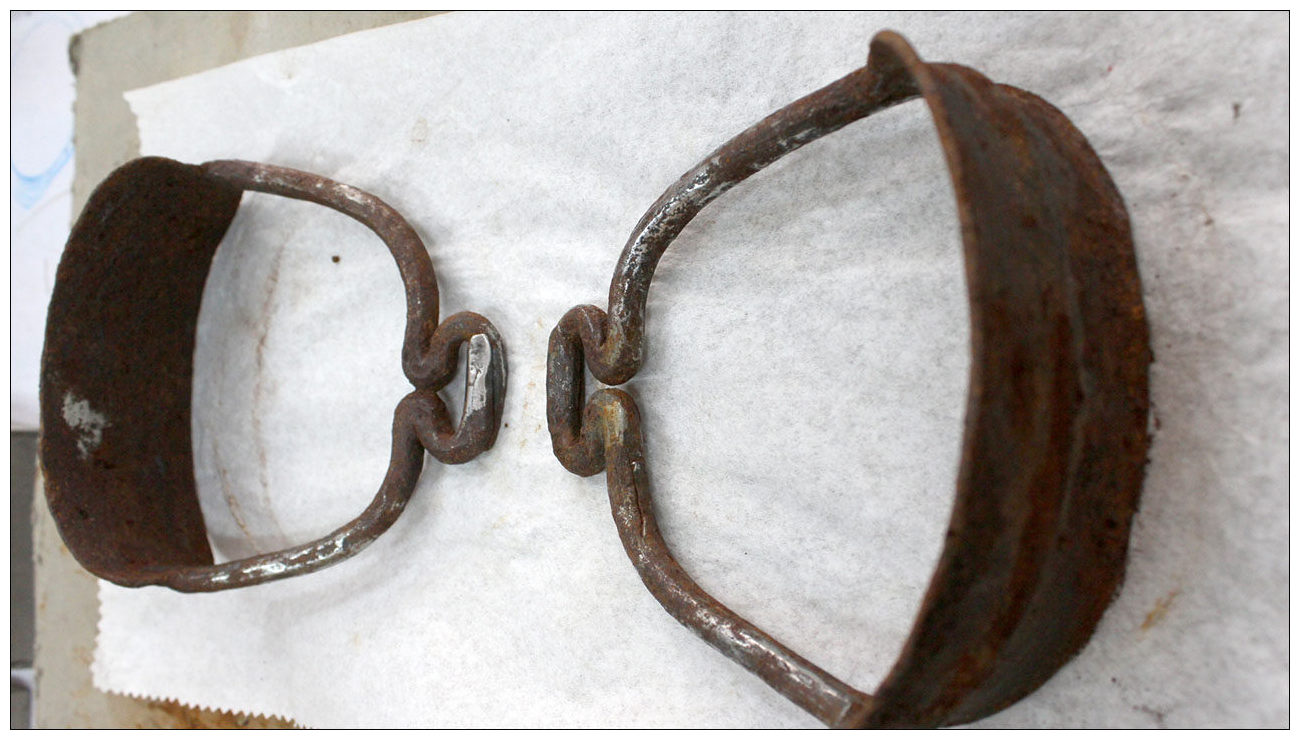
© Ars TechnicaThis pair of 1,100-year-old metal stirrups was unearthed from a Mongolian woman's grave in 2016. They were part of a well-preserved saddle with reinforcements that would have allowed the rider unprecedented mobility.
At a time when most armies won by driving ineluctably forward, the Mongols advanced and retreated while never letting up on their assault. When they met their opposition, their cavalry galloped forward with wild agility, shooting arrows continuously, presenting a terrifying united front. As they got within a few yards of the other army, the charging horsemen's unity broke. They turned and galloped away as quickly as they'd come.
The power of retreat
Historian Thomas Craughwell explains that an ability to twist in their saddles meant that, even as the Mongols rode away, they could shoot arrows back toward the enemy army. As the army continued to charge and retreat, their patterns became ever more chaotic. Marco Polo, who saw the Mongols in action, described their technique: "They never let themselves get into a regular melee, but keep perpetually riding around and shooting into the enemy."
If traditional mounted troops were like tanks, Mongol-mounted warriors were fighter pilots. Their mastery of movement made them unbeatable. The other army would advance on a shifting, uniting, scattering, and reuniting foe.
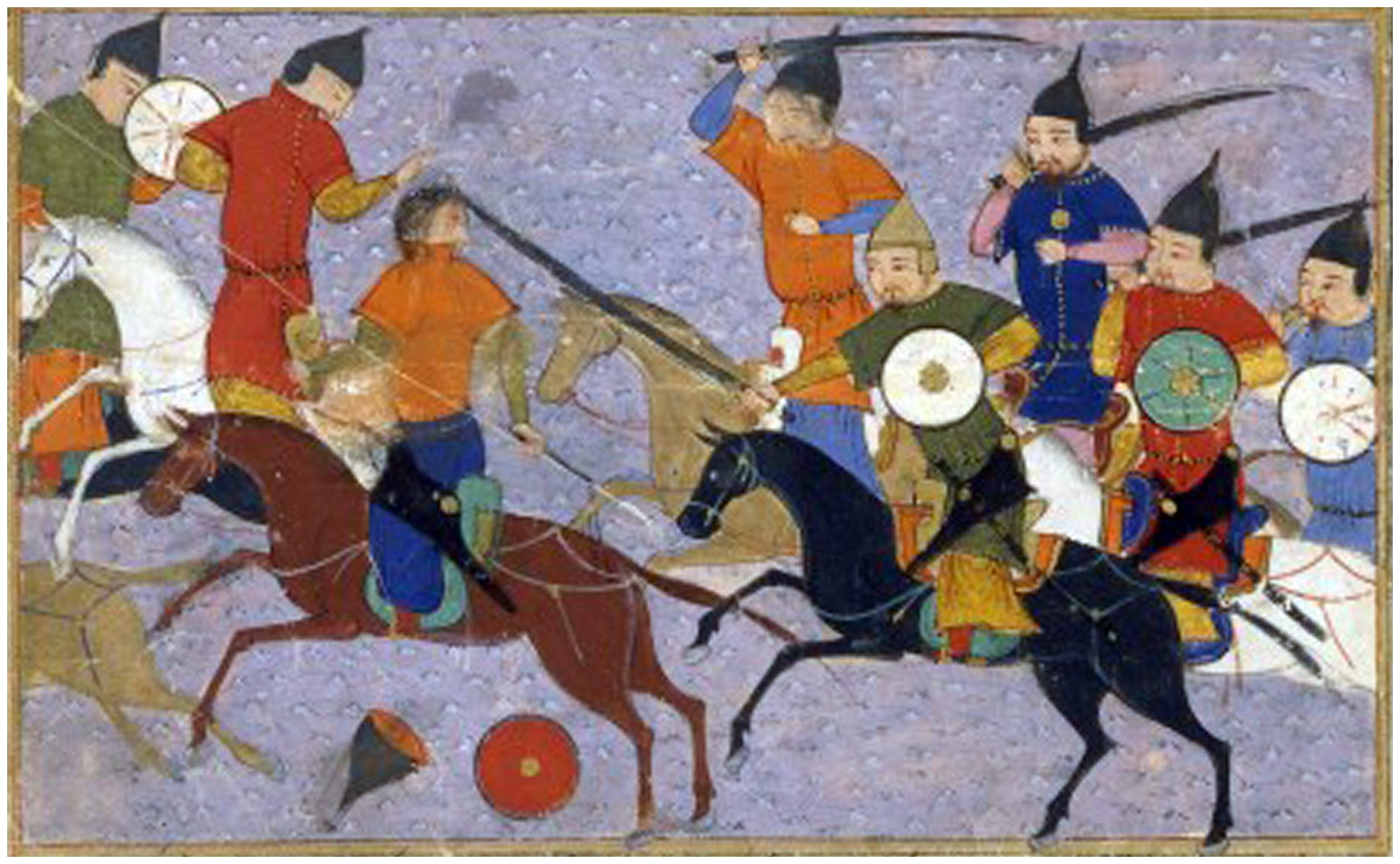
© Ars TechnicaThis is a representation of a battle between Mongols and the Chinese, recorded in 1211 in the Jami' al-tawarikh, by Rashid al-Din. Note the Mongols standing in their saddles.
The Mongolian Empire's stunning rise to power reveals how one technological development provided a literal stepping point for a new style of warfare—one that could not be resisted by any existing army. The largest land empire the world has ever known did not exist because of any one factor. A thousand different circumstances helped Genghis Khan and his immediate descendants conquer most of a continent. But the stirrup played an indispensable role. Engineering the perfect stirrup gave an army, and a people, an ineradicable place in history.



Reader Comments
Plus, these guys had really dinky bows and little wee arrows. Their smaller physical stature did not tend to serving a longbow. And on a horse no large bow is practical. So, lots of nuisance arrows. Stop from following me!. But. inflicting any serious harm, I don't think so. This is just a colourful romance idiot historians like to trot out to rustle up funding.
its a composite bow, smaller and more practical for horse back cavalry and it has immense power for its size
[Link]
The long bow is an infantry weapon, the Mongol bow is for cavalry.
The English long bow was used to fire arrows in a high arching trajectory, in huge numbers to overwhelm the opposition with a rain of arrows from the sky.Accuracy was not the issue in this case, just shear numbers And There you have it, they were much more mobile with greater range you can control the battle to your advantage.
[Link]
Great Body of Water is what Temudjin Means
Eternal Heaven of Blue Sky is a Divine Concept that is Their Spirituality, Culture and Religious Tolerance under Chingis Khan and Kublai Khan who is the Son of a Christian Mother.
Before the 1st Amendment was this to Gain Favor with Heaven all religions are to be tolerated and if there is Conflict Theocide is a Fair Solution that was on the table as a Yasa(edict).
Realm of the Mongols by Per Inge Oestmoen a Norwegian Scholar of this Great Nomadic Culture of the Steppes:
[Link]