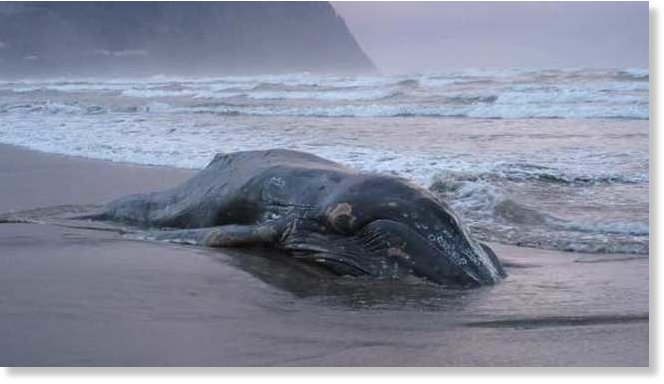
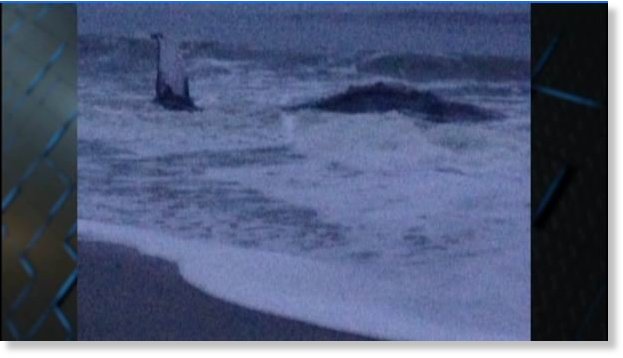
A 24-foot humpback whale was among four marine mammals that washed ashore last weekend, along a stretch of the Oregon and Washington coastline, according to Keith Chandler, the manager of Seaside Aquarium.
The whale was found on the beach in Seaside on Sunday, a harbor porpoise washed up near Fort Stevens on Saturday and a striped dolphin was found on Cannon Beach on Saturday, Chandler said. Another striped dolphin washed up in Ocean Park, Washington, also on Saturday.
Chandler said the deaths could be in some way connected and all of the mammals were dead before they reached the shore.
"It's quite a wide area, but it's a big ocean," he said. "We had some really heavy surf, so when you see one, you often see more than one."
He explained that the deaths could be disease-related, or another issue. But there were no obvious signs of trauma.
The BC Coroners Service says a Tk'emlups Indian Band elder who died after she was mauled by a dog Saturday night was trying to feed her grandson's dog at the time.
RCMP and paramedics rushed to a property on West Shuswap Road Saturday night after being called by a frantic relative.
78-year-old Kathleen Green was pronounced dead at the scene.
"We would like to extend our deepest condolences to the family who have suffered a recent loss. She was a well respected elder in the community," says Chief Fred Seymour, Tk'emlups Indian Band.
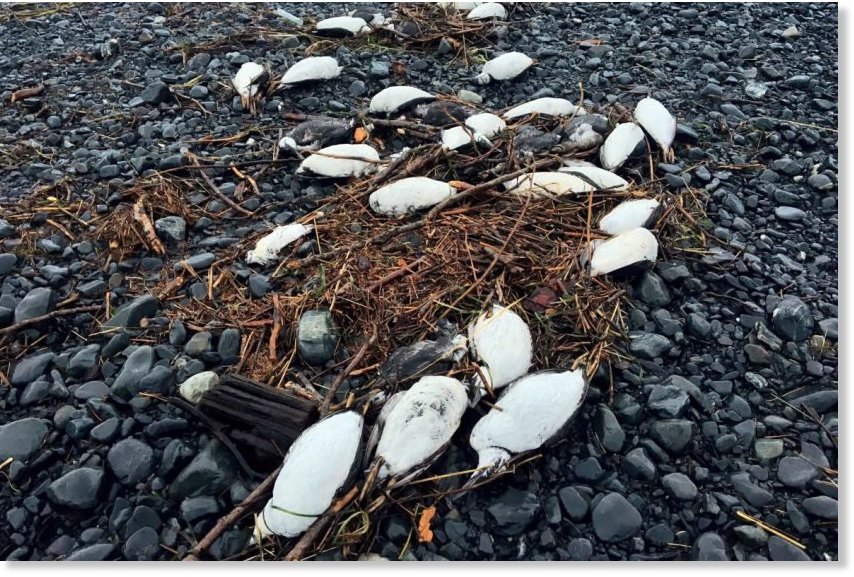
The mass of dead seabirds that have washed up on Alaska beaches in past months is unprecedented in size, scope and duration, a federal biologist said at an Anchorage science conference.
The staggering die-off of common murres, the iconic Pacific seabirds sometimes likened to flying penguins, is a signal that something is awry in the Gulf of Alaska, said Heather Renner, supervisory wildlife biologist at the Alaska Maritime National Wildlife Refuge.
"We are in the midst of perhaps the largest murre die-off ever recorded," Renner told the Alaska Marine Science Symposium on Thursday. While there have been big die-offs of murres and other seabirds in the past, recorded since the 1800s, this one dwarfs most of them, Renner said.
"This event is almost certainly larger than the murres killed in the Exxon Valdez oil spill," she said.
After that spill -- at the time, the nation's largest -- about 22,000 dead murres were recovered by crews conducting extensive beach searches in the four months after the tanker grounding, according to the Exxon Valdez Trustee Council, the federal-state panel that administers funds paid to settle spill-related claims for natural-resource damages.
Now, hundreds and thousands of dead murres are turning up on a wide variety of Alaska beaches, including nearly 8,000 discovered this month on a mile-long stretch in Whittier, she said. A preliminary survey in Prince William Sound has already turned up more than 22,000 dead murres there, she said. Starving, dying and dead murres are showing up far from their marine habitat, in inland places as distant as Fairbanks, hundreds of miles from the Gulf of Alaska coast, making the die-off exceptionally large in geographic scale.
Even if she weren't an expert, the bird die-off would be obvious to Renner. She lives in Homer, where the beaches are "littered" with murre carcasses, she said.
Herders in Marsabit County are counting loses following an outbreak of a mysterious disease that is killing camels.
Bubisa and Shuur in Marsabit North Sub-County are the worst hit by the calamity with ward representative Pius Yatani describing the situation as alarming.
"I received the report on January 19 on the deaths and so far more than 500 camels have perished. I believe the disease may have erupted earlier,'' said Turbi-Bubisa Ward Rep.
Mr Yatani said he had appealed to the county government for urgent intervention.
He said a team of vets was already on the ground supplying vaccines donated by the county government to the pastoralists.
Hundreds of seagulls have been found dead on the Sea of Galilee's western shore, with an initial inquiry pointing to botulism poisoning.
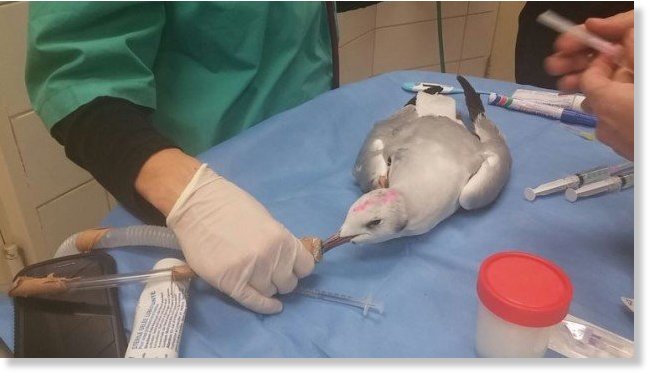
Another 78 injured birds were given emergency first aid at the Tel Afeq National Park veterinary hospital's quarantine station in Tel Aviv, with some being tested to eliminate any suspicion that they may have contracted bird flu, the Walla website reported Thursday.
The gulls were subsequently transferred to the wild animal hospital at the Ramat Gan Safari, some of them in serious condition.
Botulism spores are commonly found in soil and water. They produce the botulinum toxin in conditions such as low oxygen and hot temperatures.
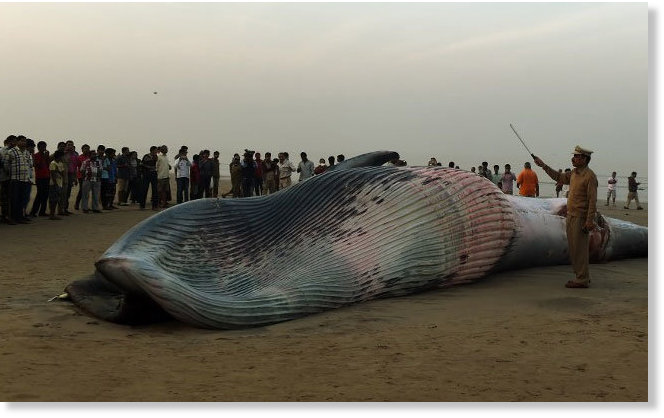
A nearly 40-foot whale drew large crowds on Mumbai's popular Juhu beach on Friday until it was removed with the help of a crane. The whale, weighing around 20 tonnes, had washed up on Thursday night.
It was noticed by lifeguards and joggers who called the police.
A forest official assessed that the "Bryde's Whale" had been dead for two or three days.
"There are no wounds. A postmortem will be done and we will try to preserve its skeleton," said Makarand B Ghodke, conservator in the Mumbai Forest Department.
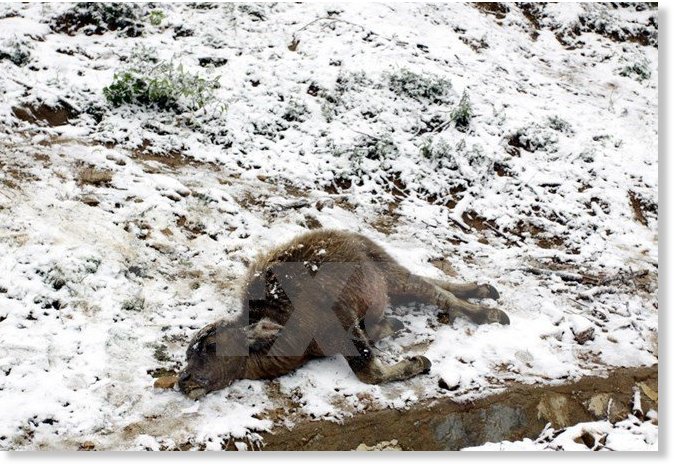
The number of farm animals killed in the record-low cold snap since last week rocketed to more than 8,900 - 11 times the figure released two days earlier, agriculture officials said on Wednesday.
Mountainous Son La Province replaced Quang Ninh Province in the previous report to become the hardest-hit locality with 2,756 animals frozen to death. This accounted for 38 per cent of the total.
Dead cattle, goat, horses and pigs were found across seven communes in Son La, one of which was Van Ho Commune, where snow fell for the first time in decades.
The northwestern province of Dien Bien was the second hardest-hit, with 641 out of 7,134 farm animals killed.
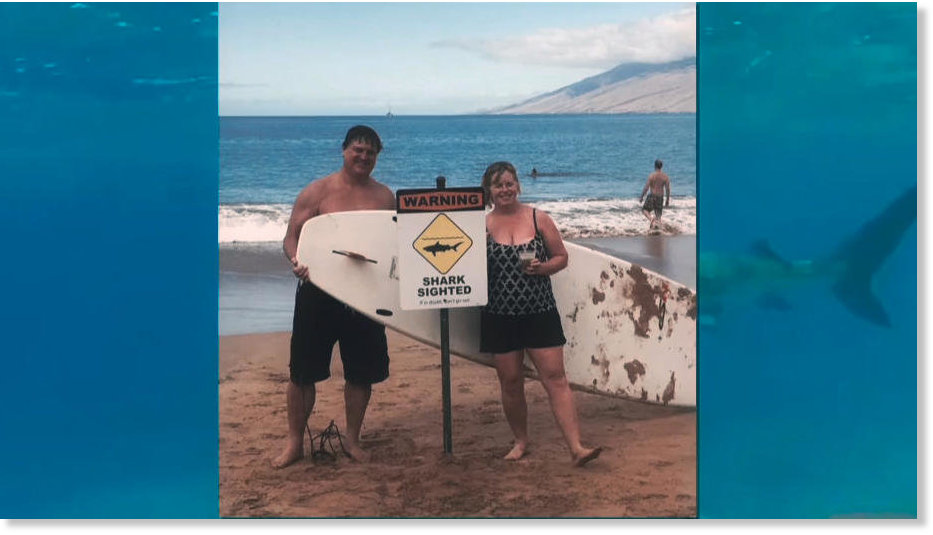
In this week's WDAZ Animal Watch, a story that's taking social media by storm: a Minnesota man was attacked by a shark in Hawaii, and lived to tell the tale.
The man describes the situation as 'nuts,' fighting off a 14-foot tiger shark that attacked him while paddle boarding in Maui over the weekend.
48-year-old Matt Mason was boarding about 150 yards off Wailea Beach late Saturday morning. His wife, who was paddling about five feet behind him, saw the shark swim underneath her, poke its head out of the water, and attack her husband's board.
Mason said the shark clamped its jaws to the back of the board, gave a twist, and it threw him off.
A beached whale was discovered on the shore at Kure Beach Wednesday.
According to Kure Beach Police, the whale was found about two blocks south of the Kure Beach Fish Pier around 6:00 a.m.
William McClellan of the University of North Carolina Wilmington says the whale was a baby humpback between 1 and 2 years old. He says the whale was very thin and appeared to have been sick for some time.
Officials say about two dozen dead whales wash up on the North Carolina coast per year. UNCW has been notified.
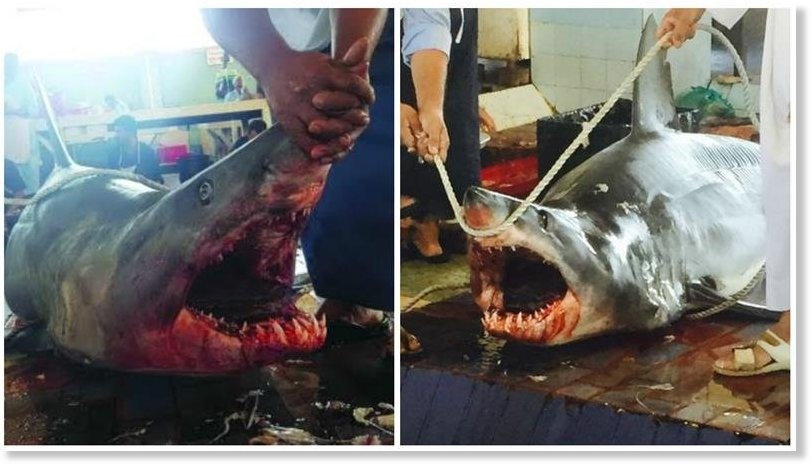
A two-tonne, 4-metre shark attacked an Emirati sailor and his crew of five on the deck of their fishing boat at Fujairah coastline.
The Emirati sailor recalled the horrific incident that took place in the early hours of Sunday when the shark suddenly jumped into the boat.
According to Hamza Al Sharaa, the Emirati sailor, the shark seemed hungry and was trying to find anything to eat.
"It was 2 am and we were 28 miles away from the shore," he told The National.
"One of our crew members was fixing the fishing rope on the boat when the shark jumped out of the water from his back trying to eat him and, in seconds, it was in the middle of the boat after it hit one of the boat barriers," he said adding that the shark leapt three metres out of the water to get onto the boat.