Animals
S


Binoculars

Wrong time, wrong place: Dark-Sided Flycatcher from east Asia found wintering on Iceland

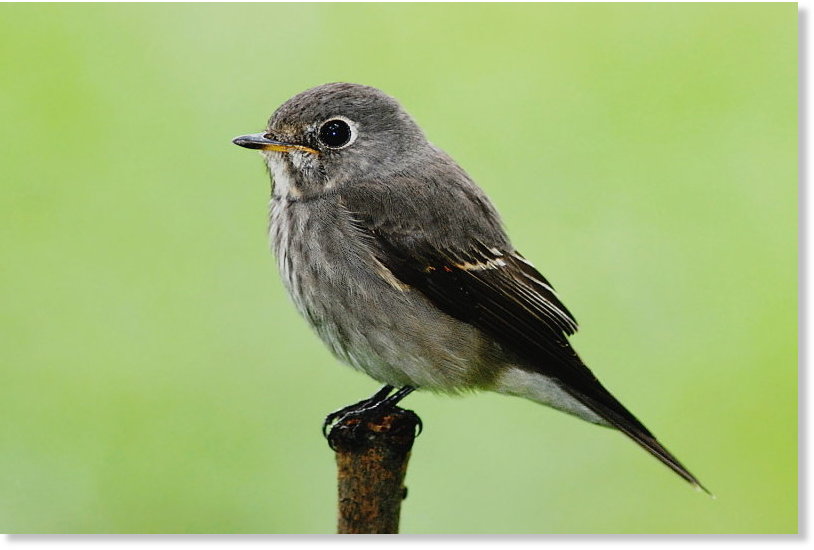
Dark-sided Flycatcher

"I had no idea what kind of bird we were looking at, it was so weird," says ornithologist Brynjúlfur Brynjúlfsson at the South East Iceland Bird Watching Centre. He is the first person to have spotted a Dark-Sided Flycatcher (Muscicapa sibirica) in Western Europe.

The species, according to Wikipedia, breeds in South-East Siberia west to beyond Lake Baikai as well as in Mongolia, China, North Korea and Japan.

Their wintering range includes India, Bangladesh, southern China, Taiwan, Sumatra, Java, Borneo and the Philippines. Vagrant birds have been previously recorded as far as Alaska and Bermuda.
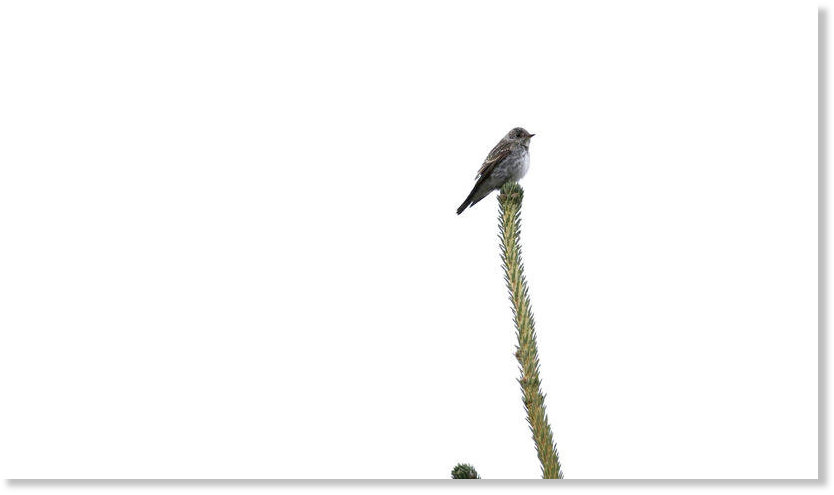
Dark-Sided Flycatcher
© Björn ArnarsonThe Dark-Sided Flycatcher is a resident of Asia.

Bell

Flooding in Argentina leaves coastal areas crawling with thousands of snakes

buenos aires`
© REUTERS/ Enrique MarcarianSnake invasion off the coast of Buenos Aires
An invasion of poisonous snakes washed downriver in recent floods forced authorities to close beaches to summer holidaymakers in northern Argentina, officials said on Monday.

Floodwaters in the Rio Plata and Rio Parana carried a species of water lily and with it countless crawling, slithering creatures, south to beaches at the mouths of those rivers near Buenos Aires.

"We are raising awareness of the risk and danger present today. There are otters and species of snakes that are poisonous," said Matias Leyes, an official in the coastal town of Quilmes, south of the capital.

"The beaches of Quilmes have been closed as a precaution. We were cleaning up the coast during the week and while doing so we saw the snakes under the water lilies."

Attention

5th dead sperm whale found on beach in UK: 17th for the North Sea region this month

Dead sperm whale
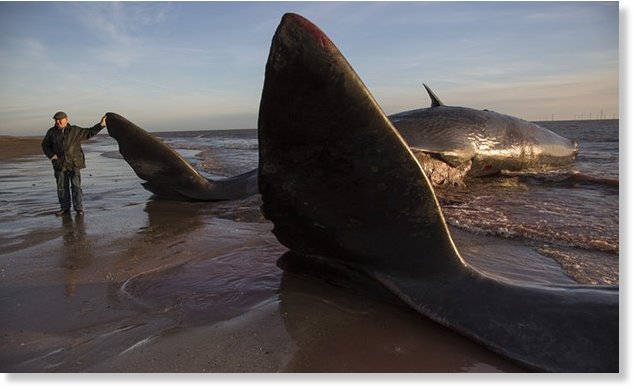
© Dan Kitwood/Getty ImagesA member of the public poses alongside one of three sperm whales found on a beach near Skegness.
A fifth dead whale has been found washed up on the east coast of England, several miles from where four whales were found over the weekend.

The whale, thought to be from the same pod as those found at the weekend, was discovered stranded on the beach in Wainfleet, Lincolnshire, five miles south of Skegness.

A member of the public spotted the beached whale on Monday afternoon further down the coast from where three dead sperm whales washed up in the early hours of Sunday. The three whales were from the same pod as one that died on Hunstanton beach in Norfolk.

Experts are investigating whether they are linked to 12 sperm whales that have washed up on the Dutch island of Texel and the German islands of Wangerooge and Helgoland since 11 January.


Smiley

Film of excited panda rolling around and absolutely LOVING the snow from freak blizzard

Panda
Loving it: Tian Tian can't get enough of the snow in Washington DC
Heartwarming video has been captured of a panda absolutely loving its time in snow.

The panda rolls around with a beaming smile, almost basking in the snow.

The footage was taken at the Smithsonian National Zoological Park in Washington, DC, after the heavy snowfall today sparked by Storm Jonas.

The animal in question is Tian Tian, whose name means 'more and more'.

He excitedly rolls and slides in the snow as he enjoys the weather that has hit the United States Middle Atlantic region, causing a shut down in the nation's capital.

Tian Tian is playful and happy as he throws the white stuff over him.


Attention

3 more sperm whales wash up along the North Sea coast at Skegness beach, UK

dEAD SPERM WHALES
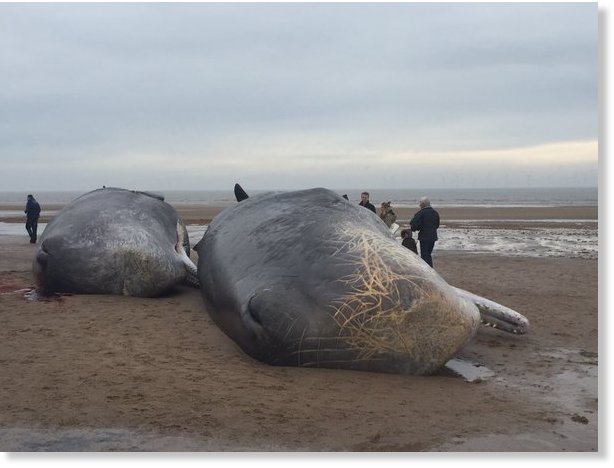
Two of the dead sperm whales
Whales are thought to be part of same pod as another discovered on the Norfolk coast on Friday

Three dead sperm whales have been discovered washed up on the Lincolnshire coast.

One of the whales was found dead on Skegness beach at about 6.30am on Sunday morning, while the two others were discovered a few miles south at about 8.30pm on Saturday evening.

Coastguard rescue teams from Sekegness and Chapel St Leonards were called to cordon off the area and members of the public are being advised not to come close to the dead animals.
We are dealing with 3 #Whales washed ashore on Skegness beach.People are asked not to go near to them.We will remove once we have permission

— EastLindseyDC (@EastLindseyDC) January 24, 2016

Comment: The other recent reports from the North Sea region: Rescuers fail to save stranded sperm whale on beach in Hunstanton, UK

Update: 2 more sperm whales found dead on Dutch beach

5 sperm whales die on Texel beach, Netherlands

Unusual stranding of 2 giant sperm whales on same beach at Wangerooge, Germany


Attention

Whale calf washes up on Marbella beach, Spain

The whale calf is the latest in a succession of dead or sick marine animals washed up on Marbella beaches

Dead whale calf found on beach at La Cabane
Passersby on the beach at Los Monteros on Tuesday came across a dead whale calf on the shore. The two-metre long sea mammal showed no sign of injury leading experts to believe it was suffering from some kind of disease. The calf was removed from the beach and incinerated after an autopsy had been carried out.

The whale calf is the latest in a succession of dead or sick marine animals washed up on Marbella beaches. A few weeks ago, a dead giant turtle appeared in El Alicate.

Smiley

Deadliest, knife-wielding crab found

A crab grabbed a knife and fought its way out of a restaurant in Brazil.
Crab with Knife
© Screen Capture YouTube
Some Internet users said in jest that walking down the streets in Brazil was so dangerous that even crabs had to carry knives to protect themselves. Another man said that in Mexico the crab would have carried a chainsaw.


Attention

Rescuers fail to save stranded sperm whale on beach in Hunstanton, UK

The dead sperm whale washed up on the beach at Hunstanton.
© Ian Burt

The dead sperm whale washed up on the beach at Hunstanton.
Battered and bruised, it came to rest on the beach as its life ebbed away with the tide.

First light today revealed the giant of the deep that washed up on Hunstanton Beach.

Overnight, the tide had moved the creature towards Old Hunstanton, washing it onto the rusting remains of a shipwreck close to the cliffs.

Hundreds of sightseers walked the half mile from the prom steps to see it.

The 30ft bull sperm whale was one of four seen swimming off the resort yesterday afternoon

.

Comment: See also these other January reports of dead sperm whales from around the North Sea coast: Update: 2 more sperm whales found dead on Dutch beach

5 sperm whales die on Texel beach, Netherlands

Unusual stranding of 2 giant sperm whales on same beach at Wangerooge, Germany


Binoculars

Wrong time, wrong place: Second Bullock's Oriole found wintering in Canada when they should be in Mexico

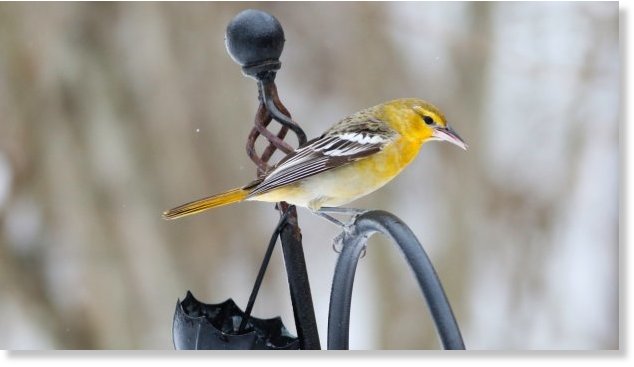
Bullock's oriole in backyard
© Sue King-Gosse Bird enthusiasts from across Nova Scotia have come to the Gosse's backyard to catch a glimpse of the visitor.
An avid birder in Cape Breton is playing host to an unusual visitor this winter. It hails from a much warmer climate — but shows no signs of wanting to leave its new home.

The Bullock's oriole arrived in Sue King-Gosse's backyard in Whitney Pier in mid-December, following a winter storm with strong westerly winds.

At first, King-Gosse thought it was a Baltimore oriole, a bird rare enough in Cape Breton.

But after she posted some photographs on social media, several fellow birders weighed in with their opinion that it is a Bullock's oriole.

The bird's normal habitat is in the western United States, and it usually winters even farther south, in Mexico and Central America.

Frog

140 years later, strange tree frog rediscovered in India

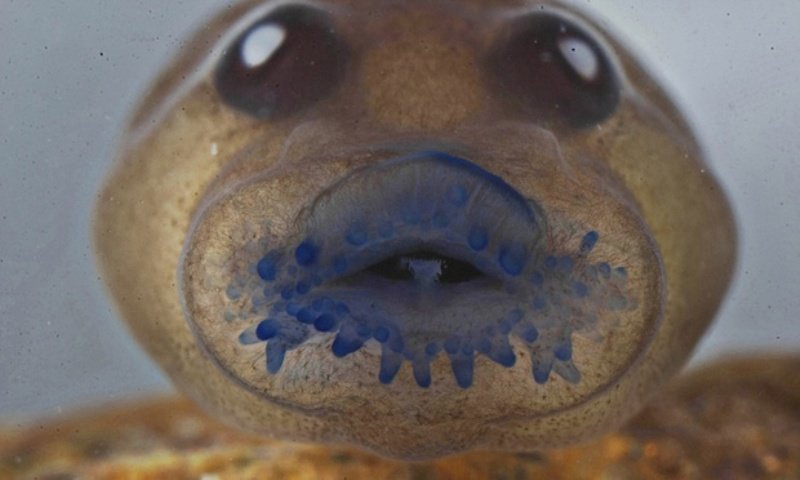
A tadpole of a frog named Frankixalus jerdonii
© APA tadpole of a frog named Frankixalus jerdonii, belonging to a newly found genus of frogs, as seen under microscope.
Last sighted in 1870, Jerdon's tree frog was thought to be long gone. But a three-year-old mission beginning in 2007 not only found the amphibian alive and well in India, new research also discovered that it belongs to a completely new genus of tree frog.

Jerdon's tree frog, also known as Frankixalus jerdonii, has a few unique quirks. The first is how the frog feeds its young. According to National Geographic, a female frog starts the process by laying her fertilized eggs in watery tree hollows. It isn't until the eggs hatch into tadpoles that things get weird.

Most tadpoles feed on plant material. However, The Verge reported that a female Jerdon's tree frog will return to her tadpoles and feed her young unfertilized eggs. The biologist who led the expedition, Sathyabhama Das Biju, told National Geographic that "It is very clear that [the tadpoles] are feeding purely on their mother's eggs."

Comment: New study finds frogs going extinct about 10K times faster than historical rate