Animals
S


Eye 2

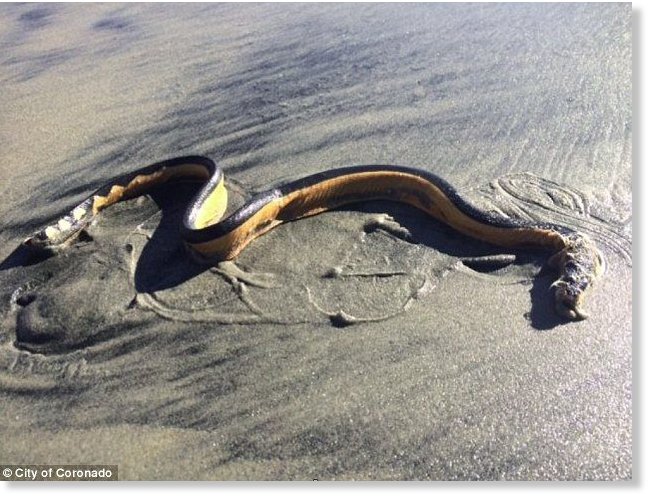
Third rare sea snake washes up on California beach in 3 months

The Pelamis platura snake
The Pelamis platura snake was found in Dog Beach, Coronado, miles away from its usual tropical habitat
For the third time in about three months, a rare venomous sea snake has washed up on a beach in Southern California.

The Pelamis platura snake, which is usually found in the tropical waters off the western coast of Mexico, was last spotted in California in the 1980s.

The sea snakes require a minimum of about 60 degrees Fahrenheit to survive and are believed to be moving north due to the unusually warm temperatures caused by El Nino.

The snake found at Dog Beach in Coronado on Tuesday measured 20 inches long and died shortly after it was placed in a bucket by a lifeguard.

In October, one yellow-bellied snake was found in Silver Strand State Beach, in Ventura County.


Comment: See also: Incredibly venomous yellow-bellied sea snake spotted in California for the first time in 30 years

Second rare yellow bellied sea snake washes up on California beach in 2 months


Sun

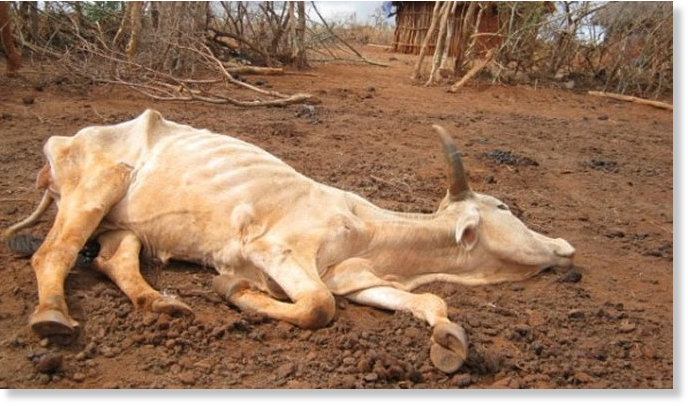
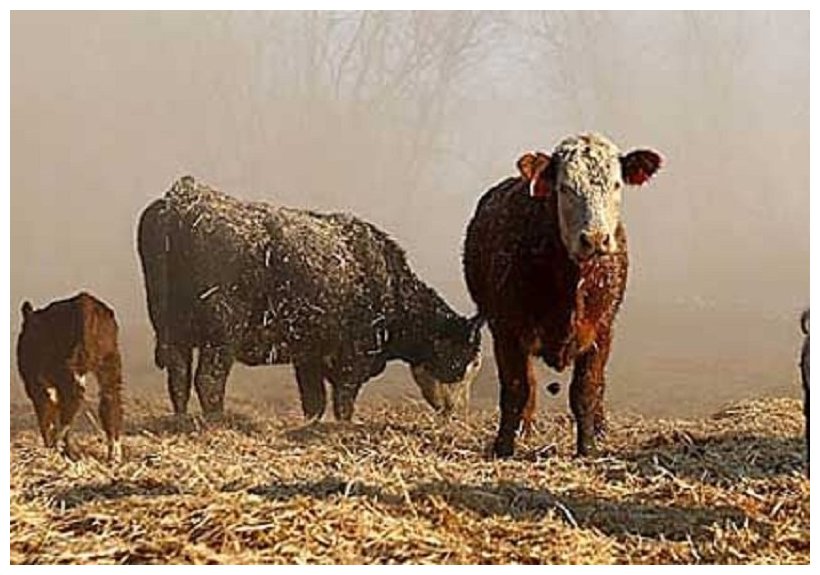
7,000 cattle dead due to drought in Zimbabwe

Livestock are dying in Zimbabwe
Severe water shortages are also affecting the Midlands and Matabeleland South.

As South Africa shoulders its own major water crisis, other countries in the region haven't been spared the hardships of the El Niño-induced drought.

In Zimbabwe, reports say around 7,000 cattle have died in its southern provinces.

The worst hit areas are in the south of the country, nearest to South Africa.

The Chronicle says that Masvingo province is the hardest hit, with around 5,000 cattle reported to have died there since temperatures went up in October.

Fish

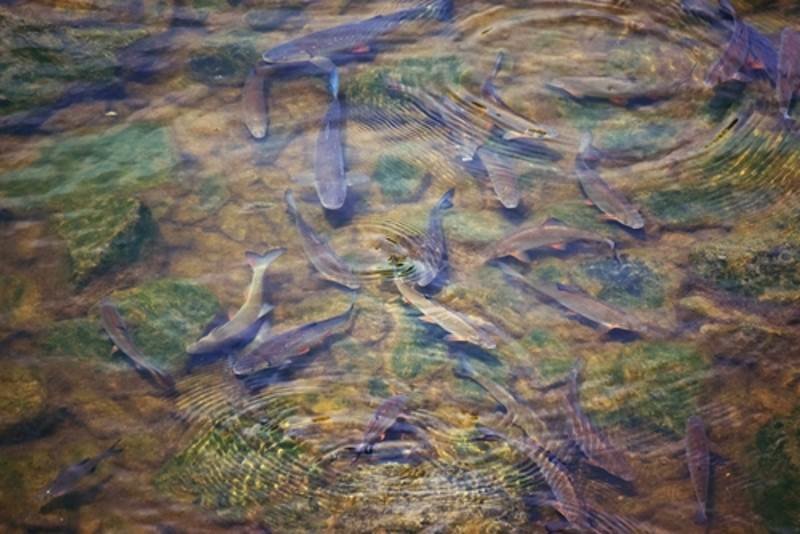
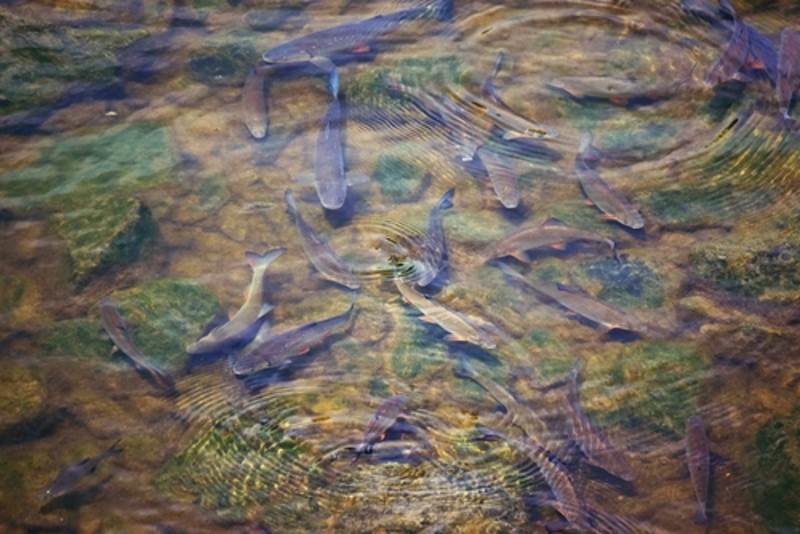
Record lows recorded for six California river fish species - corporate plundering of water resources blamed

fish dying california
© California Dept. of Fish and WildlifeFish species ranging from endangered Delta Smelt to Striped Bass continued to plummet to record low population levels in 2015 in the Sacramento-San Joaquin River Delta, according to the annual fall survey report released on December 18 by the California Department of Fish and Wildlife.
Only 6 Delta Smelt, an endangered species that once numbered in the millions and was the most abundant fish in the Delta, were collected at the index stations in the estuary this fall. The 2015 index (7), a relative number of abundance, "is the lowest in history," said Sara Finstad, an environmental scientist for the CDFW's Bay Delta Region.

The Delta Smelt, a 2 to 3 inch fish found only in the San Francisco Bay-Delta Estuary, is an indicator species that demonstrates the health of the Delta, an estuary that has been dramatically impacted by water exports to corporate agribusiness interests and Southern California water agencies during the record drought, along with other factors including increasing water toxicity and invasive species.

The Fall Midwater Trawl Survey, used to index the fall abundance of pelagic (open water) fishes most years since 1967, conducts monthly surveys from September through December. The 2015 sampling season was completed on December 11.

"In September, the only Delta Smelt collected were from index stations in the lower Sacramento River," said Finstad. "In October the only Delta smelt collected came from a non-index station in the Sacramento Deep Water Shipping Channel."

In November, no Delta Smelt were collected - and in December, the only Delta Smelt collected were from index stations in Montezuma Slough and the lower Sacramento River, according to Finstad.

Comment: Once again, corporate greed trumps all other concerns.


Cow

Cattle mutilations now reported in Georgia

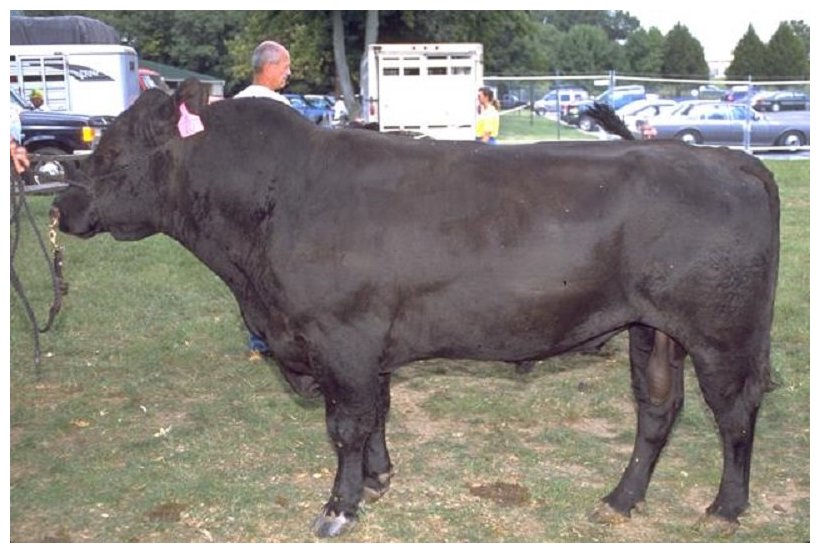
Black Angus
© Wikimedia Commons
Authorities in northeast Georgia have a mystery on their hands after cows were found mutilated, with neatly-cut circles sliced into their rear ends.

Harold Edge told investigators he found one of his Black Angus cows dead a few weeks ago.

A Jefferson County sheriff's report obtained by The Associated Press states that Edge found another Black Angus dead Jan. 6, with what appeared to be a half-circle cut around the same area of the animal. Edge told deputies there were no bite marks or indications of animal attacks.

Hall told the Athens Banner-Herald that the cuts were clean, with no jagged edges. Jackson County sheriff's Capt. Rich Lott said investigators can't explain the deaths on Edge's pasture near Braselton.

Bizarro Earth

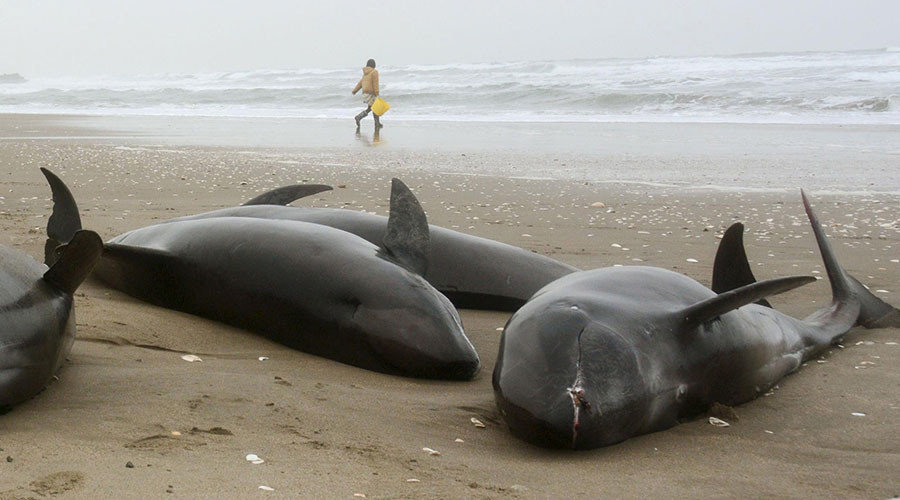
Whales and dolphins in danger of highly toxic waste still lingering in UK waters

dead Dolphins UK
© Reuters
Whales and dolphins in British waters could face extinction because of the presence of toxic chemicals banned over three decades ago, environmental researchers have warned.

Data from the UK Cetacean Strandings Investigation Programme (CISP) published Friday showed blubber taken from whales and porpoises contains some of the highest levels of a man-made chemical called polychlorinated biphenyls (PCB).

The chemical was used to make a range of materials including flame retardants, electrical equipment and paints, but were banned in 1981.

Now a study has shown that the large marine mammals are extremely vulnerable to the chemical because they are "top marine predators" high up the food chain.

The study's lead author, Dr Paul Jepson, from the Zoological Society of London (ZSL), said: "Our findings show that, despite the ban and initial decline in environmental contamination, PCBs still persist at dangerously high levels in European cetaceans.

Attention

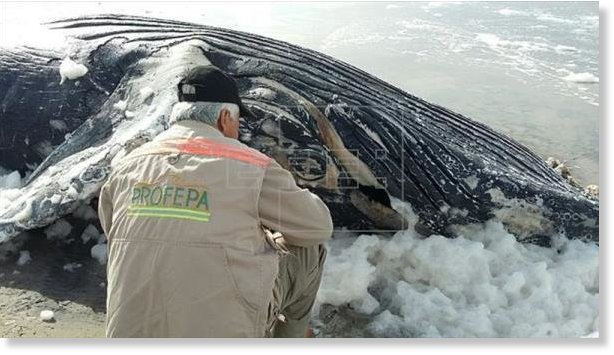
Dead humpback whale found in northwest Mexico

Juvenile humpback whale (Megaptera novaeangliae) Ensenada,
© EFE/PROFEPAAn official with the Profepa federal environmental protection agency inspects the carcass of a juvenile humpback whale (Megaptera novaeangliae) that washed up on a beach north of Ensenada, a resort city in the northwestern Mexican state of Baja California, on Tuesday, Jan. 12, 2016.
Inspectors examined the carcass of a whale that washed up on a beach north of Ensenada, a resort city in the northwestern state of Baja California, Mexico's Profepa federal environmental protection agency said.

The dead marine mammal was a juvenile humpback whale (Megaptera novaeangliae), a protected species in Mexico.

Profepa inspectors examined the whale's carcass and determined that fishing nets and human activities did not cause the whale's death.

The inspectors were unable to obtain tissue samples due to the animal's advanced state of decomposition, making it difficult to determine the reason why the whale beached itself and died.

Cow

Latest cattle mutilations bring memories of 1970s slaughter

Cattle
© Aaron Marineau
For ranchers Stanley and Carol Post, the recent mystery on the central Kansas prairie conjures up memories of their own bovine homicides 40 years ago.

It was October 1975. Within a short time period of each other, the couple discovered one of their cows dead − its udders and genitalia strategically removed and a hematoma on the head. Meanwhile, a calf's eye was taken out with detailed precision − the optic nerve cauterized at the end.

"It just blew your mind," said Carol Post, now 75, who was out feeding cattle with her husband on their Meade County ranch this week.

Call it the biggest animal cold case in the nation's history.

Thousands of cattle and other livestock were found dead in the 1970s − so prevalent that the FBI investigated the cattle mutilations.

Kansas seemed to be one of the states hit the most. In the fall of 1973 alone, the FBI news clippings showed 40 cases in the north-central part of the state - largely along Highway 81. All were seemingly killed in the same pattern on the isolated prairiescape: their ears, tongues, genitals and udders all neatly removed.

Often, the scene was bloodless and trackless as well. Post said even the veterinarian noted the several gallons of blood drained from the cow. They never found tracks.

Decades later, on the central Kansas plains, law enforcement are grappling with two similar cases.

Attention

Update: 2 more sperm whales found dead on Dutch beach

Sperm whale washed ashore on Texel
© namedreep/TwitterSperm whale washed ashore on Texel, Jan 12th, 2015
Two more sperm whales became stranded and died on the Dutch coast a day after five others, likely from the same pod, lost their lives nearby in a rare North Sea beaching, experts said Thursday.

"They are two males," said Jan Boon from the Royal Netherlands Institute for Sea Research (NIOZ), which is based on the northern Dutch island of Texel where the whales washed up.

One was found near the Texel port in front of NIOZ's buildings in the village of 't Hoorntje, while the other became stranded further to the north.

"The one I've seen here in the south has unfortunately been dead already for some time," Boon told AFP.

"There's blood, it's mouth is open," he said.

The two whales and the five others that died on Wednesday after floundering ashore late Tuesday are "probably from the same pod of six whales" that came ashore in Germany earlier this week.

Comment: See also this earlier report: 5 sperm whales die on Texel beach, Netherlands


Info

Humans were in the Arctic 10,000 years before they were supposed to be there

Mammoth
© Pitulko et al., Science (2016)Sergey Gorbunov excavating the mammoth.
More than 40,000 years ago, in the Arctic reaches of what's now Russia, the population of mammoths was at a peak. This was before the last glacial maximum - the last era when ice sheets reached down to cover extensive parts of Asia, Europe and North America - and even in the far north, mammoths would have had large expanses of open landscape in which to roam.

Astonishingly, according to a new study, published in Science, humans may have followed them there, on the hunt, further north into the Arctic than anyone ever realized humans had traveled that early in history.

New evidence, of human-made marks on mammoth bones, shows that humans had already populated the Arctic as early as 45,000 years ago, a team of researchers from the Russian Academy of Sciences reports in the new study. That would put our species in that region 10,000 years earlier than any previous evidence has shown.

The latest evidence comes from a single mammoth carcass, first discovered in August 2012, not far from a weather station in Sopochnaya Karga, an area of Russia that stretches further north than the northernmost points of Scandinavia. That summer, a student was walking along the river bank when he spotted bones in an exposed bluff.

Attention

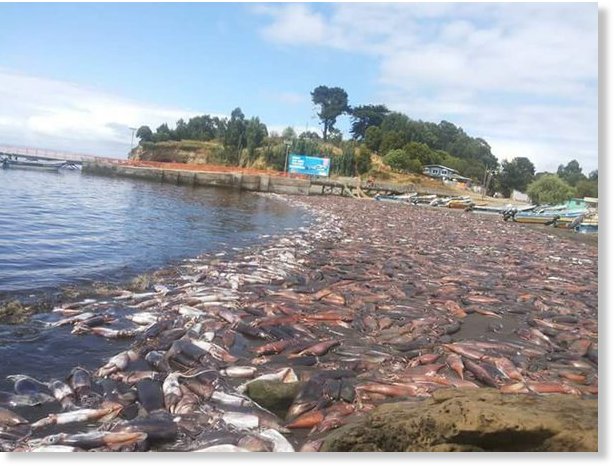
Cuttlefish mass die-off on island near Chile

Dead cuttlefish
© Twitter / Leonidas Romero SáezDead cuttlefish
Thousands of cuttlefish mysteriously washed up on Santa Maria off Coronel, Chile on January 12, 2016.

The cause of the mass die-off remains unexplained.

The animals appeared in the South Island Harbor.

Scientists have started insvestigating the possible causes for this mysterious and apocalyptical mass die-off.