Animals
S


Binoculars

Cleveland zoo researchers find rare giant turtle in Vietnam

Cleveland, Ohio - Researchers from the Cleveland Metroparks Zoo have discovered a rare giant turtle in northern Vietnam - a find that carries great scientific and cultural significance. Swinhoe's soft-shell turtle was previously thought to be extinct in the wild. Three other turtles of the species are in captivity, said experts from the Zoo's Asian turtle program.

Turtle
©AP Photo/Cleveland Metroparks Zoo
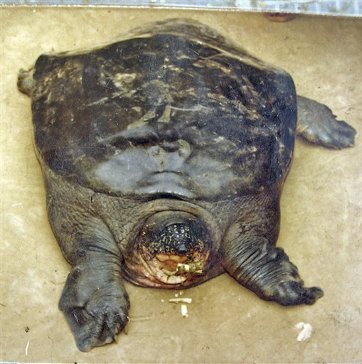
This undated photo provided by the Cleveland Metroparks Zoo shows a captive Swinhoe's soft-shell turtle from Thanh Hoa province in Vietnam. Zoo researchers recently discovered one of the rare giant turtles in the wild in northern Vietnam.

Bug

Killer Bees in Kingsville

Killer bees in Kingsville apparently living up to their name. The Africanized insects swarmed a neighborhood leaving one man seriously injured and killing at least five dogs.

As Jesse Rios was recounting his harrowing brush with the killer bees Monday afternoon, we came under attack.

House

UK Homes hit by plague of mice

UK - A plague of mice is infesting part of Preston, residents say.

Homeowners in parts of Frenchwood say they are under siege from the disease carrying rodents.

Residents in at least five streets in the area have reported sightings of mice in their homes.

Last week the Evening Post told of the concerns of some residents of Manchester Road, Frenchwood, who claimed to have spotted mice scurrying through their kitchens, living rooms and even their bedrooms every day.

Fish

Oregon, US: Collapse of chinook season devastates salmon trollers

In Charleston, on the Oregon coast, a way of life seems endangered.

In Charleston, on the Oregon coast, salmon trolling is a way of life. But now, with the chinook season collapsed, it's A life on rocky shoals.

Matt Hakki sits quietly at the plywood table overlooking Charleston's fishing port while the older men talk about predators, regulators, Chilean fish farms, seas that can turn a 50-foot salmon troller into a pinball.

Last year, banking on a favorable fishing forecast, he took out a loan and paid $80,000 for a boat built 68 years ago, ready after a decade as a deckhand to chase a legendary fish that can command $100 a head.

But for the most part, the fish didn't show up. This year, he found out there will be no salmon fishing at all.

"I'm scared," he says, and the older men fall silent. "I kind of took the leap of faith to do something to better myself and my family. Now I have to look at my wife and my two young boys.

"I ask myself everyday, did I make the right decision?"

Last week, following a stunning drop in the numbers of fall chinook projected to return from the ocean to the Sacramento River, the Pacific Fishery Management Council opted for the largest salmon fishing closure ever off the Oregon and California coasts.

Bug

US: Florida man killed by bees

For the first time killer bees are being blamed for a man's death in Florida.

State officials say a 51-year-old man was swarmed by bees on Wednesday.

Fish

"Unprecedented Collapse" of Salmon Stocks: Fishery Council Closes Fishing Off Oregon and California

The Pacific Fishery Management Council (PFMC) at its meeting in Seattle on Thursday, April 10, voted to close recreational and commercial salmon fishing off the coast of California and most of Oregon this year.

The only exception to the closure will be a selective recreational fishery for coho salmon in Oregon, according to Dan Wolford, PFMC member and Coastside Fishing Club science director. The fishery closure will extend from Cape Falcon in northern Oregon to the US-Mexico border.

This complete closure of fishing for chinook salmon will be the first since commercial fishing began in California in 1848. The decision was made because of the "unprecedented collapse" of Central Valley salmon stocks. The Sacramento River fall chinook population, until recently the most robust West Coast salmon run, was the driver of West Coast salmon fisheries.

As recently as 2002, 775,000 adults returned to spawn. This year, even with all ocean salmon fishing closures, the return of fall run chinook to the Sacramento is projected to be only 54,000 fish.

Comment: From the article:
The reason for the sudden collapse of the Sacramento fall Chinook stock is not readily apparent, although both natural and hatchery-produced fish have been similarly affected. However, it is clear that overfishing did not cause the depressed condition, as the parent spawning populations were all above the goal. The National Marine Fisheries Service has suggested ocean temperature changes, and a resulting lack of upwelling, as a possible cause of the sudden decline. Many biologists believe a combination of human-caused and natural factors will ultimately explain the collapse, including both marine conditions and freshwater factors such as in-stream water withdrawals, habitat alterations, dam operations, construction, pollution, and changes in hatchery operations.
In other words: They don't know why the salmon stocks have collapsed. We should add salmon to the list of species mysteriously dying. So far we have bees, bats and frogs.


X

US: First It Was Bees, Now It's Bats That Are Dying

Though bats are a bit spooky looking, inviting thoughts of Dracula, the real horror story is that bats are becoming sick and perishing. A massive bat die-off is happening. Their extinction in the United States is threatening -- and no one knows why.

Just as news of the massive bee die off is fading away -- though not actually ending -- the plight of bats in the United States is starting to come out. The loss of bats may be an even worse concern than the loss of bees, which are exclusively tame and mass-raised -- over-stressed, over-bred, and grown to be over-sized. They're used to pollinate crops, especially ones that are not natural to the areas in which they're grown, such as almonds in California. Wild bees are doing just fine.

Attention

US: "Major disaster" for bees may jeopardize Washington state's crops

Bees are in trouble, and in Washington, that could mean agriculture is, too.

Last year, many Washington beekeepers were relieved that they avoided a mysterious Colony Collapse Disorder that silenced hives all over the country. But this year, some beekeepers are reporting a devastating new pathogen - with no reliable cure - is killing their bees in droves.

Some beekeepers are helping to pay for a crash research program at Washington State University to figure out what is going on.

"It's a major disaster in Western Washington. We are into a huge emergency situation," said Yakima beekeeper Eric Olson, who runs the state's largest commercial pollination business.

Image
©Dean Rutz / The Seattle Times
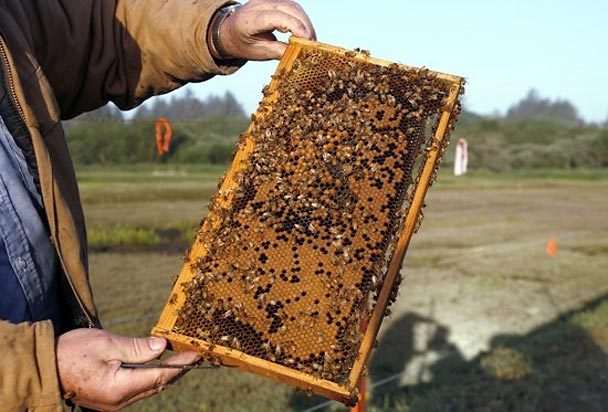
Yakima beekeeper Eric Olson holds a hive loaded with bees in Long Beach, Pacific County. A new pathogen is devastating the hives of some Washington beekeepers.

Roses

World's oldest tree discovered in Sweden

Scientists in northern Sweden believe they have discovered the world's oldest living tree, dating back nearly 8,000 years, local media said on Thursday.

A Norway spruce, which was found growing at a height of 950 meters above sea level, is more than two meters (6.5 feet) tall and about 20 centimeters (8 inches) in width.

X

South Africa: Swallows dying by the thousands

Tens of thousands of swallows have died in Limpopo province a week before they were due to migrate to Europe, said BirdLife SA on Wednesday.

Executive director Gerhard Verdoorn said the vast climate changes during March, from the extremely hot to the bitterly cold, played a major role in the death of the swallows.

About three weeks ago, cold air from Angola passed over Namibia and Botswana and entered the South African Lowveld. Temperatures plummeted from 21° to 9°.