Strange Skies
S


Question

Strange, glowing night clouds continue to spread

Noctilucent clouds
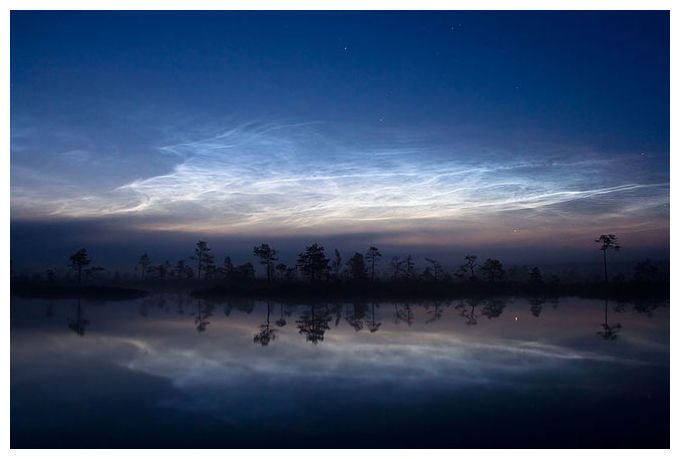
© Martin Koitmäe/WikimediaNoctilucent clouds over Kuresoo bog, Soomaa National Park, Estonia.
Just after summer sunsets in northern latitudes, shimmering, wispy clouds appear in the twilight sky. This year, these noctilucent clouds have appeared earlier and farther south than ever before.

Noctilucent clouds exist higher in Earth's atmosphere than any other cloud type. First observed in 1885 following the eruption of Krakatoa, they were a sight reserved for Earth's northernmost residents. In recent years, however, their intensity and frequency have increased, often at latitudes previously thought to be too far south for noctilucent clouds to form.

In 2009, scientists from the National Center for Atmospheric Research pointed to the southern creep of noctilucent clouds as an early warning signal for climate change high in the atmosphere. Now, new data from NASA's cloud-observing AIM satellite supports this possibility.

James Russell, principal investigator for AIM, says increasing methane emissions could be amping up the cloud show. "When methane makes its way into the upper atmosphere, it is oxidized by a complex series of reactions to form water vapor," Russell said. "This extra water vapor is then available to grow ice crystals for [noctilucent clouds]."

Fireball

Noctilucent clouds defy NASA expectations: Record early start to the season despite solar maximum

Every summer, something strange and wonderful happens high above the north pole. Ice crystals begin to cling to the smoky remains of meteors, forming electric-blue clouds with tendrils that ripple hypnotically against the sunset sky. Noctilucent clouds - a.k.a. "NLCs"--are a delight for high-latitude sky watchers, and around the Arctic Circle their season of visibility is always eagerly anticipated.

News flash: This year, NLCs are getting an early start. NASA's AIM spacecraft, which is orbiting Earth on a mission to study noctilucent clouds, started seeing them on May 13th.

"The 2013 season is remarkable because it started in the northern hemisphere a week earlier than any other season that AIM has observed," reports Cora Randall of the Laboratory for Atmospheric and Space Physics at the University of Colorado. "This is quite possibly earlier than ever before."


Comment: We very much doubt it.


Question

Mysterious Mt Shasta: High strangeness on California's Lone Mountain

Mt. Shasta
© WhoForted?
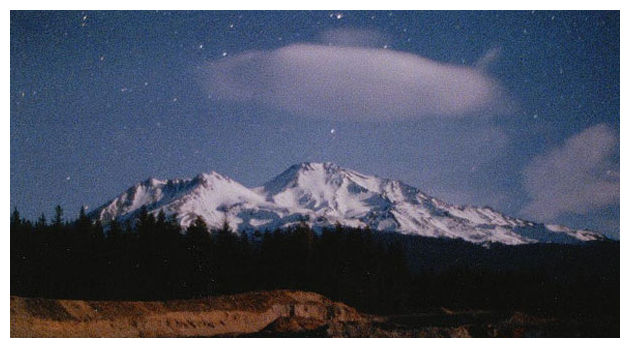
When you first catch sight of Mt. Shasta, you feel there is a great medicine centered there, as though God put it in the middle of the dark plains of Northern California just to relieve the sight of deep green forests with a crystal peak of blazing white. It stands alone, rising high above the surrounding hills, collecting clouds out of nowhere which circle around its peak like a lonley tribe dancing around a fire. All the strenuous heights of the surrounding ranges look like little ant mounds from the upper slops of this behemoth. The sight of the full moon dancing with dramatic, phantasmogoric clouds as it casts a great halo over the misty hillsides below, helps you believe that perhaps you really are standing on the axis mundi - the place where heaven and earth meet... Until you get kicked out for drinking wine in a spiritual healing circle. (But I'm Irish! How else do I heal my spirit!)

Half of those who believe the mountain is holy are making a dollar at it, exploiting its global reputation as a spiritual retreat with outrageously priced "vortex tours" and "spiritual attunement workshops." The other half are poor as pigeons, living in the forests in little tents or shrub huts even through the snow-heavy winter and the sun-blasted summer, striving for the upper branches of human consciousness in the place where "earth ends and heaven begins."

Who dwells here but bearded yokels, skinny-dipping hippies, and crystal-gazing con artists?

Legends dwell here. And plenty of them!

Sun

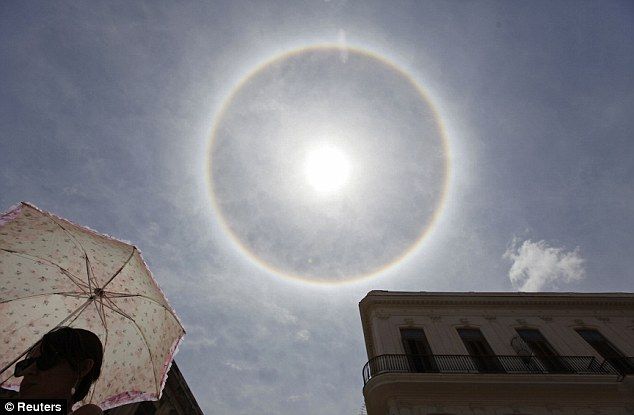
Ice Age cometh: Sun halo appears over Cuba

Those having a beer at Sloppy Joe's Bar in Havana Cuba today, will be hoping they wake up tomorrow remembering their time there.

For above the newly-refurbished and somewhat iconic bar, high in the sky occurred an atmospheric phenomenon known as a 'sun dog'.

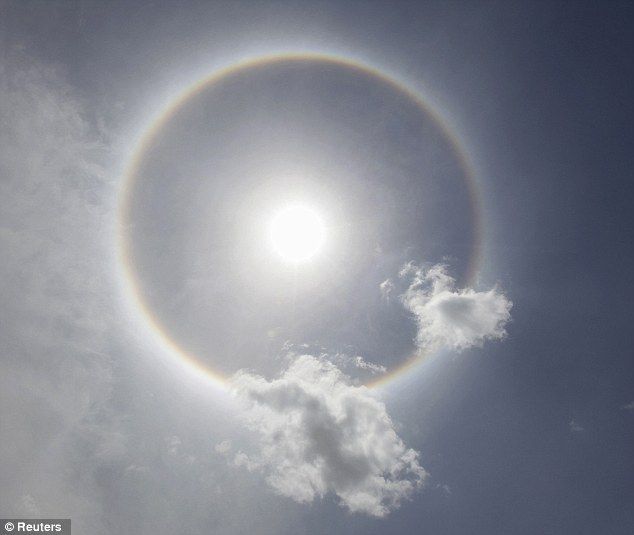
The sun was surrounded by a bright ring, caused by a refraction of sunlight by small ice crystal in the atmosphere.
Image
Bright spark: An atmospheric phenomenon known as a 'sun dog' is seen in the sky over Sloppy Joe's Bar, Havana, Cuba
Image
Put down your pint: The rare halo around the sun is caused by the refraction of sunlight by small ice crystals in the atmosphere

Comment: It's actually a sun halo; a sun dog is something like this.

So sun halos around the sun are appearing in Cuba now? Well that rules out the earlier 'explanation' that they were the result of ice crystals forming in cold environments such as the Arctic Circle.

In fact, they have appeared in the UK and Russia recently.

This is more evidence that the upper layers of Earth's atmosphere have rapidly cooled in recent years.


Camera

Noctilucent clouds appear out of season and far to the south - cometary dust from the Russian meteor blast?

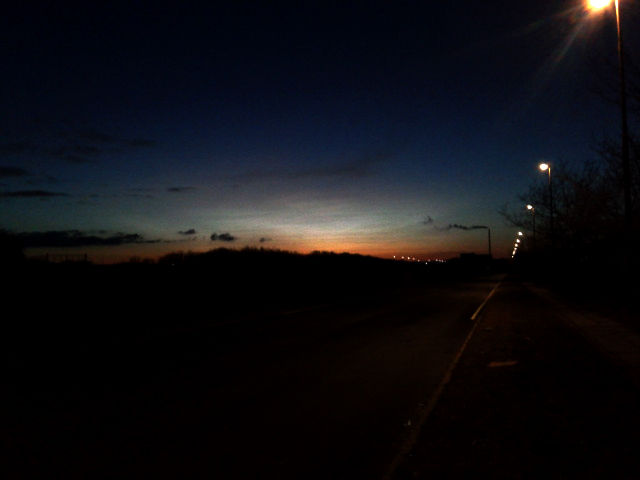
From 19-21 February 2013, noctilucent clouds were observed in the UK, Denmark, Norway and the Netherlands. Since these clouds are usually only seen in summer, it is suspected that they may be the result of comet dust deposited in the upper atmosphere by the Chelyabinsk/Chebarkul meteor or comet fragment explosion over Southern Russia on 15 February.

The following images were submitted to spaceweather.com
Image
© Terry ParkerImage taken by Terry Parker on Feb. 20, 2013 from above Birmingham, UK. 'I am an airline pilot in the UK and I occasionally see noctilucent clouds. Usually during the summer at about midnight looking North. But yesterday (20 Feb 13) I was very surprised to see them looking south towards France and so close to sunrise.'

Image
© Tom AxelsenPhoto by Tom Axelsen, Copenhagen area, Denmark

Moon

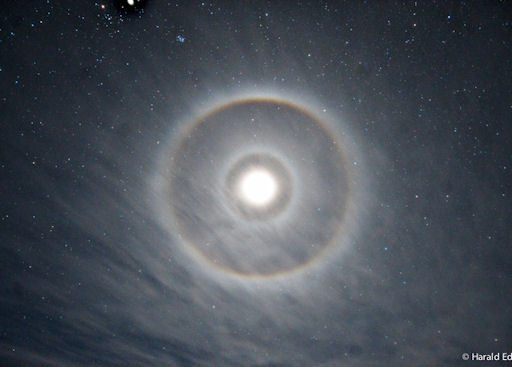
Double halo appears around Quarter Moon, 21 December 2012

Many sky watchers have witnessed a halo around the moon--a ring of light that surrounds the lunar disk at a radius of 22 degrees. The phenomenon is caused by pencil-shaped ice crystals in cirrus clouds that bend moonlight. On Dec. 21st, Harald Edens of Magdalena, New Mexico, witnessed a rare double halo:

Image
© Harald Edens

Comment: Moon halos usually appear in conjunction with a full moon, but on 21st December the moon was only at first quarter. Besides producing two halos, the planet's changing atmosphere probably made it appear to be full.

See also: Chemtrails, Disinformation and the Sixth Extinction


Meteor

Increased meteor smoke: Noctilucent clouds brightening and spreading south

noctilucent clouds
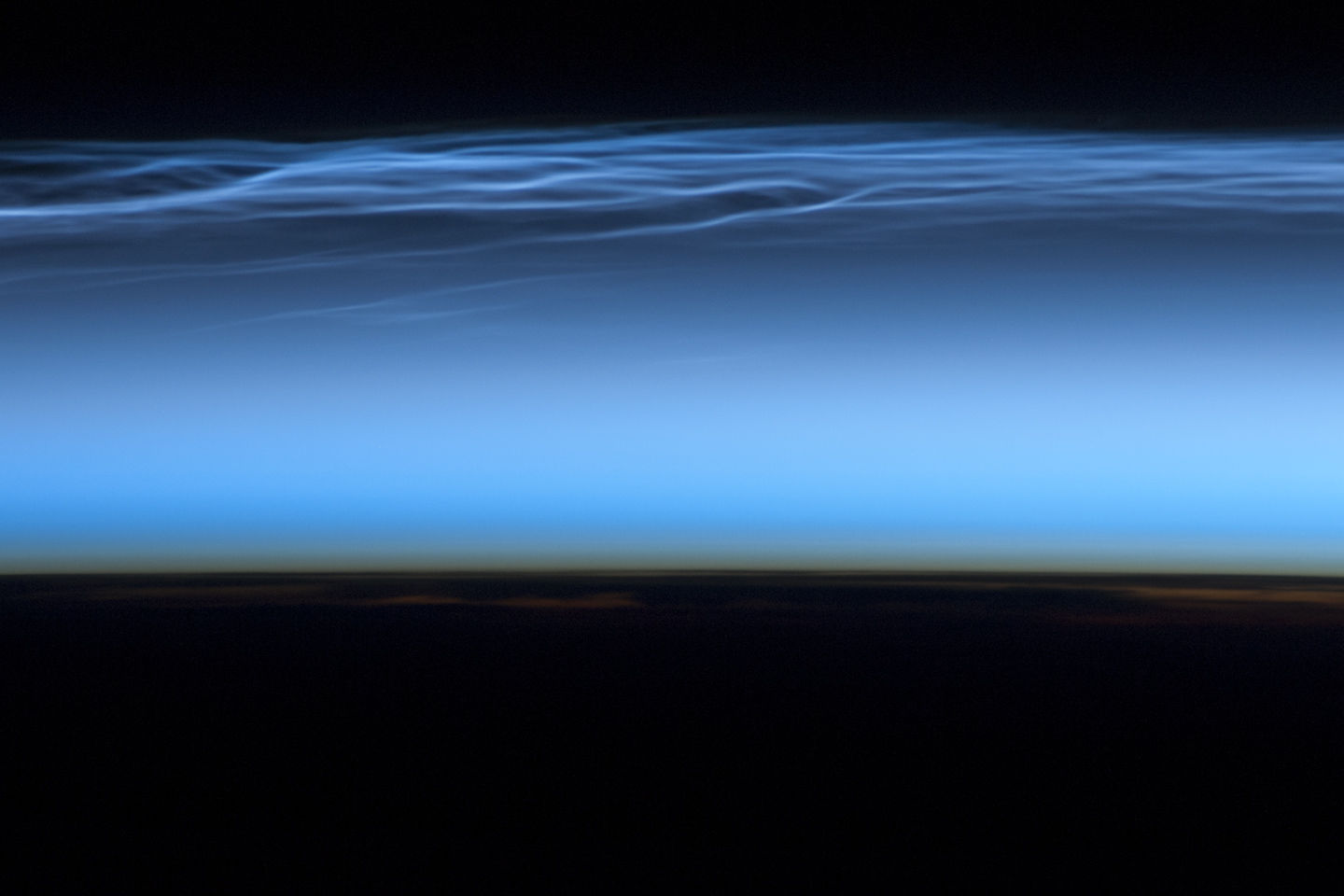
© NASAAstronauts on the International Space Station took this picture of noctilucent clouds near the top of Earth's atmosphere on July 13, 2012.

Rare and mysterious clouds that are so bright they can be seen at night have mystified people since they were first observed more than a century ago, but scientists have now discovered a key cosmic ingredient for these night-shining clouds: "smoke" from meteors as they burn up in the Earth's atmosphere.

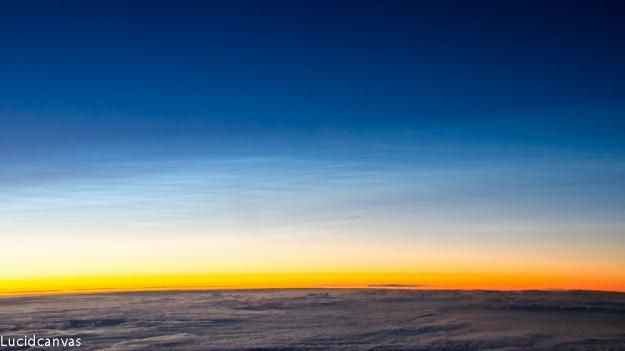
Blue-white clouds that eerily glow in the twilight sky are called noctilucent clouds, or NLCs. They typically form about 50 to 53 miles (80 and 85 kilometers) above ground in the atmosphere, at altitudes so high that they reflect light even after the sun has slipped below the horizon.

In a new study, scientists found that noctilucent clouds have an extraterrestrial link.

Comment: Indeed they are, they're telling us that something wicked this way comes...


Meteor

Meteor Smoke Makes Strange Clouds - Imbedded in Noctilucent Clouds

Anyone who's ever seen a noctilucent cloud or "NLC" would agree: They look alien. The electric-blue ripples and pale tendrils of NLCs reaching across the night sky resemble something from another world. Researchers say that's not far off. A key ingredient for the mysterious clouds comes from outer space.

"We've detected bits of 'meteor smoke' imbedded in noctilucent clouds," reports James Russell of Hampton University, principal investigator of NASA's AIM mission to study the phenomenon. "This discovery supports the theory that meteor dust is the nucleating agent around which NLCs form."


Attention

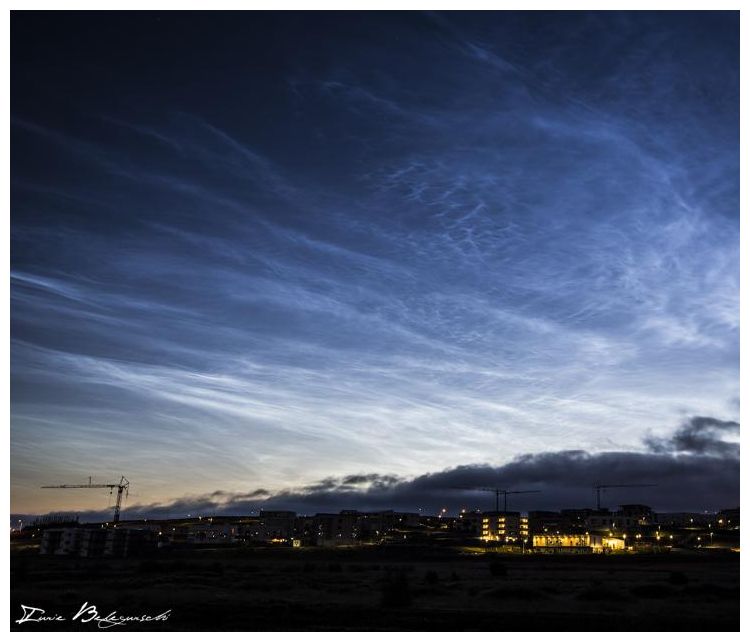
Spectacular Noctilucent Clouds Photographed Over Iceland

A bank of electric-blue noctiluent clouds swept across Iceland on August 2nd, producing a vivid display of luminous ripples and tendrils over Reykjavik:

Noctilucent Clouds
© Iurie Belegurschi

"These are the highest clouds in Earth's atmosphere, located at altitudes of around 76 to 85 kilometres," says photographer Iurie Belegurschi. "It was a beautiful display."

New data from NASA's AIM spacecraft prove that noctilucent clouds (NLCs) are seeded by space dust. The tiny ice crystals that NLCs are made of nucleate around "meteor smoke" wafting through the upper reaches of Earth's atmosphere. Not only do these clouds look alien, they really are alien. A new video from NASA explains the research.

Bizarro Earth

Noctilucent Clouds observed in Poland as they continue Southward advance

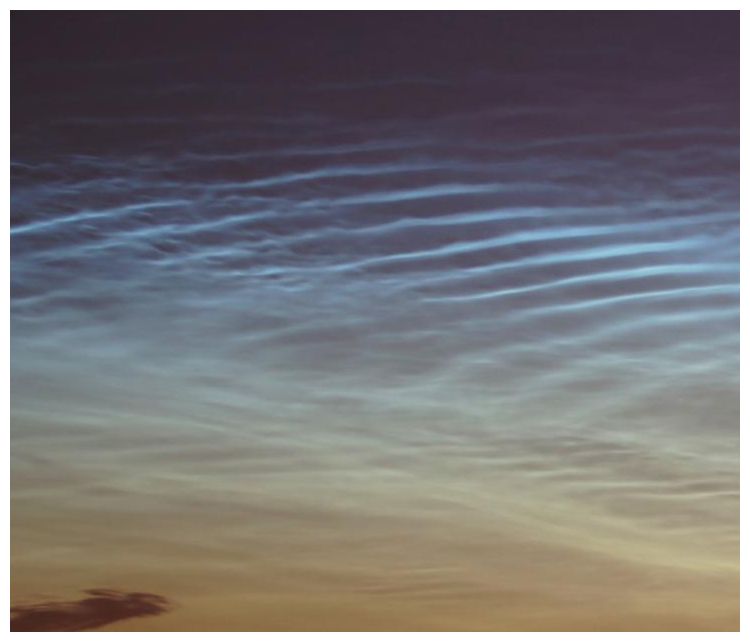
This morning a vast bank of electric-blue noctilucent clouds rippled across northern Europe. "It was like water in the sky," says Barbara Grudzinska, who photographed the display from Warsaw, Poland:
Noctilucent Clouds
© Barbara Grudzinska
"These are the first noctilucent clouds this year so clearly visible at our latitude in Warsaw (52 N)," says Grudzinska.

When NLCs first appeared in the 19th century, the mysterious clouds were confined to the Arctic, most often seen in the same places as Northern Lights. In recent years, however, their "habitat" has been expanding, rippling as far south as Colorado, Virginia, Kansas, and Utah. (Here are some examples of sightings in the lower United States.) There is growing evidence that the expansion is a sign of climate change, although this remains controversial.

Whatever the reason, noctilucent clouds aren't just at high latitudes anymore, so sky watchers everywhere should be alert for them.

Observing tips:


Look west 30 to 60 minutes after sunset when the sun has dipped 6o to 16o below the horizon. If you see luminous blue-white tendrils spreading across the sky, you've probably spotted a noctilucent cloud.

Comment: Indeed, something is 'up'...

Cosmic Climate Change is Underway