Volcanoes
S


Bizarro Earth

Philippines - Earthquakes in Mindanao to last for months, volcanic anomalies reported underground

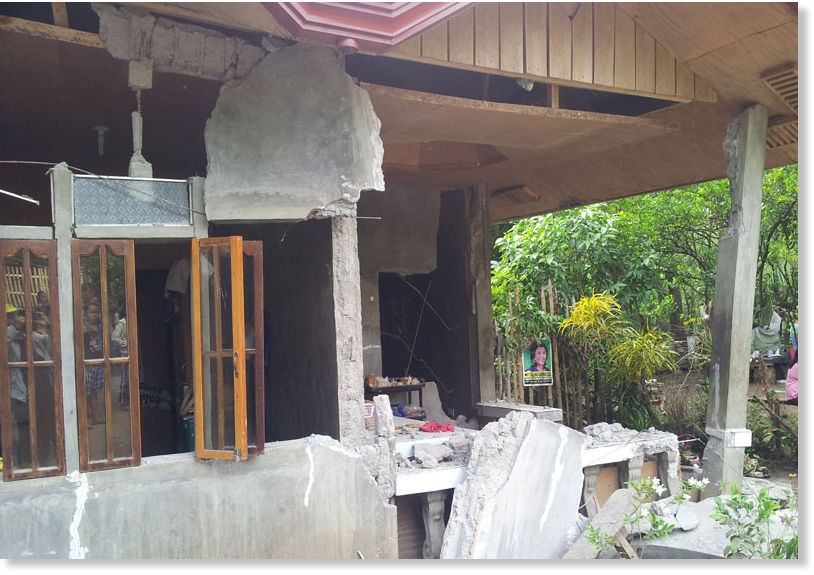
The earthquakes experienced today in Carmen town, North Cotabato and the rest of Mindanao will possibly last for weeks or months. This was according to Jenila de Ocampo, Officer-in-charge of the Davao Seismic Station of the Philippine Institute of Volcanology and Seismology (Phivolcs), in a phone interview. She added the intensity might either be "felt" or "unfelt" by humans. On Monday morning, two strong quakes struck Carmen. A 5.7 magnitude was felt at 4:08 AM with epicenter at seven Kilometers (Km) Northeast of the town. It has a depth of 10 Km. The town was placed under Intensity VI. "An Intensity VI in the PEIS (Phivolcs Earthquake Intensity Scale) means there will be a minimal damage to poorly built structures, or those with light materials and even concrete structures which do not meet building standards like the proper placement of steel bars," De Ocampo explained.
Image
Earthquakes rattle Philippines: one of many houses in Carmen, North Cotabato damaged by the 5.7 magnitude earthquake Saturday
At 7:31 AM, another quake jolted Carmen town. A 4.0 magnitude was recorded with epicenter at 7 Km Northeast of the town. It has a depth of 3 Km. Intensity II was felt in Matalam town, North Cotabato. On Saturday evening, a 5.7 magnitude earthquake rocked the town which hurt 5 people, damaged 60 houses in Kimadsil village alone, and destroyed a bridge as well as agricultural facilities, school buildings and health centers. The said quake, according to De Ocampo, "is shallow and tectonic in origin." Its depth was at 5 Km. "Strong earthquakes which are tectonic will cause aftershocks until the energy dissipates. In the case of Carmen which was hit by shallow quakes, the energy of the quake has little chance to dissipate when it reaches the surface," she said.

Attention

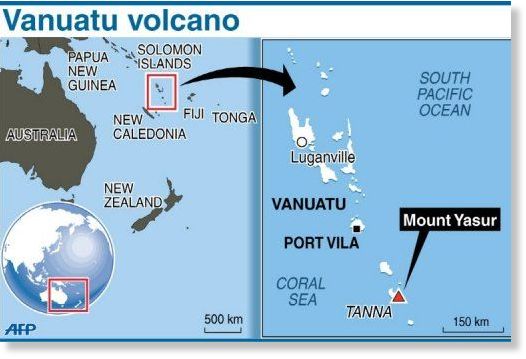
Explosive activity of Vanuatu's Mt Yasur increases

Image
Explosive activity at Vanuatu's Mt Yasur volcano has increased in recent days.

According to observations by the Vanuatu Meteorology and Geohazards department, the activity level of the volcano on Tanna island is still at alert level 2 but an increase to 3 in the near future is possible.

Bizarro Earth

A blast of a find: 12 new Alaskan volcanoes

Underwater Volcano
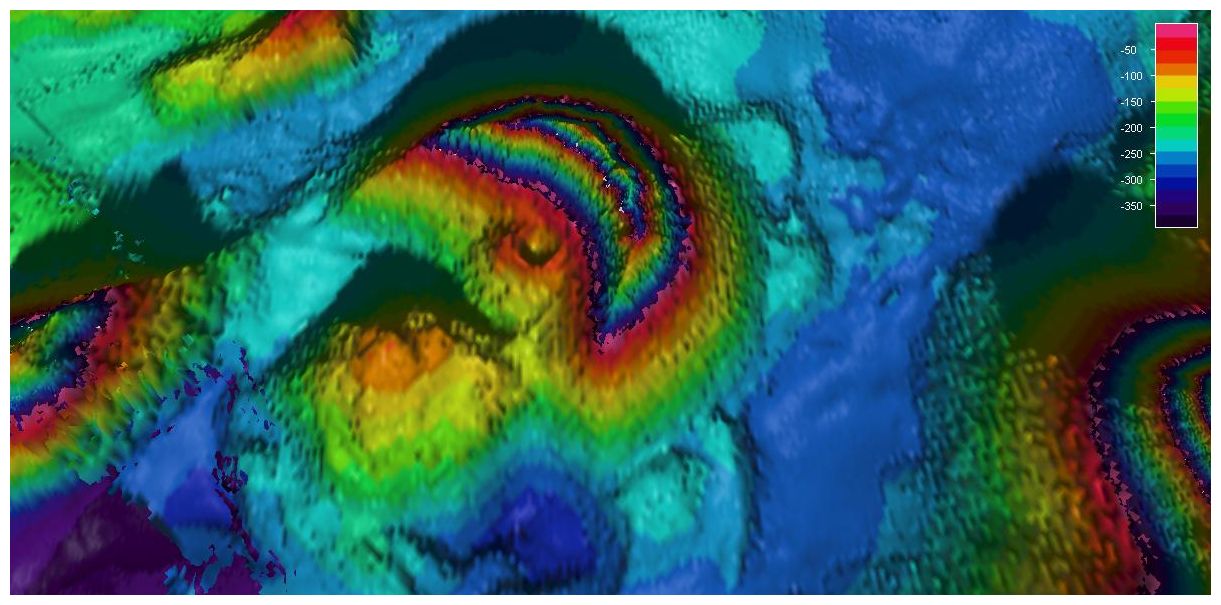
© James Baichtal, U.S. Forest ServiceOne of the newest volcanic vents discovered in Southeast Alaska is an underwater volcanic cone in Behm Canal near New Eddystone rock.
In Alaska, scores of volcanoes and strange lava flows have escaped scrutiny for decades, shrouded by lush forests and hidden under bobbing coastlines.

In the past three years, 12 new volcanoes have been discovered in Southeast Alaska, and 25 known volcanic vents and lava flows re-evaluated, thanks to dogged work by geologists with the U.S. Geological Survey (USGS) and the U.S. Forest Service. Sprinkled across hundreds of islands and fjords, most of the volcanic piles are tiny cones compared to the super-duper stratovolcanoes that parade off to the west, in the Aleutian Range.

But the Southeast's volcanoes are in a class by themselves, the researchers found. A chemical signature in the lava flows links them to a massive volcanic field in Canada. Unusual patterns in the lava also point to eruptions under, over and alongside glaciers, which could help scientists pinpoint the size of Alaska's mountain glaciers during past climate swings.

"It's giving us this serendipitous window on the history of climate in Southeast Alaska for the last 1 million years," said Susan Karl, a research geologist with the USGS in Anchorage and the project's leader.

Bizarro Earth

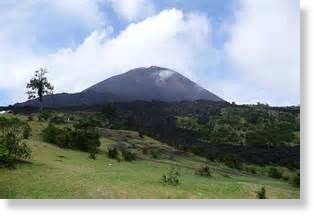
Pacaya volcano erupts in Guatemala sending volcanic material more than 400 metres in the air

Image
The Institute of Vulcanology warned that the eruption could intensify with ash rising as high as 1000 to 2000 metres, posing a threat to air traffic at Guatemala's international airport.

"Ash could spread over Guatemala City due to the direction of the wind," the country's disaster response office said in a statement.

The last major eruption of Pacaya, in May 2010, claimed the life of a television journalist, drove thousands of people from their homes and forced the closure of the Guatemala City airport for five days.

The 2552 metre-high Pacaya is 50 kilometres south of the capital and one of three active volcanoes in Guatemala.

Blackbox

Video: Strange weather phenomena over the last days of May 2013


Comment: See also Video: Strange weather phenomena for the first days of May 2013

We suspect that the Cyprus fireball video midway through the above compilation of strange weather events in the second half of May is faked. Contrary to the original YT uploader's claim, there were no NASA reports of this alleged fireball event. In fact, there were no other reports at all.


Bizarro Earth

Mount Etna eruptions becoming more violent, and scientists are baffled as to why

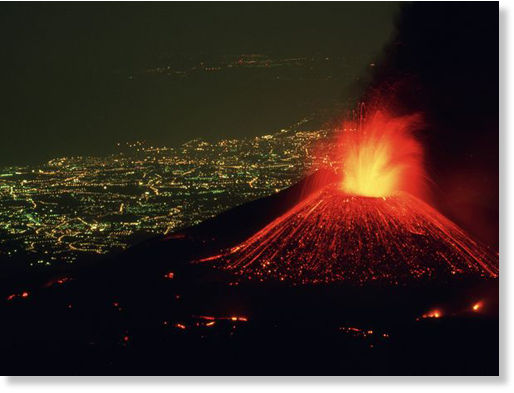
Mount Etna is spitting lava more violently than it has in years, and scientists are baffled as to why. Despite being the world's most-studied volcano, the Sicilian mountain is also its most unpredictable. The volcano is raging. Fountains of lava, some taller than the Eiffel Tower, shoot from its mouth every few weeks, flowing in red-hot streams into the surrounding valleys. There have been 13 eruptions since the beginning of February. Mount Etna, 3,329 meters (10,922 feet) high, towers majestically above the Sicilian city of Catania. In June, the United Nations Educational, Scientific and Cultural Organization (UNESCO) will decide whether to list it as a World Heritage Site. Etna is considered the most heavily studied volcano in the world, and it is thoroughly wired with sensors. In addition to lava, Etna spits out vast amounts of data - several gigabytes a day, coming from magnetic field sensors, GPS altimeters and seismic sensors.
Image
Despite this wealth of data, Etna still poses a conundrum to scientists. "The eruptions in recent weeks have been unusually fierce and explosive," reports German volcanologist Boris Behncke, who monitors the mountain together with a few hundred colleagues at Italy's National Institute of Geophysics and Volcanology (INGV). "There have been lava fountain events in the past, but rarely in such rapid succession." Behncke has fallen under Etna's spell. During the day, he maps the lava flows; at night, he hikes along its slopes. His Twitter hash tag is "@etnaboris." The volcano is the first thing he sees when he looks out of his bedroom window every morning. "This time, the range of ash fall is much wider than usual," says Behncke. A layer of black ash covers cars as far as 50 kilometers (31 miles) away.

Bizarro Earth

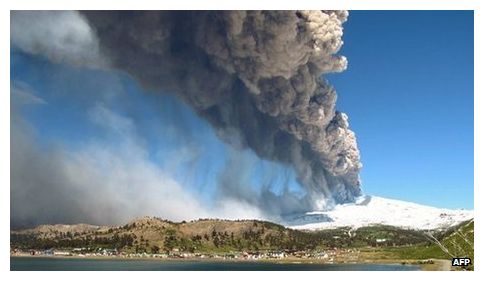
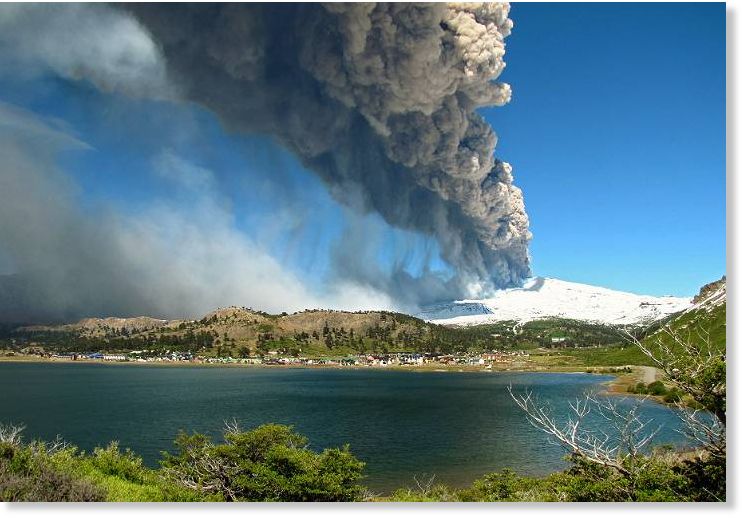
Chile volcano: Evacuation order for Copahue area

Chilean Volcano
© AFPResidents living near Copahue were also evacuated last year after the volcano erupted.
The authorities in Chile have ordered the evacuation of more than 2,000 people living near the Copahue volcano in the south of the country.

They issued a red alert - the highest possible - saying the volcano could erupt imminently.

The evacuation will affect some 460 families living within a 25km (15 miles) radius of Copahue.

The 2,965m (nearly 10,000ft) volcano sits in the Andes cordillera, on the border with Argentina.

"This red alert has been issued after monitoring the activity of the volcano and seeing that it has increased seismic activity," Interior Minister Andrew Chadwick said in a news conference.

"There is a risk that it can start erupting."

The BBC's Gideon Long, in the Chilean capital, Santiago, says that thousands of minor earth tremors have been registered in the area in recent days.

Alarm Clock

Volcanic riddle: burst in Mount Etna eruptions puzzles experts


Mount Etna is spitting lava more violently than it has in years, and scientists are baffled as to why. Despite being the world's most-studied volcano, the Sicilian mountain is also its most unpredictable.

Bizarro Earth

Chirinkotan Volcano erupts in Kuril Islands of Far East Russia as Mexico's Popocatepetl volcano unleashes another wave

The remote volcano in the northern Kuriles is probably in eruption, the latest SVERT report and satellite images suggest. A plume of gas and steam, and possibly some minor amounts ash was seen with the MODIS sensor onboard the NASA Terra satellite this morning. Satellite data also indicate that activity had likely already started in early May, because a small thermal anomaly can be traced back on archive pictures to 7 May. One should take into account that frequent dense cloud cover often prevents such observations, so activity could have started earlier than that. It is not known what kind of activity is occurring at the volcano. Possibilities include some minor explosive (strombolian ?) activity at the summit, or lava flows that might be reaching the sea and produce the steam plume observed. The last eruption of the volcano was (probably) in 2004. - Volcano Discovery

Bizarro Earth

Alert level raised on Chile's Copahue volcano to orange after ash emissions

Image
SERNAGEOMIN has raised the alert level to orange. Since May 15, a progressive increase in seismic activity as well emissions of gas and now some ash have been observed. Both earthquakes related to rock fracturing and fluid movements have picked up in numbers and possibly indicate a new magmatic intrusion on its way. This scenario is confirmed by the start of small ash emissions and glow at the crater which is visible at night. The plume of gas and ash could be seen from space by the MODIS sensor, stretching about 100 km to the southeast. Copahue volcano had already experienced a first increase of activity in December, and a second one in January. No eruption followed and alert was lowered to green in April before returning to yellow again soon after. - Volcano Discovery