
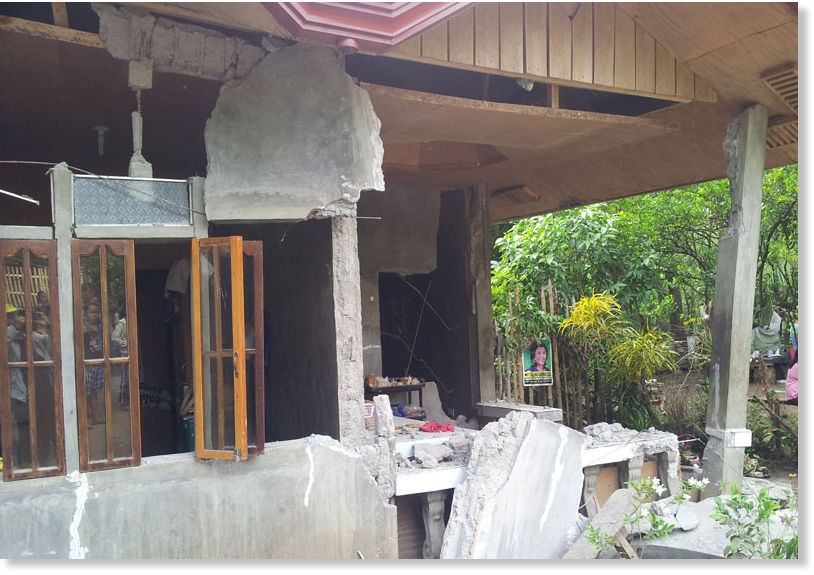
Earthquakes rattle Philippines: one of many houses in Carmen, North Cotabato damaged by the 5.7 magnitude earthquake Saturday
As of Sunday afternoon, 80 aftershocks have been recorded by Phivolcs. It was expected, De Ocampo said, but many were not felt even if it showed on their records. With the continuous tremors, affected residents wonder why no evacuation has been ordered. De Ocampo said the decision rests on the hands of the Regional Disaster Risk Reduction and Management Council and the local government unit. "We just help them (by giving our recommendations). Last Sunday, we have personnel from Phivolcs in Kidapawan City who assisted them," De Ocampo said.
Volcano awakening?
Meanwhile, De Ocampo belied claims of some residents that a new volcano was discovered in Kibudtungan village in Carmen town. Ayna Sison, a resident in the area, said Phivolcs personnel allegedly told her grandfather of a "newly found" volcano located near the site where he lives. The volcano was said to be "inverted." "My grandfather said he heard a whistling sound like gas exiting from a chamber. When the sound stopped, he said, the earthquakes happened," recounted Sison. But De Ocampo said "(T)here is no such thing. But, the area though is still within the Mt. Apo complex," she said. Phivolcs data noted there is no active fault line in the region.
But Joel Peeters, a Belgian who has lived in Davao City and has been checking the earthquakes in the country using European-Mediterranean Seismological Centre and US Geological Survey data listing, expressed that the series of quakes could "indicate that an inactive (volcano) is activating again, or forming, or that underground something is brewing." Albeit not an expert but just an observer on this matter, he said, he believes that it's "not usual" for a number of earthquakes, especially strong ones, to happen in an area not far from a sleeping volcano, which is the Mt. Apo. "Maybe the Phivolcs could check if the sleeping giant is showing signs of waking up?," he urged. Mt Apo hasn't erupted in thousands of years. - Davao Today



Reader Comments
to our Newsletter