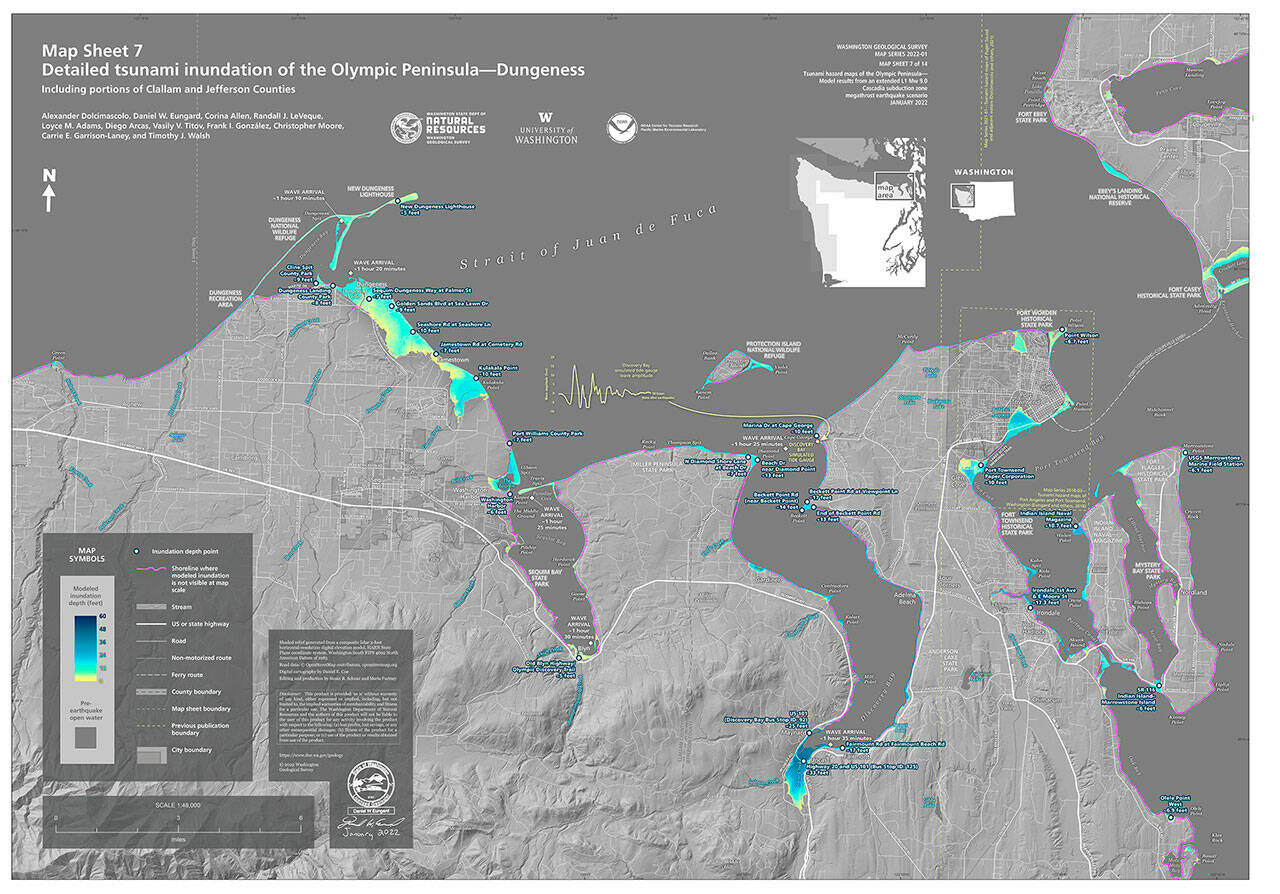
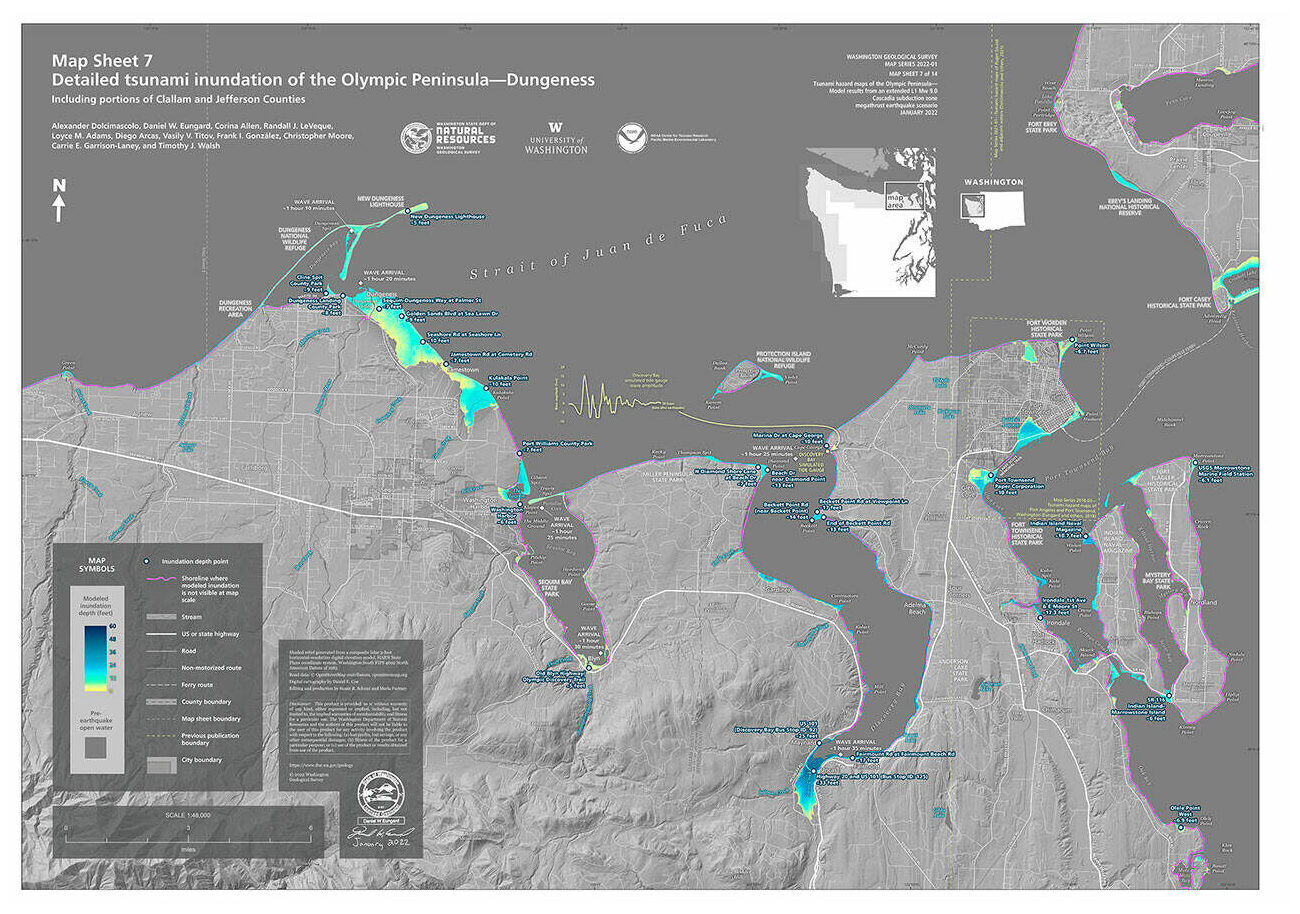
© Photo courtesy of Department of Natural ResourcesNew maps from the Department of Natural Resources show the potential flooding impact from a tsunami caused by a 9.0 earthquake along the Cascadia subduction zone.
New maps through a study by geologists with the Washington Geological Survey division of the Washington Department of Natural Resources
show that a 9.0 magnitude earthquake could be devastating to the state's coastlines and roadways, including along the entirety of the Olympic Peninsula.The new study, which became available days after the undersea volcanic eruption by Tonga on Jan. 15, uses a simulated magnitude 9.0 earthquake on the Cascadia subduction zone, according to DNR staff.
Geologists predict the first tsunami waves could reach La Push 10 minutes from the start of the earthquake, and Washington's Pacific coast in about 30 minutes.
Port Angeles would see waves about an hour from the earthquake's start, Dungeness at about 80 minutes, Miller Peninsula about 85 minutes, Blyn 90 minutes and Discovery Bay about 95 minutes.
Along the Pacific coast, flooding could reach or exceed 60 feet, geologists predict, and 100 feet at Yellow Banks Beach in Olympic National Park.
The Sequim area could see inundation of about 10 feet in Dungeness, 7 feet in Port Williams County Park, and portions of Gardiner and the Miller Peninsula, 6 feet at Washington Harbor, and 5 feet in Blyn.
Discovery Bay has the largest potential for flooding at a predicted 33 feet, which would likely block and/or destroy portions of U.S. Highway 101 and State Route 112.
Commissioner of Public Lands Hilary Franz said via press release that the "report shows what we've long known —
there won't be time for our coastal communities to react after a major earthquake, so it's vital we provide these detailed models and keep our communities safe when, not if, the next Cascadia mega-quake hits."
DNR staff said the last Cascadia rupture occurred 321 years ago, and experts estimate a 10-17 percent chance of a rupture in the next 50 years.
Geologists' model does not include tide stages or local tsunamis triggered by earthquake-induced landslides.








Comment: Notably, and possibly as a sign of an uptick in geologic activity in the region, a study of Lake Michigan published in March of 2021, using a 30-year data set of deep water measurements, found that deep water temperature there had been rising, and 'scientists don't know why'.
- Huge explosion filmed in Caspian Sea, officials speculate oil rig fire or mud volcano - UPDATE: Footage of 'new island' formed in aftermath released
- Undersea gas pipeline rupture causes fire in Gulf of Mexico
- Croatia sees gaping sinkholes emerge in area ravaged by December 2020 earthquake
And check out SOTT radio's: