Earthquakes
S


Seismograph

6.7-magnitude earthquake hits northern Mid-Atlantic Ridge: USGS

graph
An earthquake with a magnitude of 6.7 jolted northern Mid-Atlantic Ridge at 16:35:08 GMT on Tuesday, the U.S. Geological Survey said.

The epicenter, with a depth of 10.0 km, was initially determined to be at 10.819 degrees north latitude and 43.392 degrees west longitude.
Comment: Just over an hour later a 6.7-magnitude earthquake rattled Taiwan


Seismograph

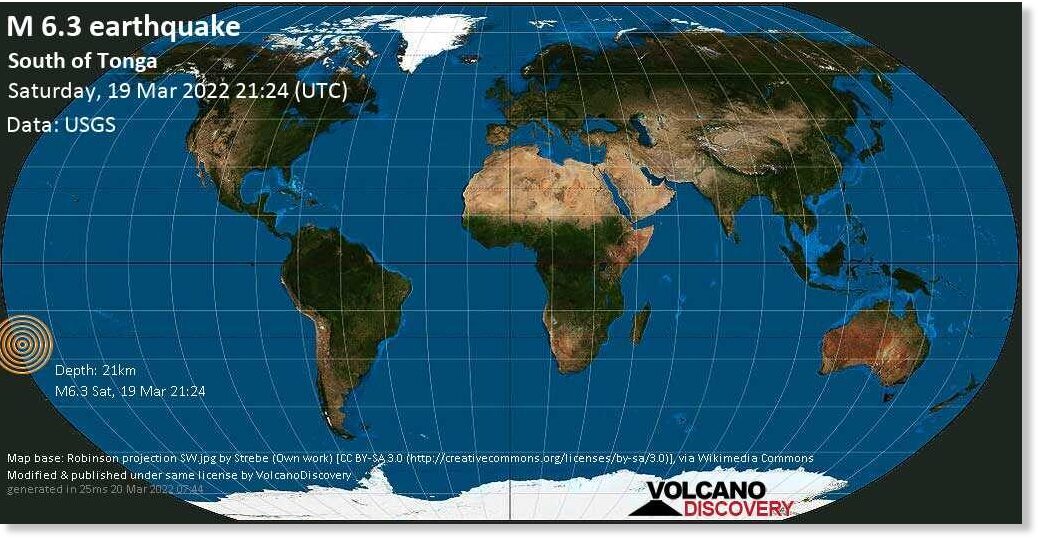
6.3-magnitude earthquake hits south of Tonga

QUAKE
An earthquake with a magnitude of 6.3 jolted south of Tonga at 21:24:17 GMT on Saturday, the U.S. Geological Survey said.

The epicenter, with a depth of 10.0 km, was initially determined to be at 25.3507 degrees south latitude and 175.9047 degrees west longitude.

Source: Xinhua

Seismograph

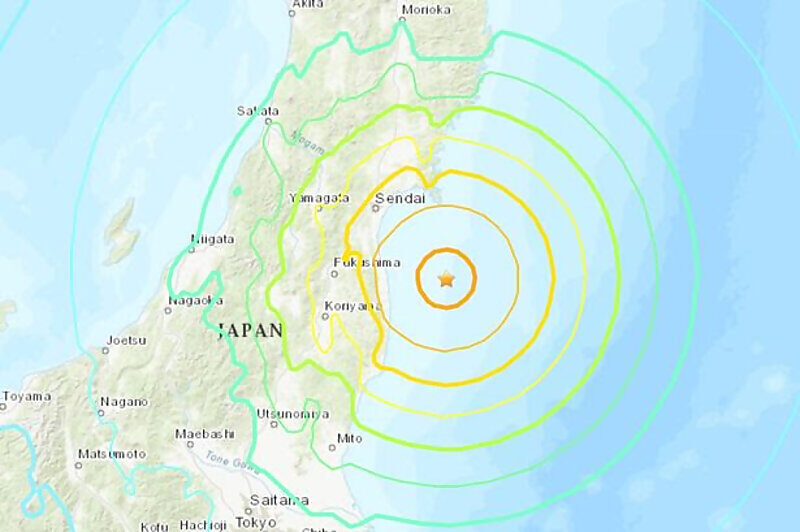
Best of the Web: 7.3 magnitude earthquake hits off north Japan, tsunami alert issued - Mag 6.4 aftershock - 2.2 million homes without electricity

Japan earthquake 2022
© USGSA 7.3m earthquake was recorded off Japan's northeast coast March 16, 2022
A powerful 7.3 magnitude earthquake struck off the coast of Fukushima in northern Japan on Wednesday evening, triggering a tsunami advisory and plunging more than 2 million homes in the Tokyo area into darkness.

The region is part of northern Japan that was devastated by a deadly 9.0 quake and tsunami 11 years ago that also triggered nuclear plant meltdowns, spewing massive radiation that still makes some parts uninhabitable.

The Pacific Tsunami Warning Center said there was no longer a tsunami threat though the Japan Meteorological Agency kept its low risk advisory in place. NHK national television said tsunami waves of 20 centimeters (8 inches) already reached shore in Ishinomaki, about 390 kilometers (242 miles) northeast of Tokyo.

NHK footage showed broken walls of a department store building fell to the ground and shards of windows scattered on the street near the main train station in Fukushima city, about 60 kilometers (36 miles) west from the coastline.


Seismograph

6.4 magnitude earthquake shakes Philippines' main island

maps
A powerful earthquake struck off the Philippines' main island Monday, jolting buildings in the capital Manila, but there were no immediate reports of damage and a tsunami warning was not issued.

The shallow 6.4-magnitude quake hit about 110 kilometres (68 miles) off Morong in Bataan province on Luzon island at 5:05 am (2105 GMT), with residents in nearby Manila woken by their buildings shaking.

Shallow quakes tend to do more damage than deep tremors, but the Philippine Institute of Volcanology and Seismology said damage was not expected.

Comment: This significant quake struck within 5 minutes of another major one off West Sumatra, Indonesia.


Seismograph

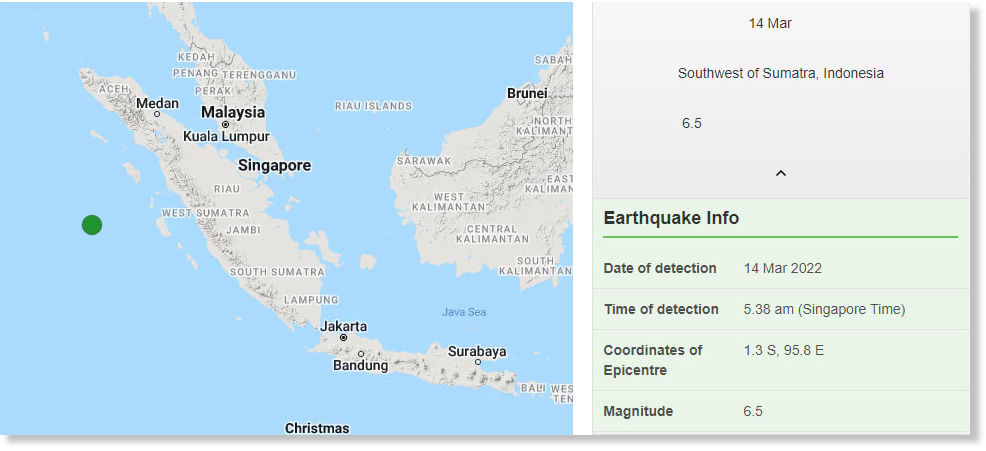
Shallow 6.7-magnitude earthquake strikes off Indonesia's Sumatra

maps
A strong quake struck off the west coast of Indonesia's Sumatra island early on Monday (March 14), sending residents fleeing from their homes, but no damage or victims were reported immediately.

The shallow 6.7-magnitude earthquake hit at 2109 GMT (5:09am, Singapore time) at a depth of 21 kilometres (13 miles), with its epicentre 167 kilometres west of the coastal city of Pariaman, the United States Geological Survey (USGS) said.

The epicentre was 197 kilometres from Padang, the capital and largest city in West Sumatra province.


Comment: Just 4 minutes before this quake struck another of similar strength hit off the Phillipines.


Seismograph

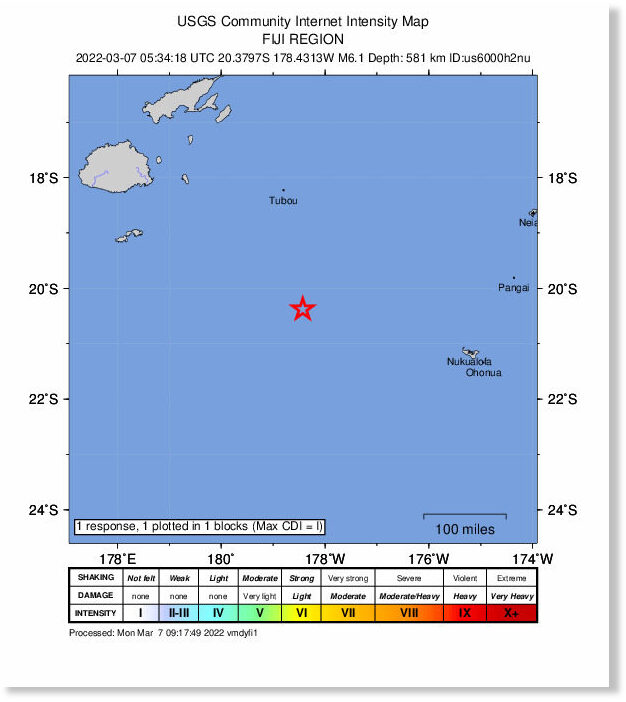
6.1-magnitude earthquake hits Fiji region - USGS

maps
An earthquake with a magnitude of 6.1 jolted Fiji region at 05:34:18 GMT on Monday, the U.S. Geological Survey (USGS) said.

The epicenter, with a depth of 581.81 km, was initially determined to be at 20.3797 degrees south latitude and 178.4313 degrees west longitude.

Bizarro Earth

Geologists unravel plate tectonic chain reaction

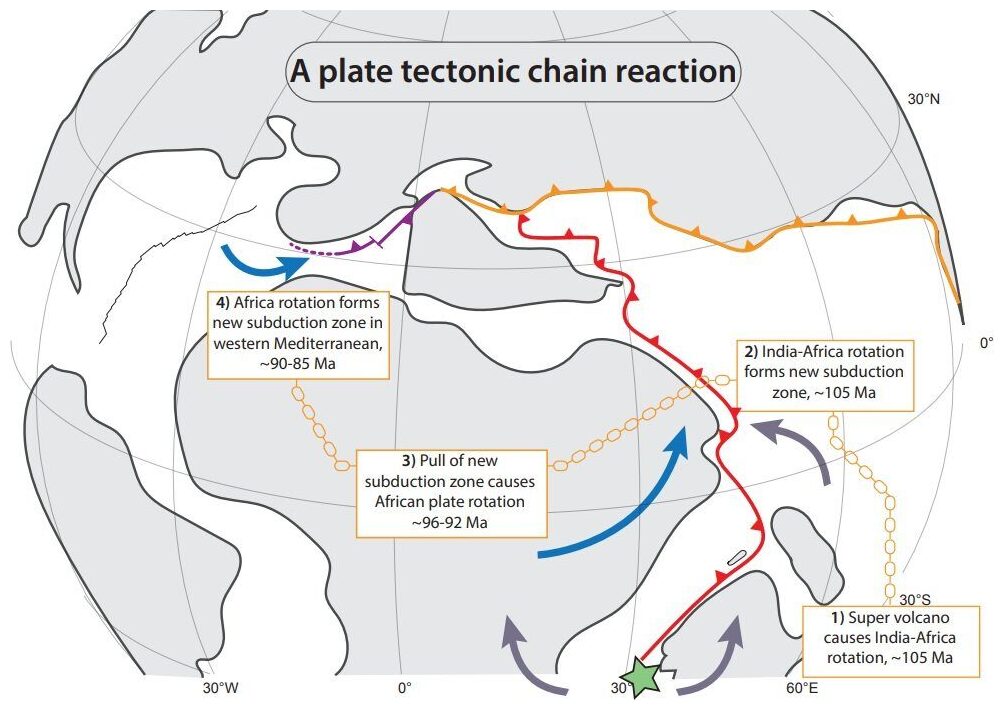
A plate tectonic chain reaction.
© Utrecht UniversityA plate tectonic chain reaction.
Geologists at Utrecht University are working hard to unravel the secrets of plate tectonics, the mechanism that continuously shapes Earth's crust and is causing earthquakes and volcanic eruptions. This time, another mystery has been dissected. In the Earth's geological past, there were 'short' periods of a few million years during which many tectonic plates around the world suddenly changed their speed and direction. What caused these abrupt changes in plate movements? Earlier research showed that changes in movement between two plates can result from continental collisions or rising mantle plumes. But could such collisions or mantle plumes set off a global chain reaction? Now geologists have succeeded in finding evidence that supports this. "With this discovery, we are able to better understand the driving forces behind plate movements, and thus processes such as mountain formation or volcanism."

This paper, published in Nature Geoscience, was a collaboration between geoscientists from Utrecht University, Australian National University, and Ben-Gurion University of the Negev. To test their hypothesis, the researchers asked themselves the following question: did the formation of a new subduction zone north of Arabia that was triggered by a mantle plume that caused a super volcano near Madagascar ~100 million years ago set off a chain reaction? Utrecht professor of plate tectonics and paleogeography Douwe van Hinsbergen, geologist, former Utrecht PhD student and first author Derya Gürer, and geophysicist Roi Granot, analysed the consequences step by step. "If our hypothesis is correct, the new subduction zone that formed north of Arabia should have caused forces that accelerated, and rotated the African Plate in the 10 million years after subduction initiation. However, to analyse this, we had to solve a major problem," says Gürer.

Seismograph

Magnitude 6.6 earthquake strikes Kermadec Islands: USGS

graph
A magnitude-6.6 earthquake struck Kermadec Islands in New Zealand on Wednesday, according to the United States Geological Survey (USGS).

The epicenter was recorded at a depth of 36.2 kilometers.

Seismograph

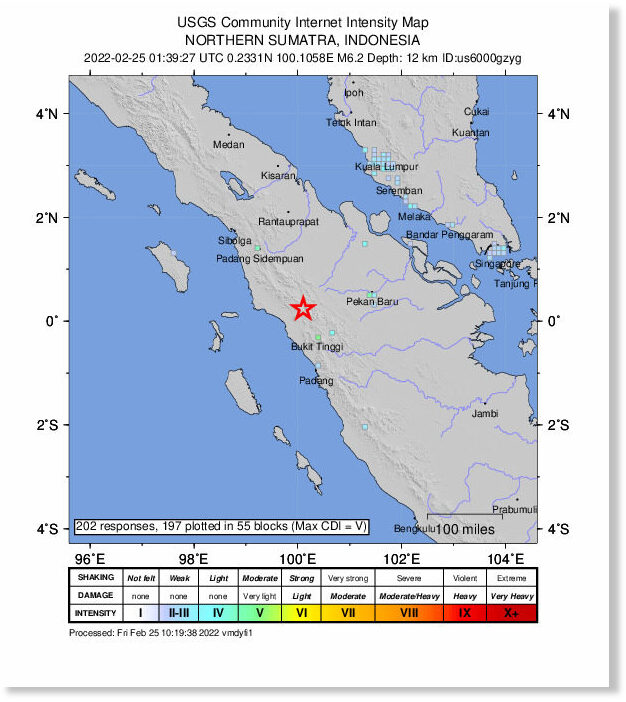
Shallow magnitude 6.2 earthquake hits Indonesia's Sumatra island, killing at least 10 (UPDATE)

maps
At least two people have died and 20 people injured in West Pasaman regency in Indonesia, following a 6.2-magnitude earthquake on Friday (Feb 25) morning, National Disaster Management Agency (BNPB) chief Suharyanto said at a media briefing.

Some buildings, including a school and a bank in the Sumatra province, have also been damaged.

The agency is sending its quick response team to Pasaman and West Pasaman regencies, two most affected regions, Mr Suharyanto added.

The quake struck Sumatra island's north at a depth of 12km, about 70km from the town of Bukittinggi in West Sumatra province, the United States Geological Survey (USGS) said.

No tsunami warning was issued, but the quake was felt in the neighbouring provinces of Riau and North Sumatra, and as far away as Singapore and Malaysia.


Comment: Update:The York Press reports on February 27:
At least 10 dead in Indonesia earthquake as search continues

Search efforts were continuing on Sunday in the hardest-hit areas of Indonesia's Sumatra island after a strong earthquake killed 10 people, injured nearly 400 others and left thousands displaced, a disaster official said.

Rescuers retrieved two more bodies late on Saturday from the rubble of homes toppled by the magnitude 6.2 earthquake that shook West Sumatra province on Friday morning, said National Disaster Mitigation Agency spokesman Abdul Muhari.

Six people died in Pasaman district and four in neighboyring West Pasaman district, he said.

Rescuers were still searching for four villagers believed to be buried under tons of mud that tumbled down from the surrounding hills triggered by the quake.

At least 388 people were injured by the earthquake,
whose tremors were felt as far away as Malaysia and Singapore, and about 42 people were still receiving treatment for serious injuries, Mr Muhari said.

More than 13,000 people fled their homes to temporary shelters, mostly in devastated areas of Pasaman and West Pasaman districts, the closest areas to the epicentre as more than 1,400 houses and buildings were damaged, he said in a statement.

Indonesia, a vast archipelago of 270 million people, is frequently struck by earthquakes, volcanic eruptions and tsunamis because of its location on the Ring of Fire, an arc of volcanoes and fault lines across the Pacific.

The last major earthquake was in January 2021 when a magnitude 6.2 quake killed at least 105 people and injured nearly 6,500. More than 92,000 people were displaced after it struck Mamuju and Majene districts in West Sulawesi province.

A powerful Indian Ocean quake and tsunami in 2004 killed nearly 230,000 people in a dozen countries, most of them in Indonesia.


Info

Searching for earthquakes in the Ionosphere

Earthquake Damage
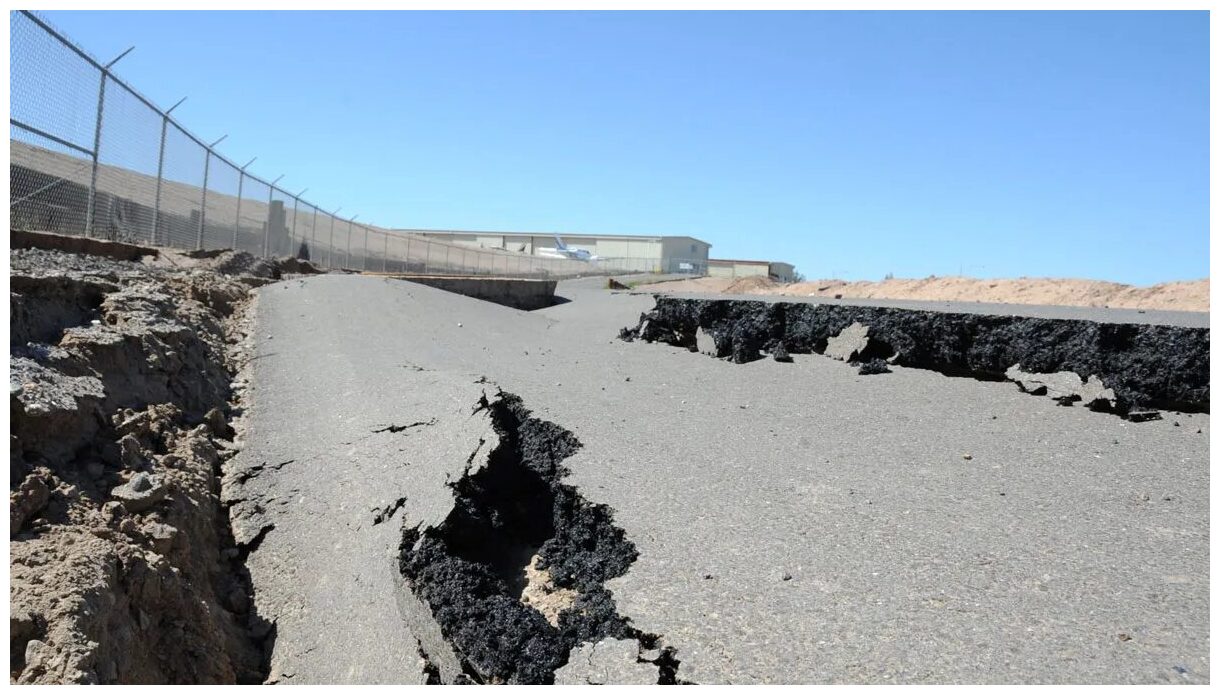
© Adam DuBrowa/FEMAA magnitude 7.2 earthquake damaged roads across northwestern Mexico and Southern California (like this one in Calexico) when it struck on 4 April 2010.
In 2010, at 40 minutes past 3:00 in the afternoon on 4 April — Easter Sunday — northwestern Mexico started to shake. A magnitude 7.2 earthquake was rattling the Baja California region, ultimately causing three deaths and more than 100 injuries. The quake caused widespread damage in the border cities of Mexicali, Mexico, and Calexico, Calif. The quake made skyscrapers sway in San Diego, more than 160 kilometers west.

The earthquake sent waves through the ground around it, but high in the atmosphere, a very different sort of perturbation might have offered a forewarning of the earthquake's impending arrival, had anyone been able to see it. Subtle fluctuations in Earth's ionosphere, a region of charged particles high above the surface, preceded the Baja earthquake, said the authors of a new paper published in Advances in Space Research. Somehow, the fault that caused the earthquake may have been telegraphing its impending rupture, sending out a rush of electrically charged particles that resonated in the ionosphere.

The ionosphere, which begins about 48 kilometers above Earth's surface and stretches to around 965 kilometers, is where incoming energy from the Sun ionizes molecules in the atmosphere, knocking off electrons. The abundance of charged particles means the ionosphere reacts to electric and magnetic fields, something other regions of the atmosphere generally do not do.

Using data from the Massachusetts Institute of Technology's Haystack Observatory on the density of electrons in the ionosphere, a team of Chinese and U.S. researchers analyzed the atmosphere above the Baja California region for 72 days both before and after the earthquake. After controlling for other things that might have been affecting the ionosphere, they said they saw a clear anomaly — a spike in the number of ionospheric electrons — on 25 March, 10 days before the earthquake. The electron spike was located over the earthquake's epicenter, and it didn't look like anything else they'd seen in the data.

We can imagine it to be something like ripples in a lake, said Chen Zhou, a researcher at Wuhan University in China and a coauthor of the paper. The electron signal looked like a brief, but telling, redistribution of particles from their normal movements and positions, one researchers were able to catch as it went by.

Zhou and his colleagues said their work could support a theory that faults release electrical energy in the days leading up to an earthquake. How exactly this happens isn't clear — some scientists think it's the result of radon gas released by a fault ionizing air molecules, whereas others hold that rocks under stress can release bursts of electrons.