Earthquakes
S


Bizarro Earth

Seismic swarm in progress between southern Cascadia and northern San Andreas Faults

San Andreas and Cascadia Faults
© Temblor
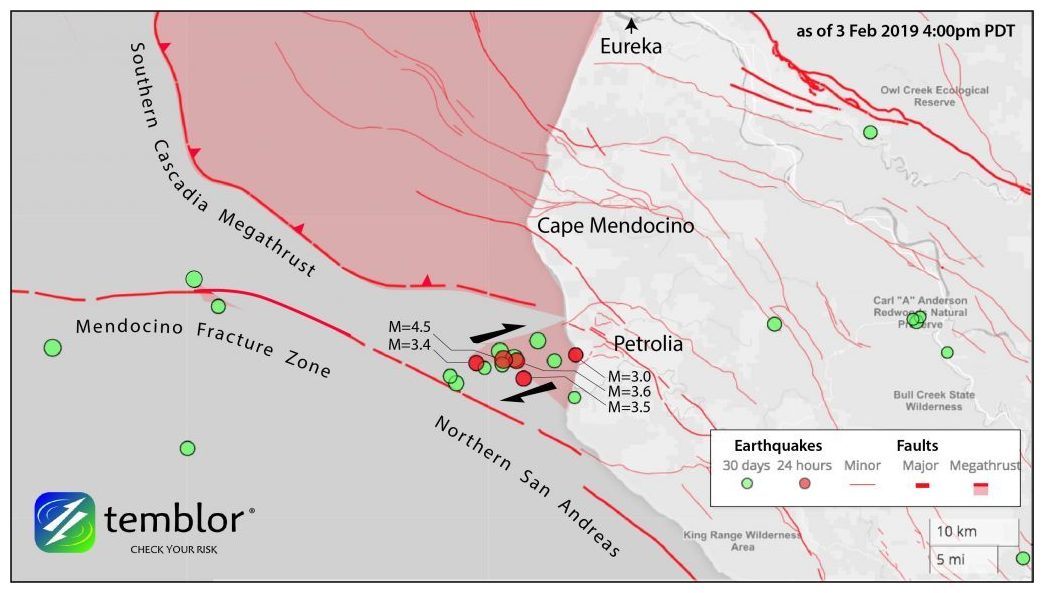
Four Magnitude-3.4 and larger quakes have struck in two hours, all south of Cape Mendocino, and west of the town of Petrolia, California. Based on the earthquake locations and their focal mechanisms (both by the USGS), the swarm appears to be occurring on a right-lateral reverse fault that connects the northernmost San Andreas-Mendocino Fracture Zone with the shallow portion of the Cascadia Megathrust (as shown by the black half- arrows in the map).

Seismograph

Powerful earthquake hits Afghanistan-Pakistan region, tremors felt in Delhi - UPDATE

earthquake afghanistan pakistan 2019
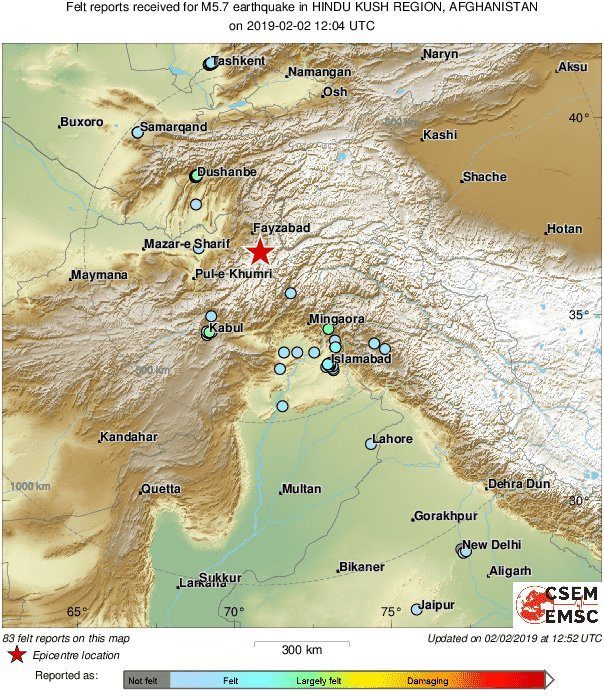
© CSEMStrong tremors were felt across North India, the first being reported from Delhi-NCR and Jammu and Kashmir's Poonch district.

A powerful 6.1 magnitude earthquake jolted Afghanistan, Pakistan and parts of North India on Saturday evening. Strong tremors were felt across North India, the first being reported from Delhi-NCR and Jammu and Kashmir's Poonch district.

The Indian Meteorological Department (IMD) said the epicentre of the quake was Hindu Kush, which is a mountain range that stretches near the Afghan-Pakistan border, from central Afghanistan to northern Pakistan.

Comment: The Hindu reports:
In Pakistan's Quetta town, one girl was killed after the roof of her house collapsed in the earthquake. Deputy Commissioner Shabir Mengal said there were also incidents in other parts of Quetta, resulting in injuries to a dozen people.

He said some villages in Balochistan province also felt the tremors. "The injured have been rushed to a nearby hospital for treatment. Emergency has been declared in all hospitals."

Rescue teams were also dispatched to the nearby Khyber Pakhtunkhwa province to assess reports of damage. However Pakistan's National Disaster Management Authority did not expect serious losses, a spokesman said.


Seismograph

Strong shallow 6.1-magnitude quake rocks western Indonesia

map quake
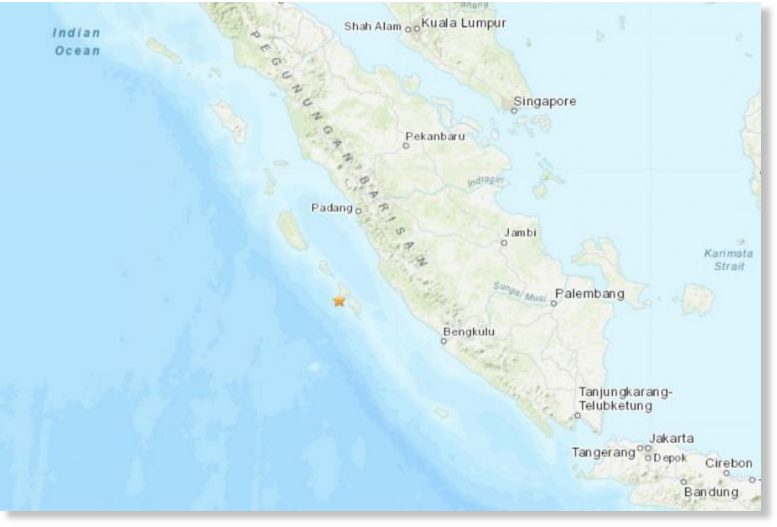
A strong 6.1-magnitude earthquake struck off the Indonesian island of Mentawai on Saturday (Feb 2), but no tsunami warning was issued.

The earthquake hit at a depth of 10km in the Mentawai island region in West Sumatra province, about 100km south-east of the town of Tuapejat and 200km south of the major port city of Padang, according to the USGS.

Officials are still assessing the impact but there were no immediate reports of damage and casualties.

"The quake was felt very strongly in Tuapejat. Our officers are still assessing the impact but so far everything is safe," said the head of Mentawai search and rescue agency Akmal, who like many Indonesians goes by one name.

Seismograph

Magnitude 6.6 quake strikes southern Mexico

earthquake
A magnitude 6.6 earthquake struck Mexico's southern state of Chiapas on Friday, the U.S. Geological Survey (USGS) said, with the quake being felt as far away as El Salvador.

An official with emergency services in Chiapas said that he felt the quake but that he did not see any immediate damage. A Reuters witness said the quake was felt in San Salvador.

The epicenter of the quake hit at a depth of 42 miles (68 km) near the Pacific coast and Mexico's border with Guatemala, according to the USGS.

There were no immediate reports of major damage in Mexico City, though some people evacuated office buildings.

Source: Reuters

Seismograph

6.2-magnitude earthquake strikes off Fiji island

earthquake
A 6.2-magnitude earthquake hit near the Pacific island nation of Fiji just before 8:00 local time (2:30 am IST) on Sunday, the US Geological Survey said.

Shortly after, the area felt another smaller tremor, which registered 5.2 magnitude.

The earthquakes hit just south of the island between Fiji and Tonga, and were detected at a depth of over 500 km.

So far, there has been no tsunami alert issued by the Pacific Tsunami Warning Center.

Source: Indo-Asian News Service

Seismograph

Earthquake: 6.2 quake strikes near Taro, Solomon Islands

earthquake
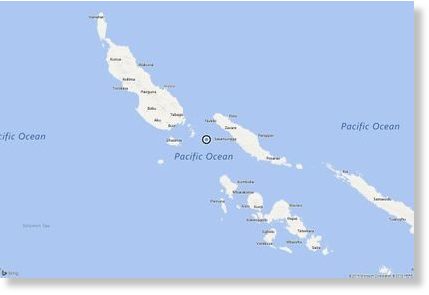
A deep magnitude 6.2 earthquake was reported Friday evening 22 miles from Taro, Solomon Islands, according to the U.S. Geological Survey. The temblor occurred at 7:51 p.m. Pacific time at a depth of 221.8 miles.

According to the USGS, the epicenter was 73 miles from Arawa, Papua New Guinea.

In the last 10 days, there have been no earthquakes of magnitude 3.0 or greater centered nearby.

This information comes from the USGS Earthquake Notification Service and this post was created by an algorithm written by the author.

map quake

Seismograph

Deep quakes reveal that magma is moving beneath an ancient German volcano

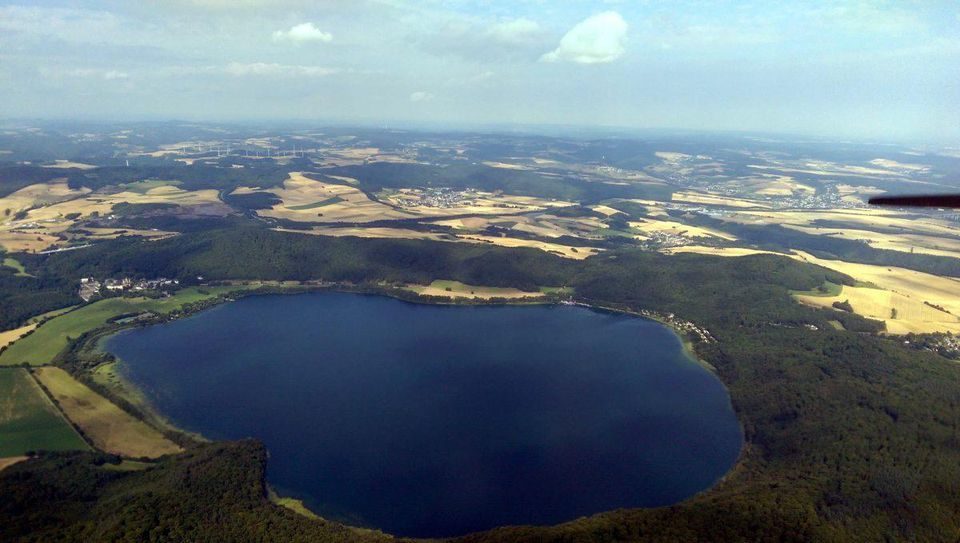
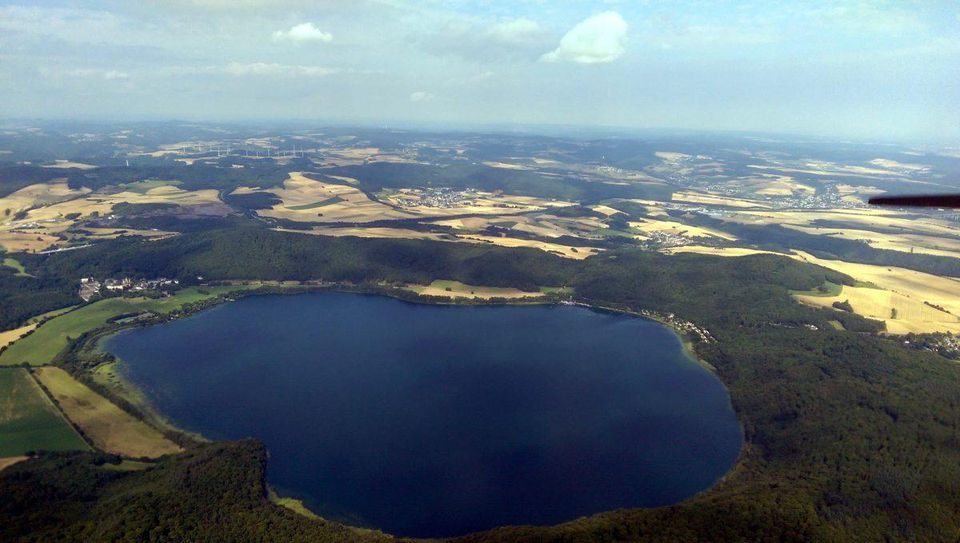
Laacher See caldera
© DF1PAW/WIKIMEDIA COMMONS; CC BY-SA 4.0Laacher See caldera, as seen today.
When it comes to active volcanoes, what country first comes to mind? Japan, perhaps? The US? What about Italy? These are all excellent examples, and understandably so. They have a wide range of fiery mountains that, at some point in the last 12,000 years, have erupted - a condition that, per the United States Geological Survey, makes them "active."

It's easy to forget that plenty of once-prolific volcanoes around the world have long fallen silent; geologically tame countries were often once replete with effusive or explosive eruptions. Just take Germany's Laacher See Volcano (LSV), found in the Eifel mountain range within the Rhineland-Palatinate state. This lake-filled cauldron ("caldera") is a rather serene site today, but it was originally forged out of fury. Around 12,900 years ago, a cataclysmic eruption, one that coated plenty of Europe in ash, was responsible for creating the crater-like edifice that we can see there today.

Make no mistake: coming in at a 6 on the Volcanic Explosivity Index (VEI), which tops out at 8, this was an unmistakably huge eruption. Today, according to Volcano Discovery, it's the only caldera in Central Europe, which means that in the last 12-13,000 years, this part of the world has never seen an eruption as powerful as the one that formed LSV.

Its days of volcanism aren't necessarily done and dusted, though. A new study, published in Geophysical Journal International, reveals that there are some curious rumblings going on beneath LSV. These specific tremors, known as deep low-frequency earthquakes, are a clear sign that magmatic fluids are on the move.

That's certainly noteworthy. The East Eifel Volcanic Field, of which LSV is part of, hasn't experienced an eruption for roughly 12,000 years, so the movement of magma beneath the surface is something that volcanologists are keen to document and comprehend.

Seismograph

USGS: 6.7-magnitude earthquake hits Prince Edward Islands region

Earthquake
© Google, EMSC, TW/SAM
An earthquake of magnitude 6.7 jolted Prince Edward Islands region at 19:01:43 GMT on Tuesday, Trend reports citing Xinhua.

The epicenter, with a depth of 10 km, was initially determined to be at 43.0778 degrees south latitude and 42.2262 degrees east longitude.

Seismograph

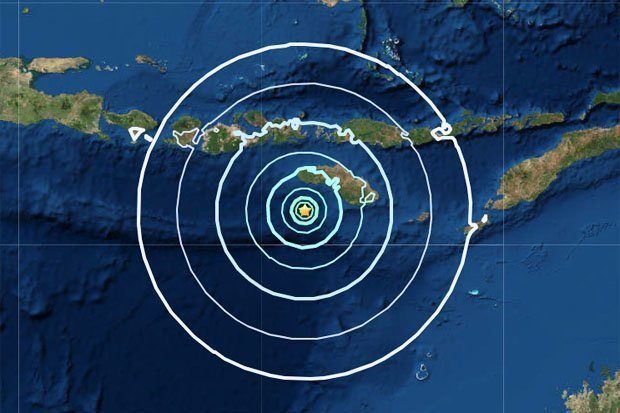
USGS: Magnitude 6.6 earthquake strikes off Indonesia's Sumbawa

Indonesia earthquake
© USGS
An earthquake of magnitude 6.6 struck south of the Indonesian town of Raba, off the central island of Sumbawa, the U.S. Geological Survey said, the second quake to hit the area on Tuesday.

There was no immediate tsunami warning or reports of damage or casualties from the quake, which hit at a depth of 36 km (22 miles), at a distance of about 230 km (143 miles) south of Raba in the east of the island, which forms part of West Nusa Tenggara province.

The quake followed one of magnitude 6 that struck in the same area.

Reporting by Clarence Fernandez; Editing by Robert Birsel

Seismograph

7.0 earthquake strikes near Anchorage, Alaska, heavy damage reported - UPDATE - Over 7,800 aftershocks

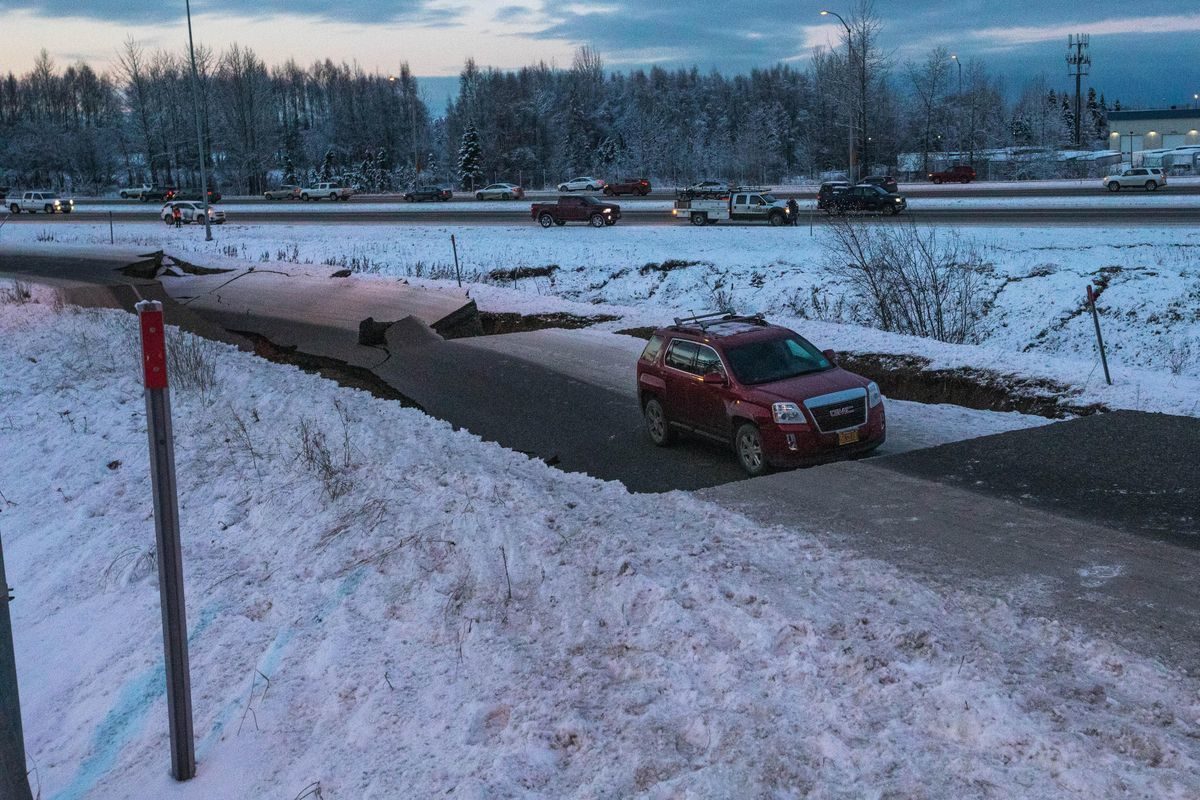
Earthquake in southcentral Alaska
© Loren Holmes/ADNThe northbound onramp for International Airport Rd. at Minnesota Blvd. collapsed Friday morning, Nov. 30, 2018 after a strong earthquake shook southcentral Alaska.
A magnitude 7.0 earthquake struck Friday morning near Anchorage, Alaska, causing widespread damage, triggering rock slides and alarming office workers who plunged under their desks.

Residents are reporting damage in the nearby areas via social media. One man tweeted a photo of his toppled chimney and a local television station showed its studio filled with debris. Former Alaska governor and vice presidential candidate Sarah Palin tweeted, saying her family is intact but her "house is not."

"This is a large earthquake and there have been numerous aftershocks," said John Bellini, a geophysicist for the U.S. Geological Survey. He said the largest aftershock was a 5.7 magnitude quake about six minutes after the big one.

The quake struck at 8:29 a.m. local time about seven miles north of Anchorage, the USGS reported. There were no immediate reports of injuries or deaths. Officials have since canceled a tsunami warning for coastal areas of southern Alaska.


Comment: UPDATE December 3rd

Anchorage Daily News reports that small aftershocks have continued with 1,800 measured between last Friday and Monday. A total of 153 measured greater than 3.0, 18 were at 4.0 or greater and five were greater than 5.0, according to the Alaska Earthquake Center.

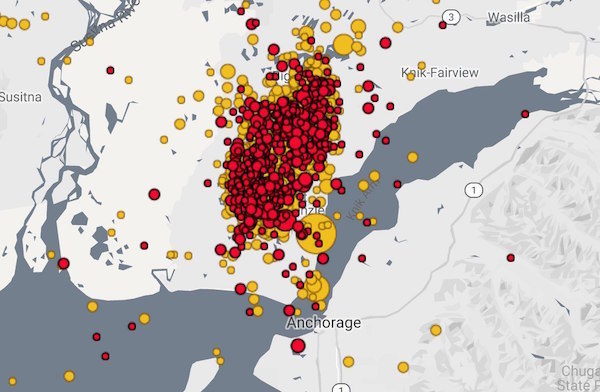
Alaska Earthquake aftershocks 11.30.18
© Alaska Earthquake Center.Earthquakes associated with Friday's 7.0 earthquake north of Anchorage as of 5:45 p.m. Sunday. The red dots represent shakes in the previous 24 hours, and the yellow dots are from the past week (with virtually all of them since Friday. The large dot directly north of the city was Friday's quake).
UPDATE January 19, 2019

Residents in Alaska are still reporting aftershocks from the event:
The latest big aftershock happened last Sunday - a magnitude 5.0 jolt that flared already frayed nerves and prompted panicky posts on social media.

That one "reminded people again that it's not over yet," said seismologist Natalia Rupert at the Alaska Earthquake Center.

There have been more than 7,800 aftershocks since the main earthquake struck 7 miles (11 kilometers) north of Anchorage, the state's most populous city. Most were too small to feel, but 20 have had magnitudes of 4.5 or greater. Rupert expects the temblors to continue for months, although the frequency has lessened, from about 200 daily to a couple dozen a day.