
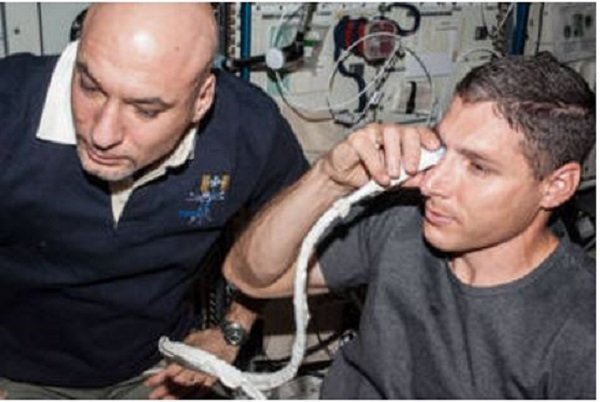
© NASANASA astronaut Michael Hopkins, performs ultrasound eye imaging in the Columbus laboratory of the International Space Station. European Space Agency astronaut Luca Parmitano assists Hopkins.
But new research presented this week provides a partial answer to what's causing this condition: pressurized spinal fluid. Noam Alperin, a researcher at the University of Miami's Evelyn F. McKnight Brain Institute, presented findings from research he and his peers conducted on 16 astronauts, measuring the volume of cerebrospinal fluid (CSF) in their heads before and after spaceflight. CSF floats around the brain and spine, cushioning it and protecting your brain as you move, such as when you stand up after lying down.
Alperin and his team found that astronauts who had been in space for extended trips (about six months) had much higher build up of CSF in the socket around the eye than astronauts who had only gone on short stints (about two weeks). They also designed a new imaging technique to measure exactly how "flat" the astronauts eyeballs had become after extended periods in space.

















Comment: See also: