Study also finds that the same genes can lead to resistance when inserted into E. coli.
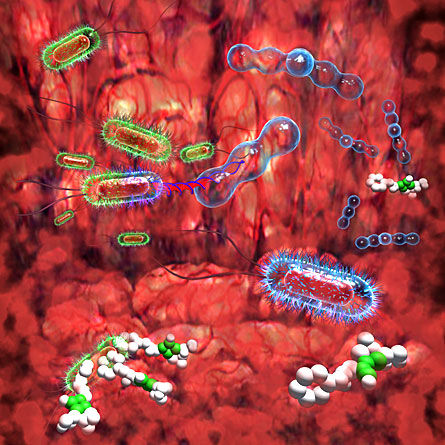
© A. Canossa, M. Sommer and G. DantasThis illustration depicts a hypothetical situation in which disease-causing bacteria (with spiky green coats) could acquire resistance to the antibiotic penicillin by exchanging DNA (red helical ribbon) with harmless bacteria living in the human gut (blue rounded chains). Penicillin (white and green balls) would have no effect on microbes with the penicillin resistance gene (spiky blue coat).
The human gut is a reservoir of antibiotic resistance. And the bacteria residing there could bequeath their gift of resistance to more harmful microbes under the right conditions, researchers report in the August 28
Science.
Researchers at Harvard Medical School have found more resistance genes in indigenous gut bacteria than were known to exist. So far, the team has identified more than a hundred new genes conferring resistance to up to 13 antibiotics. All of these genes retain that role when inserted into
E. coli bacteria, the authors say.
"This is the tip of the iceberg of what we will find when we start looking at all the bacteria in our gut that we mainly just ignore," says infectious disease physician Vincent Young of the University of Michigan in Ann Arbor.
While some bacteria in the gut help people digest food, many are considered harmless freeloaders that have "found a good seat at the table," Young says. But just as pathogens, including methicillin-resistant
Staphylococcus aureus, are developing immunities to antibiotics, the mostly harmless bacteria in the gut may be developing resistances as well.