
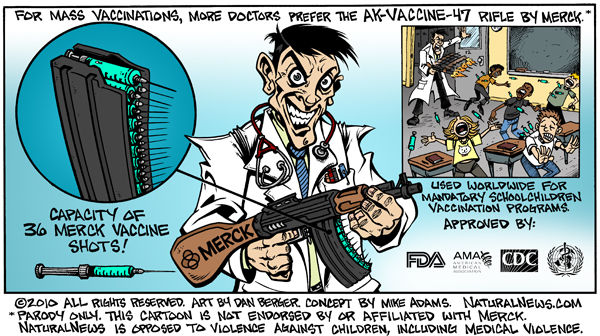
© Mike Adams/Dan Berger
This parody cartoon grew out of the idea that vaccines are "shots" that are being increasingly forced upon children and teens. At times, these vaccines are enforced at gunpoint or with the presence of vicious guard dogs -- as happened in Maryland two years ago when a court judge ordered thousands of parents to bring their children to court for vaccination or face gunpoint arrest and possible jail time.
Most modern vaccinations are, of course, a form of chemical violence against children. If they were all formulated without chemical preservatives (like thimerosal) and dangerous adjuvants (which can harm the nervous system), that might be a different story. But far too many of today's vaccines are chemical concoctions that are entirely unnatural to the human body. To force them into the bodies of innocent children is an act of medical violence.
The method of introducing the vaccines is unnatural and highly interventionist: These chemicals and DNA / RNA fragments are injected directly into the tissues and blood, bypassing the skin (a normal protective defense) and bypassing the digestive system, too. An injected mandatory vaccine dumps foreign material directly into the bloodstream of children without the consent of either the child or the parents -- that's what qualifies mandatory vaccines as "chemical violence" against children.





Comment: Our modern diet and toxic environment has a key role in producing the inflammation which is the common denominator in chronic diseases including Parkinson's disease. So instead of taking anti-inflammatory drugs with side effects like ibuprofen, it is best to go directly to the root problem, choosing anti-inflammatory foods and detoxifying our bodies. Taking drugs which don't deal with the root problem is not the solution. For more information, please visit our diet and health forum.