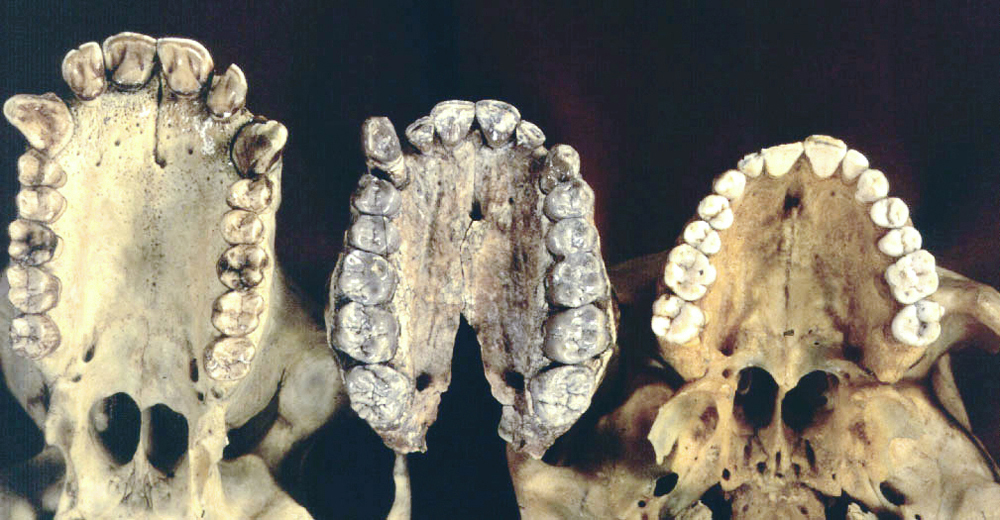
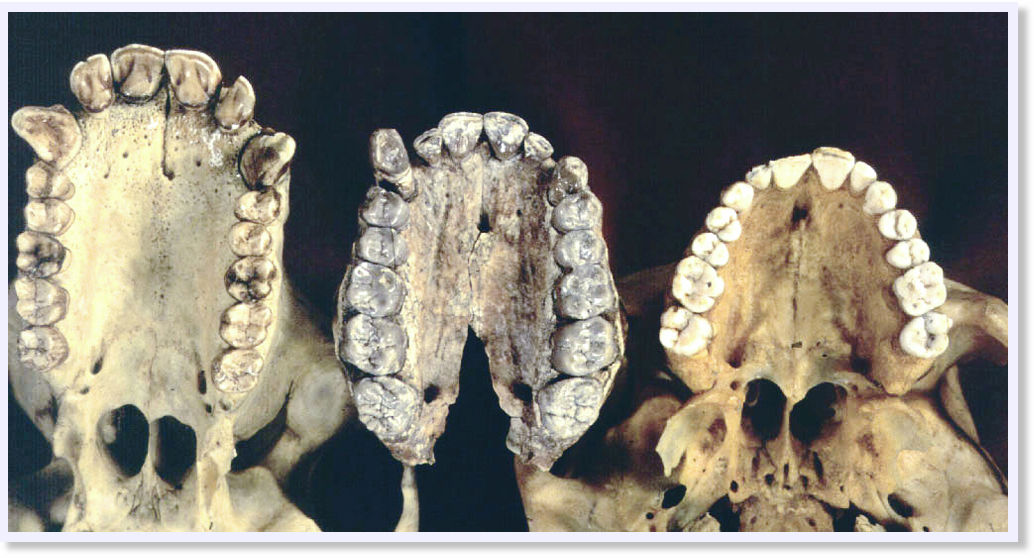
© William Kimbel/Institute of Human OriginsOm Nom Nom: As we began to shy away from eating primarily fruit, leaves and nuts and began eating meat, our brains grew. We developed the capacity to use tools, so our need for large, sharp teeth and big grinders waned. From left, a cast of teeth from a chimpanzee, Australopithecus afarensis and a modern human.
Our earliest ancestors ate their food raw - fruit, leaves, maybe some nuts. When they ventured down onto land, they added things like underground tubers, roots and berries.
It wasn't a very high-calorie diet, so to get the energy you needed, you had to eat a lot and have a big gut to digest it all. But having a big gut has its drawbacks.
"You can't have a large brain and big guts at the same time," explains Leslie Aiello, an anthropologist and director of the Wenner-Gren Foundation in New York City, which funds research on evolution. Digestion, she says, was the energy-hog of our primate ancestor's body. The brain was the poor stepsister who got the leftovers.
Until, that is, we discovered meat.
"What we think is that this dietary change around 2.3 million years ago was one of the major significant factors in the evolution of our own species," Aiello says.
That period is when cut marks on animal bones appeared - not a predator's tooth marks, but incisions that could have been made only by a sharp tool. That's one sign of our carnivorous conversion. But Aiello's favorite clue is somewhat ickier - it's a tapeworm. "The closest relative of human tapeworms are tapeworms that affect African hyenas and wild dogs," she says.
So sometime in our evolutionary history, she explains, "we actually shared saliva with wild dogs and hyenas." That would have happened if, say, we were scavenging on the same carcass that hyenas were.
But dining with dogs was worth it. Meat is packed with lots of calories and fat. Our brain - which uses about 20 times as much energy as the equivalent amount of muscle - piped up and said, "Please, sir, I want some more."









Comment: For more information on the dangers of dairy, read this SOTT article:
Speaking out against dairy