Health & WellnessS


Pills

Why antidepressants are simply a confidence trick: A leading psychologist claims taking sugar pills would work just as well

Image
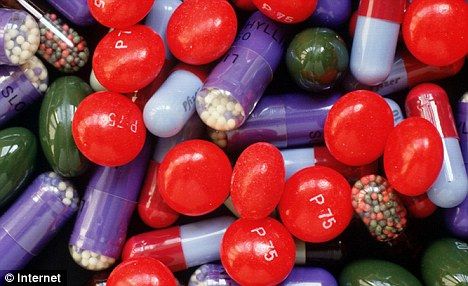
Happy pills: We spend millions every year on antidepressants but they don't work any better than placebos.
We spend more than £250 m a year on antidepressants in the UK - and it's a complete waste of money.

They are not much better than sugar pills, they have nasty side - effects, such as sexual dysfunction, and they increase young people's risk of suicide.

New research shows they don't even work on the brain in the way we thought they did.

Attention

The Dark Side of Vitaminwater

Image
© Getty
Now here's something you wouldn't expect. Coca-Cola is being sued by a non-profit public interest group, on the grounds that the company's vitaminwater products make unwarranted health claims. No surprise there. But how do you think the company is defending itself?

In a staggering feat of twisted logic, lawyers for Coca-Cola are defending the lawsuit by asserting that "no consumer could reasonably be misled into thinking vitaminwater was a healthy beverage."

Does this mean that you'd have to be an unreasonable person to think that a product named "vitaminwater," a product that has been heavily and aggressively marketed as a healthy beverage, actually had health benefits?

Health

Consumer interest in health and wellness on the rise

Consumers are continuing to increase spending on products for health and wellness - with a renewed focus on whole foods as a foundation, according to a new report from the Hartman Group.

"More than ever, consumers view fresh, real and clean food as the foundation for health and wellness," the market research organization reported.
"Consumers believe that a fresh, real and clean diet is the first step to treating and preventing disease, supporting vitality and mental energy."
The organization carried out an online survey involving 2744 respondents to find out about US consumers' attitudes toward health and wellness, their sources of information, and triggers for changing behaviors. It found that the average household spends $148.48 a month - or 19 percent of all monthly spending - on categories that have a 'wellness halo'.

Attention

Genetically Modified Salmon Present a Number of Risks to Consumer Health and Environment

Image
© corporatecrime.wordpress.com
Statement from Wenonah Hauter, Executive Director, Food & Water Watch

"As rumors swirl that the Food and Drug Administration (FDA) may allow the sale of genetically modified (GM) salmon to consumers, flaws in the review process surrounding this controversial disruption to the natural food chain are coming into focus. The FDA, which has been tasked with overseeing the public's health, could approve the divisive science experiment as early as this fall - a decision that consumers strongly oppose. If approved, the salmon would represent the first genetically modified animal sold as food to unsuspecting consumers (currently, there are no labeling requirements in place to assist consumers in identifying and avoiding GM foods)."

"Unfortunately, many in the aquaculture industry seek to genetically engineer fish to speed up production of their product. In this case, the company lobbying the FDA for approval, AquaBounty Technologies, wants to combine salmon genes that control growth hormone with a gene from another fish, the ocean pout. The ocean pout gene would keep the growth hormone in production, effectively creating mutant salmon that grow at twice the normal rate."

Arrow Up

Woman finds cancer cure in dairy-free diet based on anti-cancer plants

Image
© PACould a special diet help to keep cancer in remission?
Professor Jane Plant is an eminent geologist. In 1987, aged 42, and with two young children, she was diagnosed with breast cancer for the first time. Five years later the cancer returned four times - and, as she explains in her book Your Life in Your Hands, this was "despite a radical mastectomy, three further operations, 35 radiotherapy treatments, several chemotherapy treatments and irradiation of my ovaries to induce the menopause". The doctors gave her three months to live.

Last week I met Jane and she explained to me - in very unscientific terms - how it is that she has been cancer-free since 1992. At the time she discovered the last cancerous lump in her neck, colleagues in China - where she had worked - happened to send her an atlas detailing the different cancers found across that country. Looking at it, she realiszd that breast cancer (and prostate cancer) were virtually unknown throughout China at that time - one death in 100,000 women, as opposed to one in 10 in some western countries. Why should that be?

Cow

Are Kids' ER Visits for Food Allergies on the Rise?

Children's visits to the emergency room for serious food-allergy reactions may be on the rise, if the experience of one major U.S. medical center is an indicator.

Researchers at Children's Hospital Boston found that the number of food-induced allergic reactions treated in their ER more than doubled over six years -- from 164 cases in 2001, to 391 in 2006.

There was an even sharper increase in the number of more serious, and sometimes life-threatening, reactions known as anaphylaxis. Signs and symptoms of anaphylaxis include skin reactions like hives and flushed or pale skin; nausea, vomiting or diarrhea; dizziness or fainting; difficulty breathing; and a sudden drop in blood pressure that can lead to shock.

In 2001, the current study found, there were 78 cases of food-induced anaphylaxis; in 2006, that number was 207.

Book

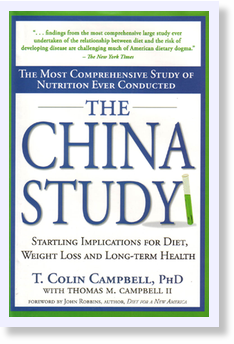
The Truth About the China Study

Image
© Wikipedia
(This review was authored by Chris Masterjohn. A version of it was originally published in Wise Traditions, the quarterly journal of the Weston A. Price Foundation. The review is copyrighted by the WAPF, which allows the non-commercial reproduction of its material providing due credit is given.)

"Eating foods that contain any cholesterol above 0 mg is unhealthy." -- T. Colin Campbell, The China Study

It was growing up on one of the many dairy farms of the rural American landscape, long before the China Study had taken place, and yet longer before the book was written, that the young T. Colin Campbell formed the views that would shape the early portion of his career.

Cow's milk, "Nature's most perfect food," was central to the existence of his family and community. Most of the food that Campbell's family ate they produced themselves. Campbell milked cows from the age of five through his college years. He studied animal nutrition at Cornell, and did his PhD research on ways to make cows and sheep grow faster so the American food supply could be pumped up with more and more protein.1

Fast forward to the present. Campbell is now on the advisory board of the Physician's Committee for Responsible Medicine,2 which describes itself as "a nonprofit organization that promotes preventive medicine, conducts clinical research, and encourages higher standards for ethics and effectiveness in research,"3 but whose opposition to the use of animal foods reflects its ties to People for the Ethical Treatment of Animals (PETA) and other animal rights groups.4

Health

The Deadly Neurotoxin Nearly EVERYONE Uses Daily (VIDEO)

By 1984, three years after its initial approval for use in tabletop sweeteners and dry food, U.S. consumption of aspartame had already reached 6.9 million pounds per year. This number doubled the following year, and continued to climb well into the 90's.

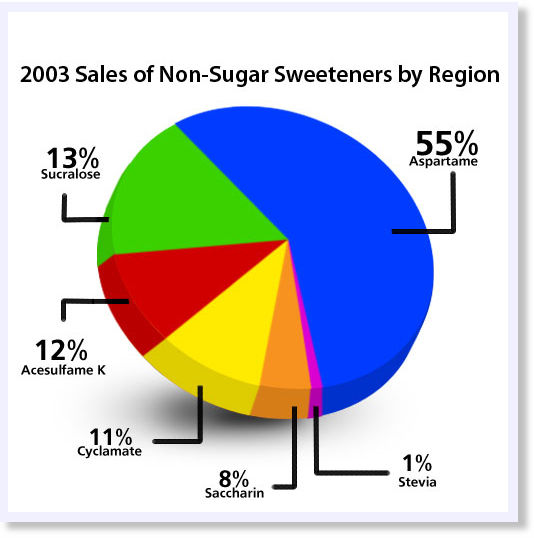
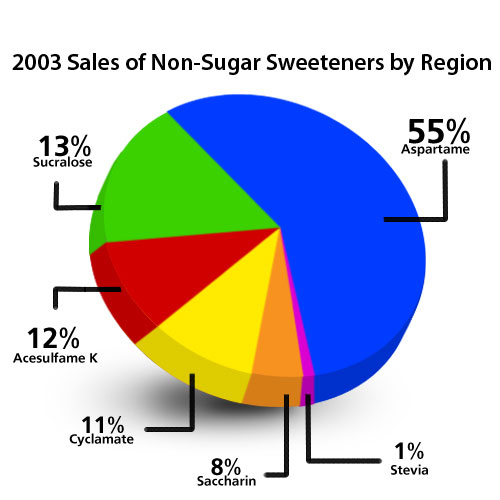
According to statistics published by Forbes Magazine [i] based on Tate & Lyle estimates, aspartame had conquered 55 percent of the artificial sweetener market in 2003. One of the driving factors behind aspartame's market success is the fact that since it is now off patent protection, it's far less expensive than other artificial sweeteners like sucralose (Splenda).
Image
© Unknown
Today, the statistics on the aspartame market are being kept so close to the vest, it has proven to be virtually impossible to find current data on usage, unless you're willing to pay tens of thousands of dollars for a market analysis reports and I felt there were better uses for the money than to purchase the answer to that question.

However, a 2009 FoodNavigator article[ii]cites the current global market for aspartame as being less than 37.5 million pounds and worth $637 million.

According to aspartame.org [iii], diet soda accounts for 70 percent of the aspartame consumed. A 12 ounce can of diet soda contains 180 mg of aspartame, and aspartame users ingest an average of 200 mg per day.

However, it can be quite difficult to calculate just how much you're really ingesting, especially if you consume several types of aspartame-containing foods and beverages. Dosing can vary wildly from product to product. For example, the amount of aspartame will vary from brand to brand, and from flavour to flavour. Some can contain close to twice the amount of aspartame as others, and some contain a combination of aspartame and other artificial sweeteners.

Health

Breast Milk Sugars Give Infants a Protective Coat

A large part of human milk cannot be digested by babies and seems to have a purpose quite different from infant nutrition - that of influencing the composition of the bacteria in the infant's gut.

The details of this three-way relationship between mother, child and gut microbes are being worked out by three researchers at the University of California, Davis - Bruce German, Carlito Lebrilla and David Mills. They and colleagues have found that a particular strain of bacterium, a subspecies of Bifidobacterium longum, possesses a special suite of genes that enable it to thrive on the indigestible component of milk.

This subspecies is commonly found in the faeces of breast-fed infants. It coats the lining of the infant's intestine, protecting it from noxious bacteria.

Infants presumably acquire the special strain of bifido from their mothers, but strangely, it has not yet been detected in adults. "We're all wondering where it hides out," Dr. Mills said.

The indigestible substance that favors the bifido bacterium is a slew of complex sugars derived from lactose, the principal component of milk. The complex sugars consist of a lactose molecule on to which chains of other sugar units have been added. The human genome does not contain the necessary genes to break down the complex sugars, but the bifido subspecies does, the researchers say in a review of their progress in today's Proceedings of the National Academy of Sciences.

Health

Wichita Child Hospitalized After Drinking Too Much Milk

Jay Armstrong says it started with a cough and a visit to the doctor.

"Immediately recognized he was pale," says Armstrong.

His two year old son, Richard, was sick but the doctor asked Armstrong a question he wasn't expecting.

"Does he drink a lot of milk?"

Right away the doctor knew what was wrong. Richard had iron deficiency anemia and his heart was failing.

"When I went to Dr. Springer, within 30 minutes he was telling me to put my son in the car and go to the hospital."

Richard was drinking too much milk. Doctors say cow's milk is loaded with protein that absorbs iron. Drink too much and kids can become anemic.

Two year old Richard was drinking about 40 ounces a day. Doctors says a child his age should only be drinking about half that.

It's advice Armstrong hadn't heard until his son got sick.