Earth ChangesS


Snow Globe

Sunspots and the great cooling ahead

Image
Presumably, even among the ill-informed ideologues at the White House, there are a few who have heard of sunspots. There may even be one who knows, as most informed persons do, of the correlation between sunspot activity and the earth's climate. But apparently no one has bothered to inform the president.

When sunspot activity is high, as it was during the 1990s and early 2000s, temperatures tend to be high as well. When it is low, as it is now, temperatures fall. And because sunspot activity occurs in decades-long cycles, the unusually cold winter and spring of 2012 may be just the beginning. As a Barron's article recently noted, current sunspot activity is now the least it has been in a century.

What this means is that the era of global cooling has begun. In the northern hemisphere, three out of the four last winters and springs have been unusually cold. This spring was so cold in East Asia that China was forced to import millions of tons of grain and soybeans from the U.S. and other suppliers.

Cloud Lightning

Storms in Quebec, Ontario leave thousands without power

High winds blamed for death of a 21-year-old woman at Boucherville, Que., swimming pool.

High winds caused by storms that swept through parts of southern Ontario and Quebec are being blamed for the death of 21-year-old woman and the loss of power to hundreds of thousands of people in both provinces.


A 21-year-old woman died after she was struck by a falling tree branch at pool in Boucherville, Que., on Montreal's south shore. Two other people were hurt - a 6-year-old boy and a 40-year-old woman.

By midnight, about 400,000 customers in Quebec were still without power in the wake of severe storms that passed through the province. High winds and falling tree branches are to blame for the outages, Louis Olivier Batty, a spokesperson with Hydro-Québec, said earlier Friday.

Eagle

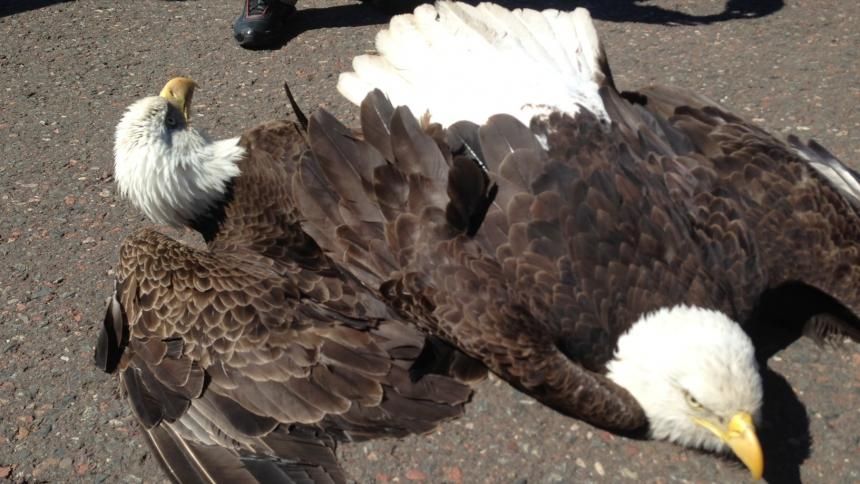
Eagle rescued from Duluth airport tarmac, rehabbed, found dead

Image
Duluth -- Talk about tough luck.

A bald eagle was found dead along the St. Louis River on Monday evening, ensnared in fishing line. That was its second unfortunate experience this year.

The bird was one of the two eagles that were found with their talons entangled May 12 when they crashed to the tarmac at the Duluth International Airport.

Mike Schrage, wildlife biologist for the Fond du Lac Band of Lake Superior Chippewa, said one of the band's conservation officers found the dead eagle Monday evening just south of the U.S. Highway 2 bridge over the St. Louis River near Brookston.

"Judging from the condition of the carcass, it had been dead for two or three days," Schrage said.

When Schrage received the bird, it was wearing a band on one leg. Schrage called the band number in to the U.S. Fish and Wildlife Service Bird Banding Laboratory at Patuxent, Md. He confirmed the bird was one of the two that had been found at the airport in Duluth on May 12. The bird involved in the fishing-line incident had been treated at the Raptor Center in St. Paul, banded and released June 12 at the Carpenter Nature Center in Hastings, Minn.

"It made a beeline back to where it had come from," Schrage said.

Attention

China may become top wheat importer after crops ruined

Image
China's wheat crop has suffered more severely than previously thought from frost in the growing period and rain during the harvest, and import demand to compensate for the damage could see the country eclipse Egypt as the world's top buyer.

Interviews with farmers and new estimates from analysts have revealed weather damage in China's northern grain belt could have made as much as 20 million metric tons (22.05 million tons) of the wheat crop, or 16 percent, unfit for human consumption. That would be double the volume previously reported as damaged.

Higher imports, which have already been revised upwards on initial damage reports, will further shrink global supplies and support prices, fuelling new worries over global food security.

The U.S. Department of Agriculture on Thursday raised its forecast for China's imports in 2013/14 to 8.5 million metric tons from 3.2 million metric tons in the previous year, prompting U.S. wheat prices to rally to more than two-week highs.

Sun

Heatwave: city centre road melts and wildfires blaze across Britain

With wildfires spreading across the country and even some roads melting, the death toll from Britain's heatwave continues to rise.


A 15-year-old boy is thought to have drowned in a river in the latest heatwave water death.

The teenager was airlifted to hospital after the incident in Roe Valley Country Park near Limavady, Northern Ireland, yesterday afternoon, but died in hospital.

It takes the death toll of water-related deaths to 14 since Britain's longest heatwave for seven years began.

According to Public Health England, 650 people died in the hot weather from July 6 to July 14, with more deaths likely to have added to that tally in recent days.

Cloud Lightning

More heat, drought and floods in 2013 as weather becomes more extreme year after year

Image
The U.S. government continues to see more extreme weather year after year

Global average temperatures in June were the fifth highest on record, as above-average heat conditions continued a multidecade streak, the National Oceanic and Atmospheric Administration reported yesterday.

June marked the 340th consecutive month -- a span of time more than 28 years -- that global temperatures surged above the 20th century average, according to the agency.

"The last below-average June temperature was June 1976 and the last below-average temperature for any month was February 1985," NOAA said in a release.

At the same time, it is too early to determine whether the stifling heat wave bringing misery to much of the eastern United States for the past week is unusual.

"This heat wave is still unfolding, so it's kind of hard for us to put it into a perspective of past heat waves," said Jake Crouch, a climatologist at NOAA's National Climatic Data Center.

Sun

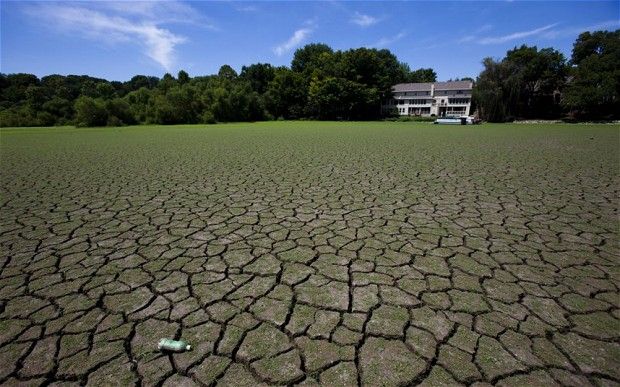
Great American drought of 2012-2013 grows for fifth week straight

Image
US Drought Map as of July 16, 2013, released by US Drought Monitor on July 18, 2013.
U.S. drought conditions expanded for the fourth week in a row as dryness persisted in the western half of the country, including key crop states of Kansas and Nebraska, while conditions in the South reached their driest in two months, according to a weekly drought report.

In contrast, the eastern half of the United States remained out of drought, given steady summer rains and cool temperatures.

The U.S. Drought Monitor, issued by state and federal experts, said on Thursday that drought areas in the "moderate to exceptional" range reached 44.85 percent, up from 44.06 percent a week ago.

"Dry conditions persisted across most of the southern Great Plains and Lower Mississippi River Valley," the online U.S. Drought Monitor said.

While temperatures there were still generally below normal for the week, they were still warm, it said. "Accordingly, the coverage of drought conditions was increased across the Southern Great Plains."

Comment: Although the above Reuters article describes the drought's growth entering its 4th week, it has since entered its 5th week...

U.S. Drought Expands for 5th Straight Week


Info

Monsanto gives up on new GM crops grown in EU

Faced with widespread concerns in Europe over its genetically modified foods, US agro-chemicals giant Monsanto said Thursday it was giving up on plans to grow new GM crops in the EU, which has held up approval for years.

"We will no longer be pursuing approvals for cultivation of new biotech crops in Europe," Monsanto said, adding that it would now focus on its conventional seeds business.

The European Commission, the EU's executive arm, said it "took note of the decision" by Monsanto which produces a whole stable of GM crops and in wide use in the United States and elsewhere.

In Europe, however, suspicion about the use of GM food products is widespread, with many fearing their use is a health hazard.

Bizarro Earth

New Zealand shaken by dozens of earthquakes in 24 hour period

Image
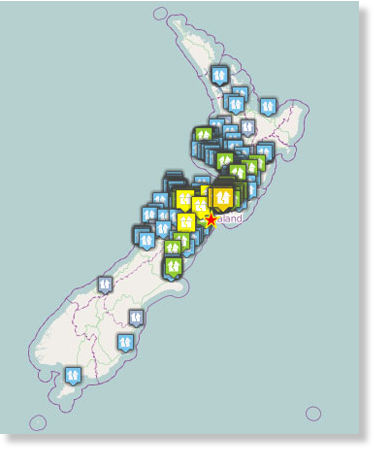
© GeonetThis Geonet map shows quake felt reports across New Zealand. Yellow is strong, green is moderate and blue is light.
A 4.3 quake hit the east coast of New Zealand tonight, following a 4.5 magnitude quake in central New Zealand this afternoon, and a 5.7 earthquake that rattled people in Wellington and Blenheim this morning. Geonet reported tonight's quake was 20 km east of Te Araroa, a settlement on the east coast of the north island, near the southern edge of the Bay of Plenty. The quake was 62 km deep and hit at 11.42pm. GeoNet reported this afternoon's was of a "strong" intensity, 35 km east of Seddon, at a depth of 15 km. The quake hit at 3.21pm.

The first quake struck at 9.06 am and was centered 30km east of Seddon, south of Blenheim, at a depth of 8 km. Rated as severe, it turned Wellington office workers white-knuckled as it swayed high-rises in the capital, with buildings also being rocked in Blenheim. The shallow tremor was felt as far away as Christchurch and New Plymouth. In Wellington it was felt as one jolt, gradually picking up in intensity, while those in Blenheim felt two shakes. GeoNet said it received more than 6000 reports after the jolt. It said the fact it struck off the South Island spared the region from its full force, though there were a few reports that it had a damaging intensity.

Question

Woman recovering after 'vicious' OTTER attack in West Yellowstone, Montana

Image
Shock: Sydney Sainsbury describes the 'terrifying' and 'unprovoked' otter attack
Otters have the popular reputation of being kind, playful and friendly animals, but one Montana woman found to her painful cost that this is not necessarily the case.

Sydney Sainsbury of West Yellowstone was 'viciously' attacked by an otter on July 9, leaving her needing serious medical attention, including an arm brace and eight stitches to her head.

Sainsbury was tubing on the Madison River when she says she saw the animal about 20 feet away. She says that the animal then launched a sudden and unprovoked attack.