Earth ChangesS


Nuke

Highly radioactive water leak discovered at Fukushima, Tepco says

Fukushima
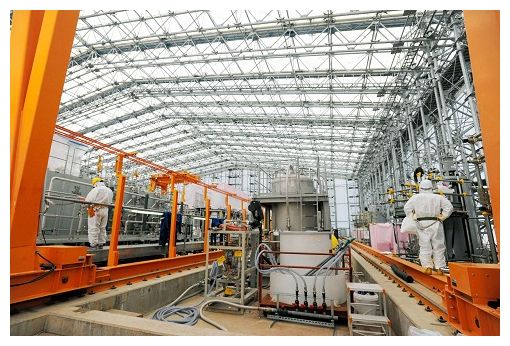
© ReutersTepco said a new leak of 100 tonnes of highly radioactive water has been discovered at Fukushima.
A new leak of 100 tonnes of highly radioactive water has been discovered at Fukushima, the plant's operator said on Thursday after it revealed only one of nine thermometers in a crippled reactor was still working.

The toxic water is no longer escaping from a storage tank on the site, said a spokesman for Tokyo Electric Power, adding it was likely contained, but the news is a further blow to the company's already-battered reputation for safety.

"As there is no drainage way near the leak, which is in any case far from the ocean, it is unlikely that the water has made its way into the sea," he said.

The tank, one of hundreds at the site that are used to store water contaminated during the process of cooling broken reactors, sits around 700 metres from the shore.

However, the water was highly radioactive, with a beta radiation reading "at 230 million becquerel per litre", he said.

Igloo

Warning signs heralded Korean resort tragedy

Collapsed Roof
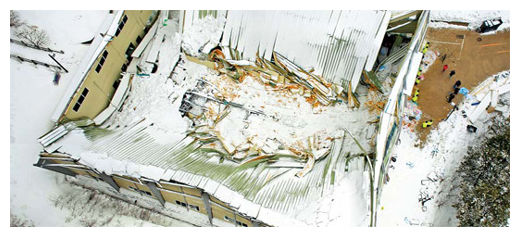
© ChosunAn aerial view of the gymnasium in a mountain resort in Gyeongju, North Gyeongsang Province that collapsed under heavy snow on Monday.
The resort collapse in Gyeongju, North Gyeongsang Province on Monday night that killed 10 students and injured 105 was no freak accident.

Record snowfall in southeastern Korea on Nov. 9 had already caused five roofs in the neighboring port city of Ulsan to cave in and another 27 reports of possible structural failure at factories and homes.

On Feb. 10, the roof of one autoparts maker in Ulsan caved in crushing one worker to death, and on Feb. 11, the roof at another factory nearby collapsed, killing one worker and injuring two others.

Gyeongju, just 20 km away from Ulsan, saw 50 to 60 cm of snowfall since Feb. 9, but nobody took the time to voice concerns as hundreds of students piled into the gymnasium at the snow-covered resort.

Ice Cube

Will the new ice age produce a US invasion of Mexico?

snow NYC
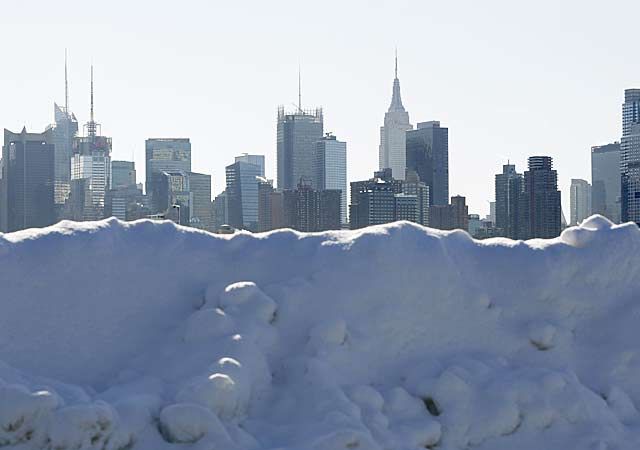
© AP Photo/Seth WenigPiles of snow line the waterfront overlooking the New York City skyline in Weehawken, N.J., Friday, Feb. 14, 2014. Commuters faced slick roads on Friday after yet another winter storm brought snow and ice to the East Coast, leaving at least 24 people dead.

Los Angeles civil rights lawyer Alex Jacinto is known among some of his friends and acquaintances as the Don Quixote of California, a modern day knight errant never shy about jousting with windmills he may find offensive to his sense of justice. He even went out on a limb and stated that the US may one day invade Mexico to escape the extreme cold brought on by climate change.

He once ran for sheriff against a powerful but corrupt longtime incumbent, becoming a cause celeb in the process - and did respectively well, with boxing legend Muhammad Ali, his major endorser, campaigning alongside him.

At other times, carrying a life-size replica of the Virgen de Guadalupe tilma enshrined in Mexico City, he has crusaded in liberal corners of L.A. against abortion, stem cell research and other causes dear to progressive Democrats, much to their chagrin.

But perhaps nothing seemed as absurd as the night some years back at a Hollywood Mexican restaurant, with several politicians including then former Gov. Jerry Brown nearby, when Jacinto went on a long diatribe about how the United States in the not so distant future would "have" to invade Mexico to expand into that South of the Border country for survival.

Huh?

Sun

More than 140 Brazilian cities ration water amid prolonged heat wave

Image
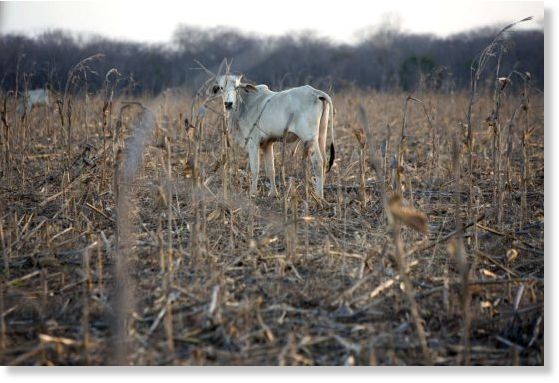
© AURELIEN FRANCISCO BARROS / AFP/GETTY IMAGESA cow in Quixada, in Brazil's Ceara state, stands in a dried-up field in early January. An ongoing heat wave in Brazil is causing a serious drought, forcing more than 140 cities in the country to ration water.
More than 140 cities are rationing water amid the worst drought to hit Brazil in decades, according to a survey conducted by the country's leading newspaper.

The Folha de S. Paulo newspaper wrote Saturday that water is being rationed to close to six million people living in 142 cities in 11 states.

The newspaper quoted water supply companies saying reservoirs, rivers and streams are the driest they've been in 20 years.

Some neighbourhoods in the city of Itu in Sao Paulo state only receive water for 13 hours, once every three days.

Water consumption normally grows by up to 20 per cent during the Southern Hemisphere's summer. But this year, consumption has risen by up to 30 per cent due to a prolonged heat wave affecting several states.

Sun

Flashback Heat wave kills 32 elderly people in Brazil

Image
© University of California
The heat wave besetting most of Brazil with temperatures above 40 C (104 F) has killed 32 elderly people in just two days in the city of Santos, in the southwestern state of Sao Paulo, the municipal Health Secretariat said Wednesday.

The victims, who died on Monday and Tuesday, ranged in age from 65 to 90 and all of them suffered from chronic health problems such as diabetes, hypertension and heart difficulties.

Dehydration caused by the intense heat could have aggravated the victims' preexisting problems as well, the secretariat said.

Of the 32 people, 17 died at their homes, while the other 15 expired in health centers where they had been admitted.

There were 220 telephone calls for help received by the emergency services during those two days, whereas the daily average is 130, Santos Health Secretary Santos Odilio Rodrigues Filho said.

Phoenix

Boulder crews contain half-acre wildfire on Flagstaff Mountain, Colorado

Image
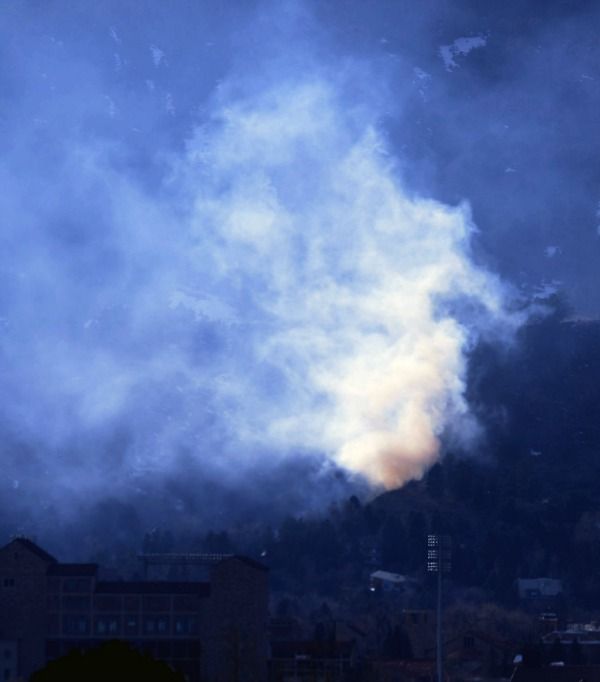
© Paul Aiken / Daily CameraSmoke can be seen rising from a fire on Flagstaff Mountain on Tuesday
Boulder crews were able to reach containment on a half-acre wildfire on Flagstaff Mountain near Fifth Street.

Dispatchers received reports of smoke and flames 2 to 3 feet high around 3:30 p.m. at the base of Flagstaff Road, but by about 4:20 p.m. officials on the scene said the fire had been contained and crews were in mop-up duty.

Officials said the fire started on private property, and the cause is unknown at this time.

Flagstaff Mountain Road has been re-opened.

Snowflake Cold

This polar vortex graphic is the most upsetting map of the winter

Image
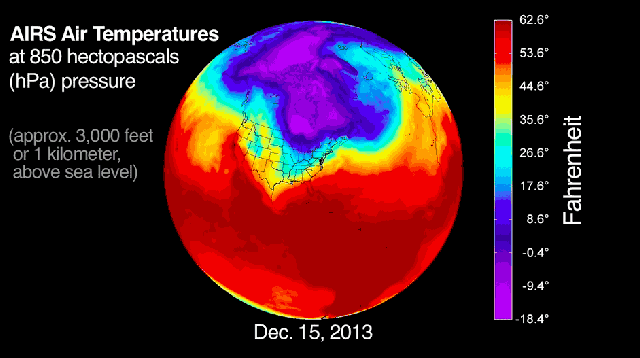
NASA put together this look at the record-breaking cold temperatures it's been monitoring this winter using infrared sensor 3,000 feet above the earth's surface. As you can see, we began December with a pretty normal polar vortex lingering over top of Canada and the Arctic. Things started to unravel in late December, and by early January, there's a single line of arctic air stretching straight from the North Pole clear down to Florida.

So what happened to cause it all? NASA scientist Eric Fetzer explains how a low pressure system in Canada's Hudson bay and an unusual movement of the jet stream conspired to drop temperatures in this video:

Question

Pond suddenly turns blood red Wichita, Kansas


"It's been a weird day!" Freddy Fernandez says.

The weirdness began Tuesday morning when the pond outside his Wichita house took on a pinkish color. Within a few hours, it had turned blood red.

Fernandez says the pond is full of fish, and there's no indication any have died because of this. There's also no odor.

Fernandez took a photo last week of the pond when it was frozen-over. At that time, an unusual pink pattern had formed in the ice.

"I just don't want any zombies coming out of there!" he says.

Comment: A couple of other weird things that happened in Wichita, Kansas lately:

US: Hundreds of fish die in Wichita park's pond

US: Wichita, Kansas Experiences Rare 'Heat Burst' Overnight

As for water sources turning blood red, check out these recent cases:

Yet another European river turns 'blood' red overnight, this time in Northampton, UK, 16 Jan 2014

Another European river turns 'blood' red overnight, this time in Slovakia!, 03 Dec 2013

River turns blood red overnight in The Netherlands, 01 Nov 2013

Waters at Bondi Beach, Australia turn blood red, 28 Nov 2012

Yangtze River turns red, 07 Sep 2012

Lebanon: Beirut River mysteriously runs blood red, 16 Feb 2012

Texas Lake Turns Blood-Red, 01 Aug 2011


Bizarro Earth

Yellowstone belches ancient helium

 Yellowstone National Park
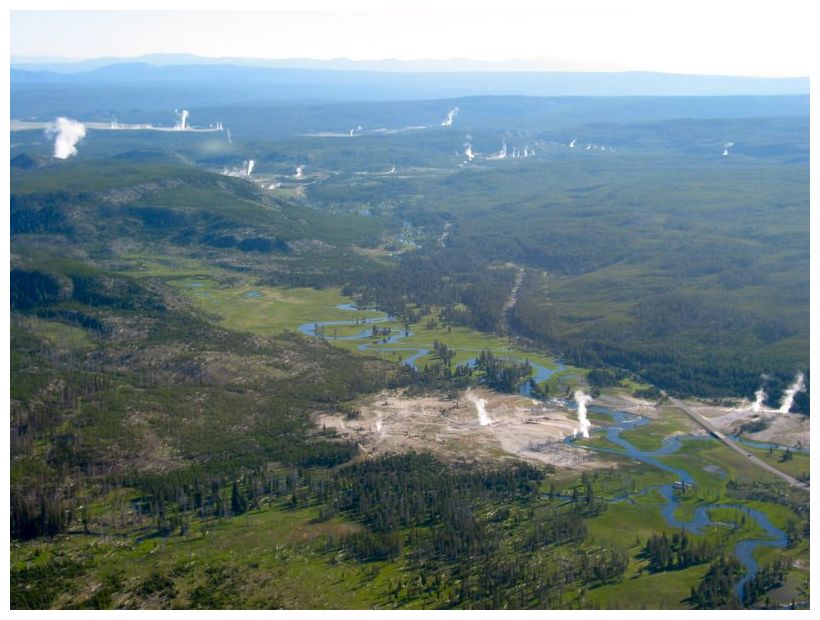
© Ken McGee/U.S. Geological SurveyPlumes of steam rise up from many spots along the Firehole River in Yellowstone National Park.

Yellowstone National Park's geysers, hot springs, fumaroles and other hydrothermal features spew out a collection of gases from deep within the Earth - steam, carbon dioxide, methane, neon, argon and helium. There's not enough of that last one, helium, for the park to start selling balloons or for visitors to sound like chipmunks, but there's plenty for scientists to study.

Helium can bubble out of volcanic rocks that drive hydrothermal activity, but that's not where most of Yellowstone's helium is coming from, it seems. The park's gas originates deep in rocks where it's been stored for hundreds of millions of years, U.S. Geological Survey scientists report today in Nature.

Helium is the second-most abundant element in the universe - it's formed by the nuclear fusion of hydrogen atoms, a process that powers stars - but it's pretty rare here on Earth. Lucky for birthday-party goers and clowns (and modern medicine), helium can be extracted from reserves of natural gas underground.

Helium on Earth can be found in two main forms: Nearly all occurs as helium-4 (named thus because it has two protons and two neutrons), which can be produced during the radioactive decay of heavy elements such as uranium. A tiny fraction (about one in a million) occurs as helium-3 (two protons and one neutron), most of which has been present on Earth since the planet's formation and is a vestige of material that originally formed the planet.

Igloo

Official forecast of the U.S. Government never saw this Winter coming

Image
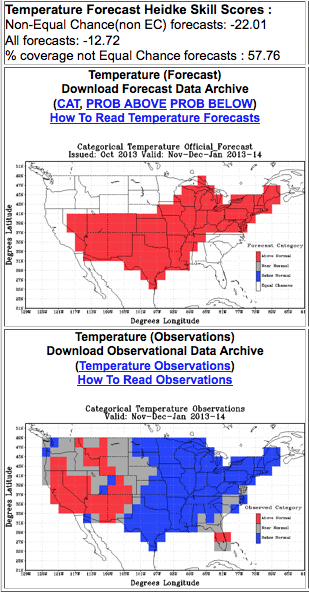
Surprised by how tough this winter has been? You're in good company: Last fall the Climate Prediction Center of the National Oceanic and Atmospheric Administration predicted that temperatures would be above normal from November through January across much of the Lower 48 states. This graphic shows just how wrong the official forecast of the U.S. government was:

The big red blotch in the top map represents parts of the country in which the Climate Prediction Center forecast above-average temperatures. The frigid-looking blue blotch in the bottom "verification" map shows areas where temperatures turned out to be below average.

"Not one of our better forecasts," admits Mike Halpert, the Climate Prediction Center's acting director. The center grades itself on what it calls the Heidke skill score, which ranges from 100 (perfection) to -50 (monkeys throwing darts would have done better). October's forecast for the three-month period of November through January came in at -22. Truth be told, the September prediction for October-December was slightly worse, at -23. The main cause in both cases was the same: Underestimating the mammoth December cold wave, which brought snow to Dallas and chilled partiers in Times Square on New Year's Eve.