Earth ChangesS


Arrow Down

Woman, dog rescued after being swallowed by massive sinkhole in Portland, Oregon

Image

Portland firefighters rescued a woman and her dog after they fell into a sinkhole in her back yard Tuesday night.

She was looking for her small poodle mix in her back yard when she fell into the sinkhole, which was 20-feet-deep and 3½ feet in diameter.

The woman lives near Southeast Clinton Street and 39th Avenue.

A neighbor heard her cries for help from the bottom of the pit and called 911.

Crews from the Portland Fire Bureau arrived around 7:25 p.m. and immediately used ropes and ladders to get the woman and her dog out of the sinkhole.

Portland Fire and Rescue Lt. Rich Chatman said firefighters at the scene were amazed the woman and her dog were not seriously hurt.

Phoenix

Viking Apocalypse: Norse myth predicts world will end this Saturday

Image
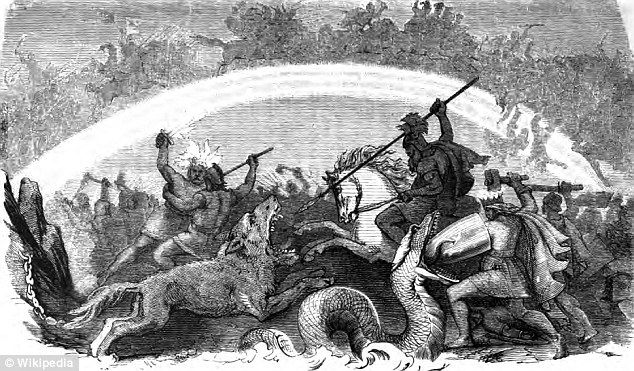
Doom: The final battle of the gods, otherwise known as Ragnarok, signals the end of the world. Vikings believe the apocalypse will begin on Saturday.
We've survived the Mayan apocalypse and Y2K, but be afraid - the end of the world is coming...again.

This time it's the Viking apocalypse that is allegedly set to destroy Earth, with Norse mythology claiming the planet will split open and unleash the inhabitants of Hel on February 22.

According to the Vikings, Ragnarok is a series of events including the final predicted battle that results in the death of a number of major gods, the occurrence of various natural disasters and the subsequent submersion of the world in water.

The wolf Fenrir is also predicted to break out of his prison, the snake Jormungand will rise out of the sea and the dragon of the underworld will resurface on Earth to face the dead heroes of Valhalla - who, of course, have descended from heaven to fight them.

Attention

California drought: 10 communities at acute risk of running out of drinking water in 60 days

Image
California's drought has put 10 communities at acute risk of running out of drinking water in 60 days, and worsened numerous other health and safety problems, public health officials in the most populous U.S. state said on Tuesday.

Rural communities where residents rely on wells are at particular risk, as contaminants in the groundwater become more concentrated with less water available to dilute them, top state health officials said at a legislative hearing on the drought.

"The drought has exacerbated existing conditions," said Mark Starr, deputy director of the California Department of Public Health.

The state has helped about 22 of 183 communities identified last year as reliant on contaminated groundwater to bring their supplies into conformance with environmental guidelines, but the rest are still building or preparing to build systems, he said.

Phoenix

Large grass fire threatens homes in Oklahoma City

Image
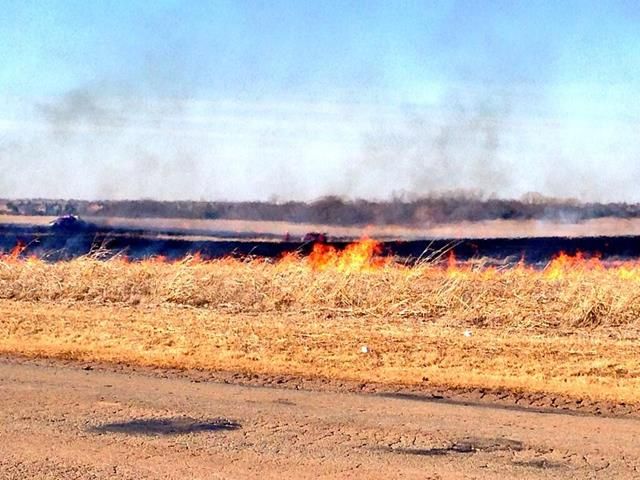
With winds gusting to 40 miles and hour Tuesday, it didn't take much for a Oklahoma City wildfire to get big, fast.

Firefighters say the fire started along 192nd between May and Penn and moved fast toward a nearby neighborhood.

Tim Branch saw the fire over his fence and got to work, doing whatever he could to stop the flames.

"I just don't want my house to catch on fire," he said, using a shovel to dig, creating a fire line. "If it was your house, you'd do the same thing, right?"

Firefighters soon appeared over the same fence, delayed by people on the roads who wouldn't get out of the way.

"We did have a pretty tense situation in the beginning when we were trying to get in here," said OKCFD battalion chief Brian Stanaland. "We were trying to evacuate personnel out here and the people that live here, and they weren't incredibly cooperative, so kind of got in the way a little bit."

That delay allowed flames to get close to several homes.

One home's fence was still on fire about a hour after most of the flames were extinguished. It was no match for the flames---that burned right through it, and right up to the back of the house.

Comment: Interestingly, just prior to the outbreak of this fire, 20 earthquakes were recorded a little way north of the city, accompanied by mysterious booms. See also: Scientists mystified as 20 earthquakes hit Oklahoma in one day


Igloo

Tough, volatile winter creates menace: Ice falling from skyscrapers, causing injuries

Image
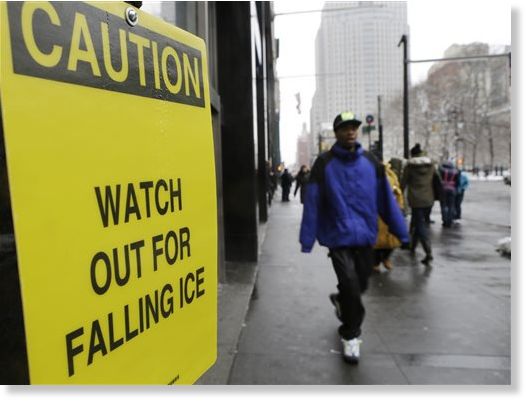
© AP Photo/Frank Franklin IIPedestrians pass a sign warning them of falling ice near City Hall Tuesday, Feb. 18, 2014, in New York
City dwellers battling one of the most brutal winters on record have been dealing with something far more dangerous than snow falling from the sky: ice tumbling from skyscrapers.

Streets around New York's new 1 World Trade Center, the nation's tallest building, were recently closed when sheets of ice were seen shearing from the face of the 1,776-foot structure - turning them into potentially deadly, 100-mph projectiles.

And sidewalks around high-rises in cities big and small have been cordoned off with yellow caution tape because of falling icicles and rock-hard chunks of frozen snow, a situation that experts warn could get worse over the next few days as a thaw sets in over much of the country.

"The snow starts to melt and the liquid drips off and makes bigger and bigger icicles, or chunks of ice that break off skyscrapers," said Joey Picca, a meteorologist at the National Weather Service in New York, which has had 48.5 inches of snow this winter and several cycles of freeze and thaw.

"Be very, very aware of your surroundings," he said. "If you see ice hanging from a building, find another route. Don't walk under hanging ice."

Question

Despite cool temperatures and average humidity, numerous large wildfires break out in New Mexico and northern Texas

Image
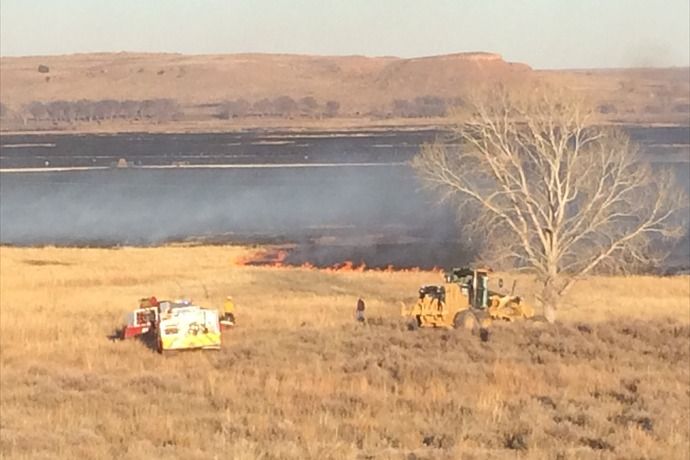
© Preston FowlerThe largest 'winter wildfire' appears to be in Hutchinson County, where at least 600 acres have been torched.
Crews are fighting multiple grass fires in Curry County.

They're fighting one in Roosevelt County, too.

No word on how big, just that there are many.

We also know of one fire burning northeast of Borger right now. That fire started around 1:50 p.m.

We'll have more as it becomes available.


Cloud Lightning

Erm, two waterspouts hit snow-covered New York state in late January

Image
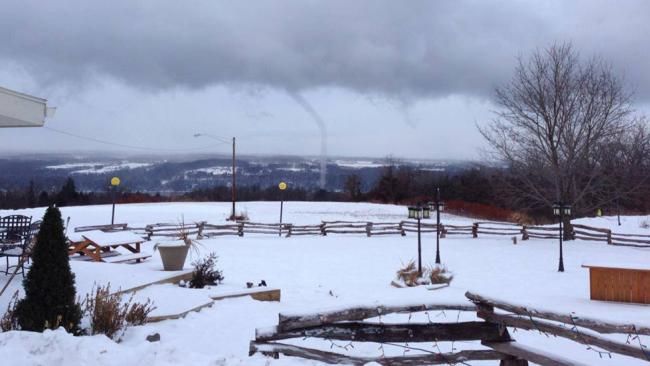
© Aaron Godart via 'vanostrandman'A waterspout is photographed over Cayuga Lake in central New York on Jan. 21, 2014.
When you hear the term waterspout, you may think of places like the Florida Keys or Gulf Coast in summer. If you live around the Great Lakes, you may have seen one in the fall.

But what about the dead of winter in the northern U.S.? It's not just theoretically possible, it actually happened twice this week.

The photo above was taken in the Finger Lakes region of central New York, specifically Cayuga Lake, on the morning of January 21. The morning low temperature in nearby Ithaca, N.Y. was 5 degrees, so it's conceivable temperatures at the time of the photo were no warmer than the single digits or teens.

A second waterspout was photographed on the southern end of Lake Champlain near Essex, N.Y. on the afternoon of January 22.

The daytime high in nearby Burlington, Vt. was two degrees below zero.

Isn't it too cold for this in January? Doesn't it have to be at least somewhat warm and humid?

Comment: Clearly, warm-cool temperature differences and humidity alone do not explain what causes tornadoes, waterspouts, hurricanes and other air spirals to form.

In his upcoming book on Earth Changes, SOTT.net editor Pierre Lescaudron explains the primary driver behind air spirals:
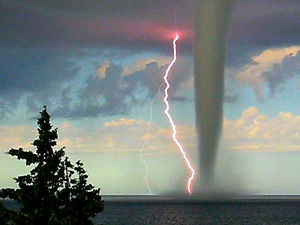
Air spirals are the manifestation of electric discharges between the ionosphere and the Earth's surface. The image below shows a waterspout and a lightning bolt occurring in the same place at the same time, illustrating how electric potential difference between the clouds at the top of the picture and the ground at the bottom is what powers both the lightning and the tornado.
Image

If air spirals are electrically driven, how then can we explain an increase in their frequency when the Sun's activity has dropped and the atmospheric electric field has weakened? While the overall atmospheric electric field has indeed weakened, another factor must be taken into account. The increase in atmospheric dust concentration reduces the electric conductivity of the atmosphere. Conductivity in the atmosphere is due to the mobility of small ions. When dust is present, these ions attach to the relatively large dust particles and lose mobility, hence the decrease in atmospheric conductivity.

So, on the one hand, reduced solar activity tends to reduce the atmospheric electric field, but on the other, atmospheric dust tends to counteract this trend by increasing atmospheric resistance. The decreased conductivity limits the progressive current leakage that is typical of fair weather, favoring the buildup of local charges that eventually cause discharges like air spirals or lightning. In other words; the net balance of electric potential in the atmosphere can remain the same, but the manner in which it's discharged can change.


Radar

Scientists mystified as 20 earthquakes hit Oklahoma in one day

Image
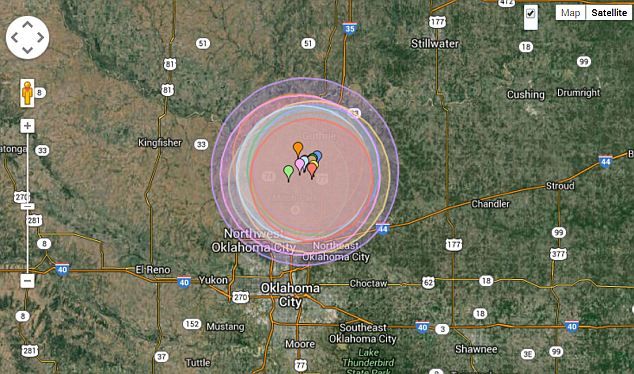
Quake cluster: A map created by earthquaketrack.com shows the massive cluster of 20-plus quakes that have shaken central Oklahoma in recent days
Residents of Oklahoma were left feeling rattled over the weekend after a strong of some 20 earthquakes as powerful as 3.5 magnitude rocked the central part of the state on Saturday alone.

Areas north of Oklahoma City felt the brunt of the temblors, which some say were accompanied by startling booms like the sound of an explosion.

The mystery earthquake wave now has residents fearing for their personal safety and the security of their property. Meanwhile, scientists have been left scratching their heads over the quakes, which are becoming more frequent each day.

Sun

California's historic extreme drought as seen from space

California's drought
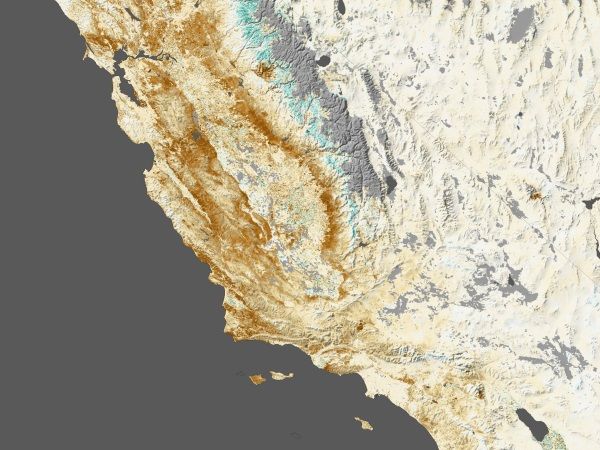
© NASA.govCalifornia's drought as seen from space, Feb. 16, 2014.
The historic drought that's devastated California and much of the West this year is visible from space.

In an image taken by NASA's Terra satellite on Feb. 16, effects of the extreme drought on vegetation is evident: shades of brown where green should be, shades of green where the Earth should be blanketed in white.

"In a normal year, much of the green areas near the mountains would be snow-covered," Ramakrishna Nemani, a vegetation sensing expert at NASA's Ames Research Center, said in a blog post. "Since there is not much snow this year, the evergreen vegetation appears anomalously green. In fact, that is bad news for this time of the year."

Indeed, says the NASA blog, the coastal mountains stretching from Northern California on south are bone dry:
In the midst of California's Sacramento and San Joaquin valleys, there are a few patches of green indicating some farms that still have access to water for irrigation. But much of the region is brown - signs of land suffering from drought stress or left fallow when it would normally be planted with crops.

Monkey Wrench

Cognitive Dissonance - CBS News blames global warming for freezing cold

Image
© Breitbart
During the February 13 broadcast of CBS This Morning, host Charlie Rose and his guest turned to the topic of this year's harsh winter, calling the extreme cold an example of global warming.

Guest Michio Kaku, a physics professor from New York City College--not a climatologist, but a physicist--claimed that the "wacky weather" could get "even wackier" and its all because of global warming. "What we're seeing is that the jet stream and the polar vortex are becoming unstable. Instability of historic proportions. We think it's because of the gradual heating up of the North Pole. The North Pole is melting," professor Kaku said.

"That excess heat generated by all this warm water is destabilizing this gigantic bucket of cold air... So that's the irony, that heating could cause gigantic storms of historic proportions," the prof explained.

This was all because of global warming, Rose insisted.

Kaku went on to say that the weather "instabilities" we are seeing are because of the "erratic nature of the jet stream" and the "polar vortex."

Comment:
Ice Age cometh: Global cooling consensus is heating up - cooling over the next one to three decades
Ice age cometh: No warming left to deny... Global cooling takes over... CET annual mean temperature plunges 1°C since 2000