Earth ChangesS


Magnet

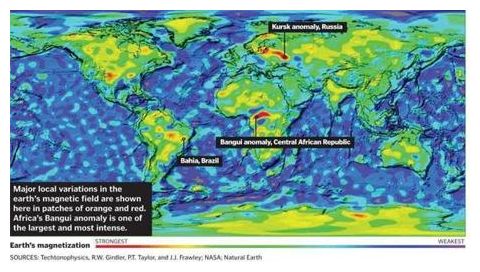
The African country where compasses go haywire - What's behind the Bangui magnetic anomaly?

Magnetic Anomaly
© The Boston Globe
Until the last year, when the Central African Republic's civil war became a humanitarian crisis too dire to ignore, most Americans thought little about the country at all. It has a low global profile in part because it is exceedingly poor, with four out of five people living on less than $2 a day. It has some natural resources, but because it is landlocked by other troubled countries - Chad, Sudan, Congo, and Cameroon - even if a lull in the war allowed it to extract those from the ground, it would still face formidable problems in exporting them.

But for one group, the Central African Republic is anything but ignorable, and in fact is home to an enduring scientific mystery. Geophysicists who map the earth's magnetic fields have identified a disturbance in the earth's natural magnetic fields within the Republic. They still have few clues about what causes it, but at least some think it could be key to understanding one of the most dramatic events in the history of the planet.

When geophysicists look at the globe, they don't see national borders. Instead they see geological features like fault lines and tectonic plates, or, if they study geomagnetism, zones where the earth's normal, needle-points-north magnetic field seems to go haywire. They map these anomalies by satellite and with ground surveys. When they look at the Central African Republic, something strange appears in the center of the country: a massive aberration known as the Bangui Magnetic Anomaly, named for the country's capital. At 600 miles across, it is one of the largest such anomalies on earth.

"If you were on the ground there and you had a magnetic compass, you'd need to correct for it," says Patrick T. Taylor, a NASA geophysicist who has studied the anomaly closely. "The compasses would go berserk."

Attention

Reunion Island volcano erupts again after four years

Reunion volcano
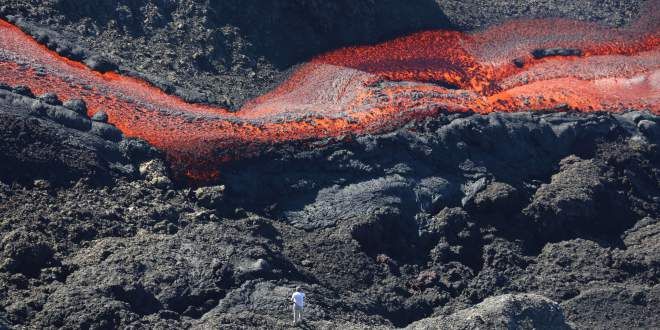
© Richard Bouhet/AFP/Getty ImagesA picture taken on June 21, 2014 shows lava flowing out of the Piton de la Fournaise volcano, one of the worldThis morning at 1:35 am tourists on the French Indian Ocean Islands La Reunion tourists witnessed a spectacular many had been waiting to see for some time. The Piton de la Fournaise volcano erupted.
This morning at 1:35 am tourists on the French Indian Ocean Islands La Reunion tourists witnessed a spectacular many had been waiting to see for some time. The Piton de la Fournaise volcano erupted.

"It made a few days that we were waiting for it, said Pascal Viroleau, CEO of Reunion Island Tourism, about the eruption of the volcano of Reunion Island, the Piton de la fournaise. According to Viroleau, "the volcano entered in activity this morning at 1:35 am."

Most recently, an eruption occurred on December 9, 2010 and lasted for two days. The volcano is located within Réunion National Park, a World Heritage site. It is considered one of the major attractions of the Indian Ocean Vanilla Islands.

"Sleeping since December 2010," Piton de la fournaise is considered as one of the major attractions of the Indian Ocean Vanilla Islands.

Igloo

Receding Swiss glaciers reveal 4000 year old forests - Warmists try to suppress findings

Glacier
© Climate Change Dispatch.com
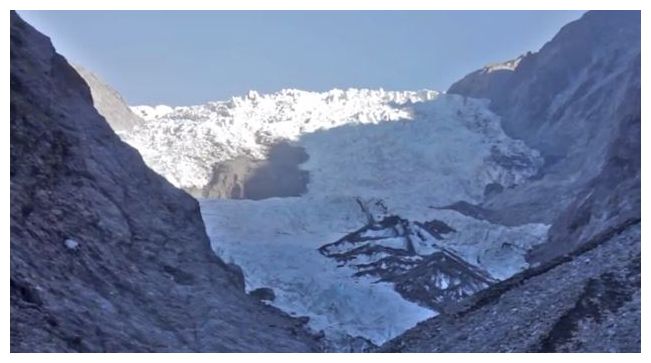
Dr. Christian Schlüchter's discovery of 4,000-year-old chunks of wood at the leading edge of a Swiss glacier was clearly not cheered by many members of the global warming doom-and-gloom science orthodoxy.

This finding indicated that the Alps were pretty nearly glacier-free at that time, disproving accepted theories that they only began retreating after the end of the little ice age in the mid-19th century. As he concluded, the region had once been much warmer than today, with "a wild landscape and wide flowing river."

Dr. Schlüchter's report might have been more conveniently dismissed by the entrenched global warming establishment were it not for his distinguished reputation as a giant in the field of geology and paleoclimatology who has authored/coauthored more than 250 papers and is a professor emeritus at the University of Bern in Switzerland.

Then he made himself even more unpopular thanks to a recent interview titled "Our Society is Fundamentally Dishonest" which appeared in the Swiss publication Der Bund where he criticized the U.N.-dominated institutional climate science hierarchy for extreme tunnel vision and political contamination.

Following the ancient forest evidence discovery Schlüchter became a target of scorn. As he observes in the interview, "I wasn't supposed to find that chunk of wood because I didn't belong to the close-knit circle of Holocene and climate researchers. My findings thus caught many experts off guard: Now an 'amateur' had found something that the [more recent time-focused] Holocene and climate experts should have found."

Other evidence exists that there is really nothing new about dramatic glacier advances and retreats. In fact the Alps were nearly glacier-free again about 2,000 years ago. Schlüchter points out that "the forest line was much higher than it is today; there were hardly any glaciers. Nowhere in the detailed travel accounts from Roman times are glaciers mentioned."

Arrow Down

Sinkhole partially swallows car at Perth casino, Australia

Image
A social media post showed the front and back tyres of a white Hyundai stuck in the hole.
An unlucky driver was left stranded at a Perth casino after a sinkhole partially swallowed their car.

The sinkhole, which opened up in the Crown Casino carpark yesterday morning, developed after heavy rain at the weekend, WA Today reports.

Nine News reporter Scott Cunningham said the bitumen had collapsed in two places, trapping the two left wheels of the driver's side.

"The bitumen has caved in, there's probably a metre-and-a-half drop I suppose where you can see that the sands just all cave in, around and underneath the wheels," he said.

"There's just one car that appears to be stuck there at the moment, security has fenced-off the area around it."

A photo posted by the reporter to social media showed the full extent of the damage.

As the sinkhole is on private property, the casino will be responsible for its repair.

Source: Nine News, WA Today

Arrow Down

15 feet deep sinkhole snares bus near Cincinnati Zoo

Image
© The Cincinnati EnquirerA Cincinnati Metro bus was stuck in a sinkhole Thursday night.
A sinkhole near the Cincinnati Zoo & Botanical Garden that trapped a city bus will likely take a month to fix, according to a Metropolitan Sewer District official.

The Metro bus was partially stuck in the hole, 15 feet wide and 15 feet deep, near Vine and Shields streets in Corryville around 9 p.m. Thursday, said Cincinnati police Lt. Tim Brown, the night chief.

"It's crazy," he said.

The bus was towed overnight.

An MSD crew investigated a reported buckle in the pavement earlier Thursday when crews discovered a backup of sewage upstream of the buckled pavement in the sewer manhole, according to a release. The bus drove over the buckled area around 9 p.m., at which point the sinkhole opened.

MSD crews were called to repair the hole, which sewer construction inspector Dave Rieman says is the largest he has seen in at least a decade. "Cave-ins are common, but not ones this big," he said.


Magnet

Satellite swarm spots North Pole drift

Magnetic Pole
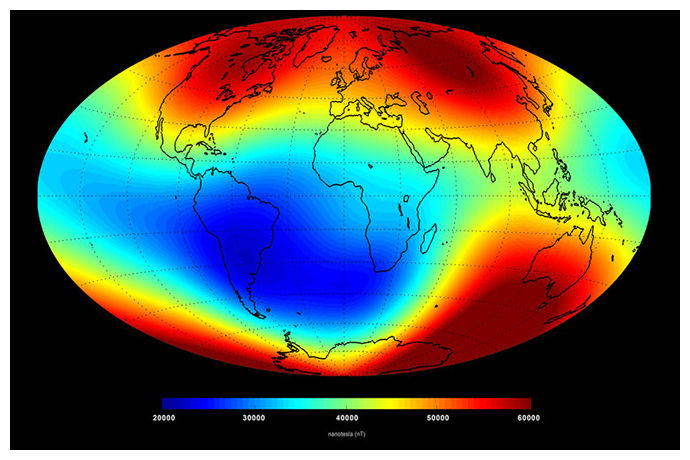
© ESA/DTU SpaceSwarm measurements of Earth’s magnetic field from June 2014. Blue areas show where it has weakened.
The North Pole is moving. Not the geographic axis around which Earth spins, of course, but rather its magnetic pole, the north end of which is slowly but steadily wandering across the Arctic Ocean toward Siberia. Scientists have known about our planet's shifting magnetic field for a long time, since at least 1904 - and today we now have a "Swarm" of satellites investigating its many inconsistencies from orbit.

Launched in November 2013, ESA's Swarm mission consists of three 9-meter satellites orbiting the planet at altitudes of 300-530 km (186-330 miles). Their goal is to monitor Earth's dynamic magnetic field, observing its changes over a period of four years.

The data gathered by the Swarm satellites will help scientists better understand how our magnetic field works, how it's influenced by solar activity, and why large parts of it are found to be weakening.

Because the magnetic field is our planet's first line of defense against radiation from both the sun and deep space, understanding what makes it tick is very important.

Attention

Dead humpback whale washes up near Maldives island

Image
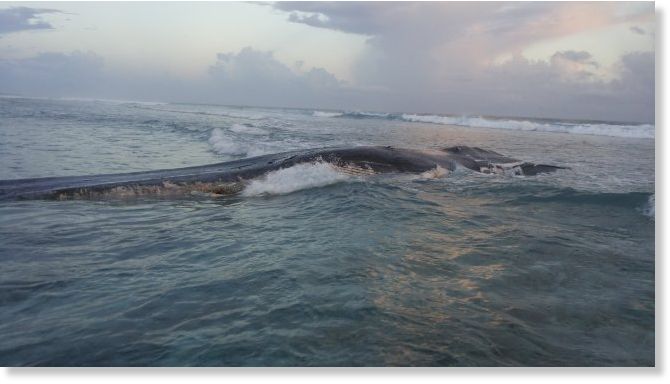
© FENFUSHI ISLAND COUNCILThe dead humpback whale that washed up near Fenfushi in Alif Dhaalu atoll.


A dead humpback whale has washed up near Fenfushi in Alif Dhaalu atoll on Sunday.

The island's deputy councilor Ahmed Saeed said that the whale that measures about 50-foot washed up near the island sometime on Saturday. The whale is about 1500-foot away from the island's beach, he added.

"The whale hasn't started rotting yet. But when it does, it'll prove to be problematic to us," Saeed said.

The deputy councilor also said that they have informed the authorities about the dead whale that washed up near the island.

"This is a breeding area for whale sharks. So lots of tourists come here every day to see them. If the whale starts rotting, it'll be a nuisance for the tourists who come here as well," Saeed said.

Cloud Precipitation

3 million affected by deadly floods in China

Image
© AFP PhotoThis picture taken on June 4, 2014 shows rescuers helping two children cross a heavily flooded street in Shiqian county of Tongren, southwest China's Guizhou province
Rainstorms and floods sweeping eastern and southern China since mid-June have left 14 people dead, four missing and up to 3 million people affected. The cost of the flooding is estimated at $250 million in one province alone.

China's central Hunan Province was one of the worst hit, where seven people died. Also badly affected was Jiangxi province in the east where another five people lost their lives and in Guangxi Zhuang, an autonomous region in the south of the country, where another two people perished, China's Xinhua news agency reports.

In Hunan a total of ten cities and 47 counties were affected by the rainstorms and 171,000 people have had to be relocated. The economic cost to the region is $251 million, with 122,700 hectares of crops damaged.

Camera

Rare 'Karman Vortex' spiral clouds spotted off coast of Baja California

Image
© NASA-MODIS
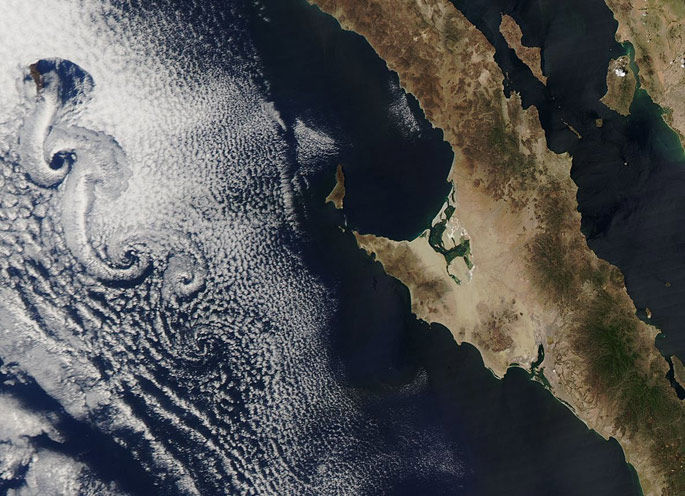
A unique weather event called a Karman Vortex was created by airflow disturbed by Island Guadalupe off the coast of Baja California only occurs in a few places around the world and only on rare occasion.

The National Aeronautics and Space Administration (NASA), photographed a strange atmospheric phenomenon in northern Baja California Sur called Karman vortices, which occur only in very specific climatic conditions.

The image of four eddies spinning in the Pacific in the wake of Isla de Guadalupe of the coast of Baja California, was taken by the MODIS instruments onboard the Aqua satellite in mid June 2014; also managed to capture a Gloria, a kind of circle that reproduces a spectrum effect

Arrow Down

Massive sinkhole opens up near World Cup stadium in Brazil

Image
Residents have been evacuated from a favela near one of Brazil's World Cup stadiums, after a huge sinkhole opened up.

Footage shows partially-collapsed homes perched on the edge of the crater in Natal, already filled with household appliances, furniture and vehicles.

The hole is four miles (6.5km) from the Arena das Dunas stadium, which will host the Group D match between Italy and Uruguay on Tuesday.

The sinkhole opened up earlier this week after record rainfall, but has continued to grow since.