Earth ChangesS


Arrow Down

Record low February temperature set in Cuba

Image
Cubans bundle up against a record low temperature in Havana
The Cuban Institute of Meteorology reported that early Friday morning it registered a temperature of one degree Celsius (33.8oF) in the town of Union Reyes, in western Matanzas province, the lowest temperature ever recorded in Cuba for the month of February.

This temperature was due to the strong influence of a very dry mass of cold air of arctic origin, in combination with low clouds in the interior of the western and central regions, which favoured heat radiation at night and caused again another remarkably cold dawn in parts of the interior of much of the country

There were several areas with less than 10 degrees Celsius (50oF) in Cuba's western provinces. In the rest of the country the minimum temperatures were between 11 and 15 degrees Celsius, higher in coastal areas.

The previous record in Union de Reyes was set on February 18, 1996, at 2.5 degrees. The absolute record in the town for any month of the year was also one degree, and happened on January 21, 1971.

Bizarro Earth

Noctilucent clouds, behaving strangely

The southern season for noctilucent clouds (NLCs) has come to an end. NASA's AIM spacecraft observed the last wisps of electric-blue over Antarctica on Feb. 20, 2015. The end of the season was no surprise: The polar clouds always subside in late summer. Looking back over the entire season, however, reveals something unexpected. In an 8-year plot of Antarctic noctilucent cloud frequencies, the 2014-2015 season is clearly different from the rest:
NLC Frequency
© SpaceWeather
These data come from the AIM spacecraft, which was launched in 2007 to monitor NLCs from Earth orbit. The curves show the abundance ("frequency") of the clouds vs. time for 120 days around every southern summer solstice for the past 8 years.

"This past season was not like the others," notes Cora Randall, a member of the AIM science team and the chair of the Department of Atmospheric and Oceanic Sciences at the University of Colorado. "The clouds were much more variable, and there was an enormous decrease in cloud frequency 15 to 25 days after the summer solstice. That's when the clouds are usually most abundant."

Attention

Rare Arctic bowhead whale seen for the first time in UK waters

Image
© SeawatchThe bowhead was spotted with a mobile phone camera
The bowhead whale was photographed on a mobile phone off Par Beach on the remote island of St Martin's by diver Anna Cawthray who immediately suspected it was special.

But it took an international exchange of e-mails between experts in Britain and the United States to identify it as a young bowhead who was 2,000 miles from home.

Anna feared the whale - which was about 25ft long - could have been stranded but she said: "After about 15 minutes it swam away.

"Seeing it was a once in a lifetime experience."

Bowhead whales normally live in the high Arctic near the ice edge and their closest population is off Spitzbergen far to the north of Norway.

They can reach up to 70ft in length, weigh up to 90 tonnes and live for up to 200 years which makes them possibly the longest lived marine mammal in the world.

They live off small crustaceans and use their large heads to smash through pack ice.

Comment: See also: King crab from Arctic waters found on Redcar beach, UK


Attention

Wild boar attacks and injures five in Mizoram village, India

Image
© David J SlaterWild boar
A male wild boar entered a village in eastern Mizoram on Wednesday morning and injured five people, three of them grievously, before villagers shot it dead.

Village leader C Lalnunpuia said the wild boar entered Saichal, within Champhai district, from the nearby woods around 9.45 am, chasing a woman who was coming from the same direction.

As it reached a house on the outskirts, it attacked a group of women sitting on the porch.

One of the women, identified as Lalruatliani, sustained wounds on her hands and arms, with several fingers broken.

Attention

Dead whale found washed ashore at Cuddalore, India

Image
The carcass of the beached whale at Pettodai near Periyakuppam in Cuddalore on Thursday.
The carcass of a 30-foot-long whale washed ashore at Pettodai near Periyakuppam on Thursday evening.

A group of fishermen spotted the carcass near the shore at around 6 p.m. and alerted the Forest Department.

News about the dead whale spread like wildfire and people gathered in large numbers to get a view of the mammal.

"The whale had a length of 9 metres and weighed nearly five tonnes. A post-mortem examination alone can reveal reasons behind the death and how it was swept to the shore. The whale might have been hit by a barge or a ship passing through the coast," Sundaramurthy, Cuddalore Range Forest officer said.

Attention

Jellyfish bloom reported for the first time off coast of Visakhapatnam, India

Image
Representational image
A bloom of jellyfish has been reported off the Visakhapatnam coast for the first time. MFV Matsya Shikari, a survey vessel attached to the Vizag base of the Fishery Survey of India (FSI), has reported a bloom of jellyfish around 60 nautical miles off Visakhapatnam.

The vessel was carrying out a demersal (near the seabed) fishery resource survey in the area and researchers were surprised that 500 kg of jellyfish was caught in a single haul from a single-patch area at a depth of 40m. They say this is an indication of their abundance in the area.

The jellyfish found off was identified as Crambionella stuhlmanni, which causes skin rashes if touched. There are many species of jellyfish, which are venomous and its sting considered dangerous. World over, jellyfish blooms have caused power plant outages, destroyed the fishing-industry and damaged the beaches of holiday destinations.

Snowflake Cold

Cold world, cooling sun: Global warming is dead on arrival

Hudson River
© Spencer Platt/Getty ImagesIce flows along the Hudson River in New York City on Feb. 20, 2015.
The cold crept in early on the 15th of Feb. 2015. By the 21st more than 100 million Americans were being impacted by the arctic blast known as the "Siberian Express" as record (low) temperatures were broken across the eastern third of the nation. Chicago experienced its coldest February since 1875. Last year it was the Polar Vortex and that took down GDP (Gross Domestic Product) quickly. This year the numbers are not in yet but we can expect economic activity to contract.

During this cold, more than 4,700 square miles of ice formed over the Great Lakes in just one night on the 17th. It was minus 41 in Minnesota at that time. "Great Lakes ice is now running ahead of last year and ice will increase with more brutal cold coming," says meteorologist Joe d'Aleo. "We are likely to have the most ice since records began."

Forbes magazine is now equating global warming proponents with snake oil salesmen. There was never any manmade global warming."Global warming activists are in full-throttle damage control, desperately claiming global warming causes record snow and cold," says Forbes. "When global warming alarmists claim winters will become warmer and free of snow, yet their predictions are proven false for 20 years in a row, at some point logical people come to realize that global warming alarmists are selling snake oil."

Music

Washington residents rattled by mysterious loud booms

Strait of Juan de Fuca
© Komo NewsWitnesses say the loud booms seem to be coming from the direction of the Strait of Juan de Fuca, shown here.
Port Angeles - The source of home-rattling booms heard in the Port Angeles area on Wednesday remains a mystery.

"We're not finding anything," said Ron Cameron, chief criminal deputy for the Clallam County Sheriff's Office.

Several who reported hearing the booms on Facebook said the sounds seemed to be coming from the Strait of Juan de Fuca.

Spokesmen from the U.S. Coast Guard and U.S. Navy each said Thursday their units have not taken part in any activity that could produce loud booms in the Strait on Wednesday.

They said they had no knowledge of any event on the Strait that could explain the explosions.

The first report appears to have been placed at 2:40 p.m. Wednesday to Clallam County emergency dispatchers from a resident on Strait View Drive, east of Port Angeles, who reported several loud booms.

At the same time, Michelle Kaake heard two booms while in her home on O Street in west Port Angeles.

"It vibrated the floor and rattled windows," Kaake said of the first boom.

The second boom came about five minutes later, she said.

Snowflake Cold

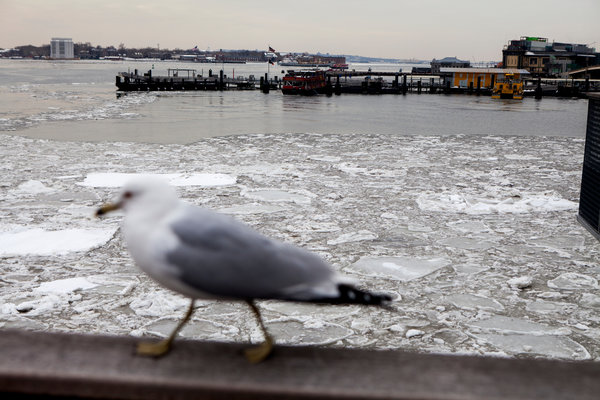
New Yorkers struggling to deal with a winter that is as cold as it's ever experienced

Image
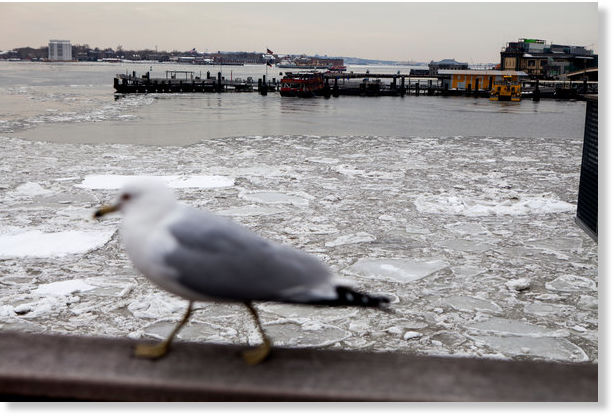
© Sam Hodgson for The New York TimesA seagull walking along a pier next to a frozen portion of the East River this week.
It will end. Allegedly.

It will get warmer. One day. Someday.

Won't it?

We have reached the 69th day of winter. It seems like the 6,669th. Pretty much the same nonsense is reprised day after day. Miserable, punishing, obnoxious, teeth-rattling, bone-numbing weather. Unmitigated, merciless, are-you-kidding-me cold.

New Yorkers cannot recall the last time they walked with their eyes trained forward, rather than watching for ice patches waiting to send them flying, which leaves them vulnerable to ice sliding off buildings from above. And in the evenings the snowplows screech past, drowning out the television in the middle of a Letterman cold joke.

Throughout the parks, on the edges of sidewalks, ice just sits with defiant, assertive permanency. It will not melt, just keeps getting icier and more discolored. The whole city feels like a giant ice cube. People lean into the wind, pull hard to get doors open, to get out of this weather already, as the whistling wind pushes back.

As it limps away, February will not be missed. With the average temperature for the month lingering around 24 degrees, some 11 degrees shy of normal by the National Weather Service's calculation, this insult of a month looks as though it will clock in as the coldest recorded February in New York City since 1934. That is 81 years of weather. That is all the way back to the Depression, when there were so many more dire things to worry about than whether 7-Eleven had salt or whose turn it was to walk the dog.


Magic Wand

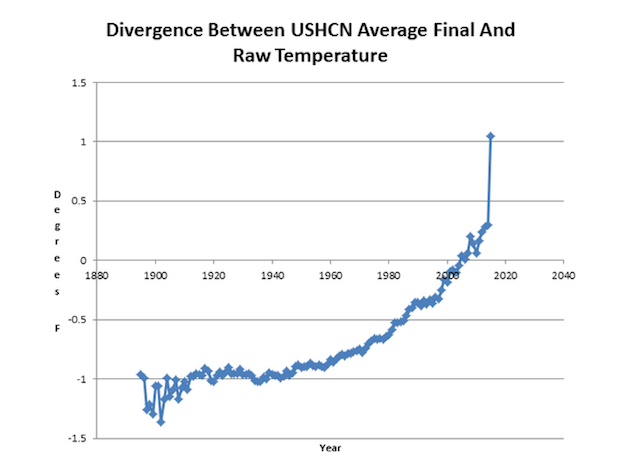
U.S. Climatology Lab and National Climatic Center hit new milestone in fake climate data

So far this year, more than 50% of USHCN data is fake, and NCDC is adjusting US temperatures upwards by more than one degree. New records for both.
Image
© Steven Goddard
Ushcn.tavg.latest.FLs.52i.tar.gz
Ushcn.tavg.latest.raw.tar.gz

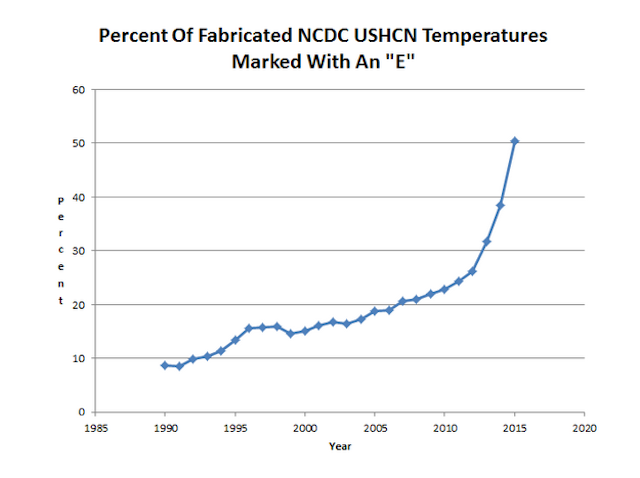
Monthly temperatures which are marked with an "E" are "estimated" rather than measured. More than half of the current data for 2015 is fake.
Image
© Steven Goddard
As more data comes in, these numbers will go down some, but the point is that the more data is missing, the higher the temperature. This is likely due to to loss of rural data, and infilling with UHI contaminated urban data.

Comment: Ice age cometh: Brutal winters point to Earth turning colder