KPIX 5 Morning Weather Anchor Roberta Gonzales answers the questions you never get to ask on-air.
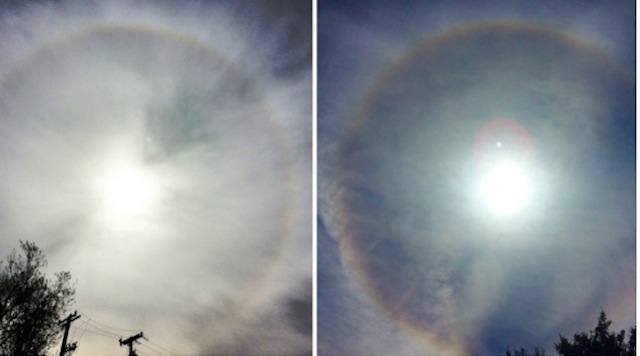
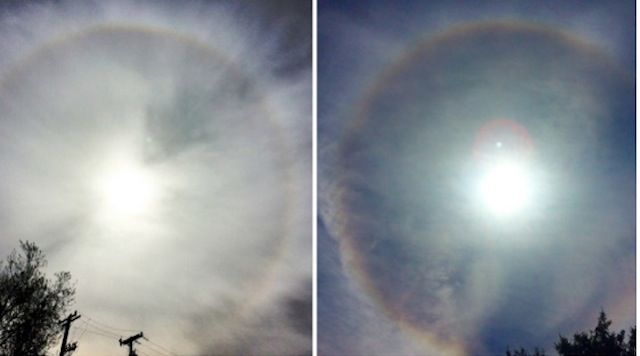
© CBSTwo images of the halo seen around the sun, September 27, 2015.
Hey Roberta, did you see the super moon lunar eclipse? Brian Cain; Hayward
A: Yes I did! But did YOU see yesterday's "halo" around the sun?
I was running in the San Jose Rock and Roll Marathon yesterday when I looked up (probably gasping for air!) and saw the prettiest halo around the sun! Did you see it?
Officially, scientists refer to a ring or circle of light around the sun or moon, a halo. What makes a halo around the sun or moon?
Well, there's an old weather saying, "ring around the moon means rain soon". That's not necessarily true. The true part is, high cirrus clouds often come before a storm. And if you look at my photos, those wispy looking clouds are cirrus clouds. They are high and thin and usually located around 20,000 feet in elevation. The cool thing about cirrus clouds, is they contain millions and millions of ice crystals! A halo forms because of the refraction (splitting of light) and reflection (glints of light) from these ice crystals.
What I love about a halo is, because of the positioning of the ice crystals and an individual's positioning looking up, everyone sees a halo differently. So my halo yesterday was different than the one you probably saw. Just think about it, your own personal halo!


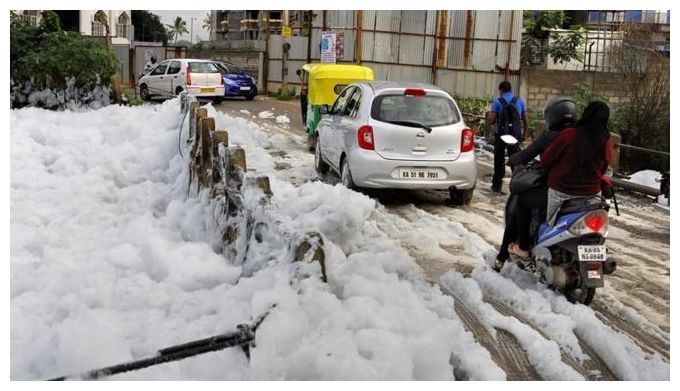







Comment: This has apparently been happening for a number of years on this lake, although this year the 'froth' became utterly 'other-worldly': it's thicker and smellier than ever, and it even caught fire!
This is what the 'froth' looked like in April this year:
And here it is on fire in May:
Most everyone is assuming that this is caused by untreated sewage pouring into the lake as a result of mismanagement of the city's explosive growth in recent years. There was a mass fish kill in a nearby lake in 2011. The following report in The Hindu attributes the froth's 'rotten eggs' sulphur smell to methane: While methane is a by-product of sewage, untreated sewage does not typically result in such 'fiery froth'. Given the hundreds of instances of unusual methane outgassing we've collected from around the world over the last decade, we naturally wonder if this 'froth' phenomenon may be the result of - or at least significantly amplified by - methane outgassing coming from below, either directly or tangentially related to the global increase in seismic activity.
After all, if geysers of methane can erupt on a golf course in Ontario, and methane gas pockets can surface then detonate and leave behind incredible crater-holes in Siberia, anything is possible on our changing planet.