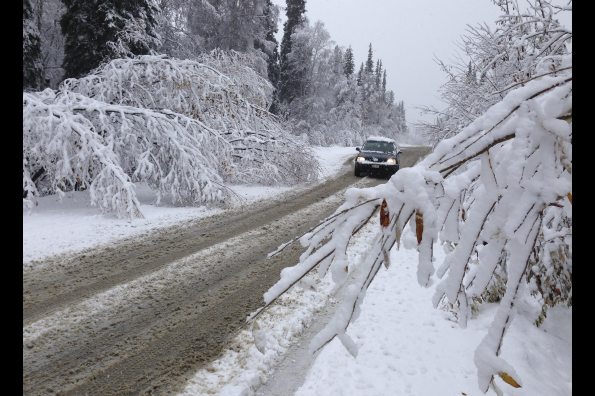
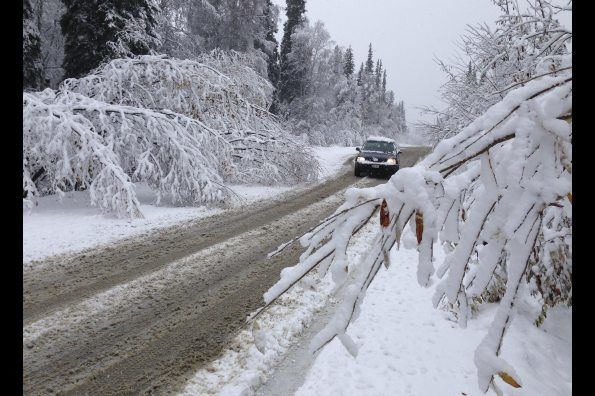
© www.adn.comEarly snow in Fairbanks
A disaster declaration was being discussed Wednesday evening by the Fairbanks North Star Borough after
snowfall caused thousands of power outages and paralyzed much of the area, borough spokesperson Lanien Livingston said. According to Livingston, a final decision on the declaration won't be made until Thursday or Friday.
At about 6:10 p.m. Wednesday, Golden Valley Electric Association reported 7,000 customers didn't have power. A few hours later, the company said it "continued to make headway," although there were still "a lot" of trees down on power lines. GVEA had reported on Wednesday morning that
more than 20,000 people had lost power at some point overnight Tuesday as heavy snow fell. "Due to the outages being so widespread, it is impossible to list all the streets or neighborhoods that crews are working (on)," GVEA wrote on Facebook.
In a special weather statement, the National Weather Service said
Fairbanks set a new daily snowfall record of 11.2 inches on Tuesday. The previous record had been set in 1972 at 7 inches. NWS said North Pole accumulated 10 inches of snow, Mile 3 of Chena Hot Springs Road reported 15 inches,
South Fox reported 15.5 inches and the University of Alaska Fairbanks accumulated 13 inches. Snow was expected to fall in Fairbanks on Wednesday night and continue through the weekend. There were no winter storm warnings in effect late Wednesday evening in any part of the Interior.
GCI reported to the borough that
"many cell towers" were down because of the power outage, according to borough spokesperson Amber Courtney. "So that means people can't call 911 from their cellphones; they'll need to find landlines," Courtney said.

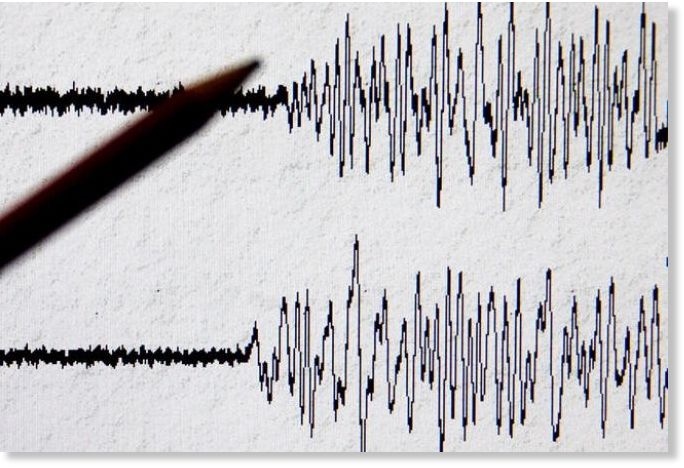
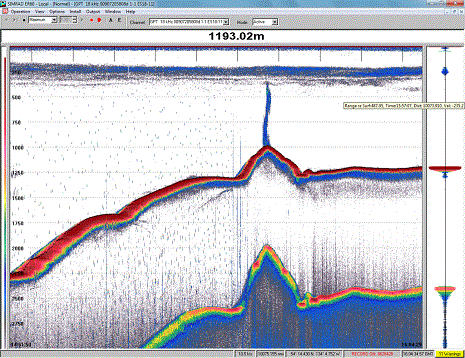

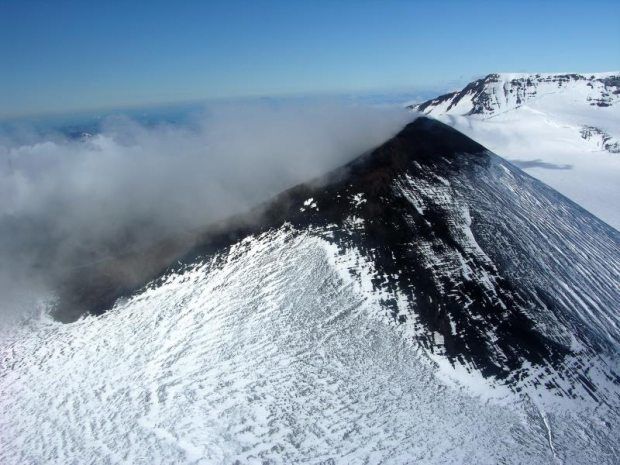






Comment: Other underwater volcanoes have been discovered in recent times off the coast of Australia, New Zealand and Antarctica. In April this year, scientists were stunned by the apparent eruption of a submarine volcano, 'Axial Seamount' off the Northwest US coast (at a similar time to the devastating Nepalese earthquake and the massive eruption of the Calbuco volcano in Chile), which could explain the "unprecedented warming occurring over the last 13 years" of water in this area.
As the number of volcanoes erupting right now is greater than the 20th century's YEARLY average, a comparable escalation in activity of their underwater counterparts seems logical.
It is estimated there are up to one million submarine volcanoes on our planet. Effects from this volcanic activity, combined with increased methane outgassing, radiation from the Fukushima disaster are probably also causing the ongoing devastation of marine life, mass fish die offs and strange migratory behaviour we are currently witnessing.