Earth Changes
2013-10-30 02:51:51 UTC
2013-10-29 23:51:51 UTC-03:00 at epicenter
Location
35.413°S 72.368°W depth=18.3km (11.4mi)
Nearby Cities
9km (6mi) SSE of Constitucion, Chile
59km (37mi) WNW of San Javier, Chile
61km (38mi) N of Cauquenes, Chile
63km (39mi) W of Talca, Chile
268km (167mi) SW of Santiago, Chile
Technical Details
Seattle - There have been recent reports of starfish that appear to have melted in bodies of water located in Washington state and British Columbia. Biologists are not yet sure about what is causing these creatures to die in such an unusual way.
According to King 5, biologists recently went scuba diving in the waters of Puget Sound to recover several different healthy and diseased starfish. During their expedition, they noticed a disturbingly large number of starfish that appear to have died and melted into a pile of goo on the ocean floor.
How much longer do we have before the ice begins to spread across the Earth's surface? Less than a hundred years or several hundred? We simply don't know.
Even if all the temperature increase over the last century is attributable to human activities, the rise has been relatively modest one of a little over one degree Fahrenheit - an increase well within natural variations over the last few thousand years.
While an enduring temperature rise of the same size over the next century would cause humanity to make some changes, it would undoubtedly be within our ability to adapt. Entering a new ice age, however, would be catastrophic for the continuation of modern civilization.
The storm claimed 14 lives in Europe.
Particularly hard hit was the north German port city of Hamburg, which saw wind gusts of up to 120 km/hr. That in itself is not an unusual event for the city, as North Sea storms of this magnitude occur about every 5 or 10 years. What was unusual and devastating, however, was how the city waited until the storm was raging over the city at peak fury before issuing any storm warning at all. Hamburg is governed by a coalition of socialists and environmental greens.
Meteorologist Dominik Jung of wetternet.de here writes that even though Storm Christian had been forecast for days, Hamburg city officials remained deeply asleep and did not wake up to issue any storm warning until 2:26 pm Monday afternoon. By that time the storm was already raging at its peak and the city had plunged into chaos. See wind speed chart below.
2013-10-29 10:37:55 UTC
2013-10-29 20:37:55 UTC+10:00 at epicenter
Location
61.694°S 154.730°E depth=10.0km (6.2mi)
Nearby Cities
645km (401mi) NW of Young Island,
1912km (1188mi) SSW of Invercargill, New Zealand
1961km (1219mi) SSW of Gore, New Zealand
2032km (1263mi) SSW of Dunedin, New Zealand
2150km (1336mi) S of Hobart, Australia
Technical Details

The Castle Geyser at Yellowstone National Park is a dramatic manifestation of a giant magma reservoir — which turns out to be two and a half times larger than previously thought.
The reservoir of molten rock underneath Yellowstone National Park in the United States is at least two and a half times larger than previously thought. Despite this, the scientists who came up with this latest estimate say that the highest risk in the iconic park is not a volcanic eruption but a huge earthquake.
Yellowstone is famous for having a 'hot spot' of molten rock that rises from deep within the planet, fuelling the park's geysers and hot springs1. Most of the magma resides in a partially molten blob a few kilometres beneath Earth's surface.
New pictures of this plumbing system show that the reservoir is about 80 kilometres long and 20 kilometres wide, says Robert Smith, a geophysicist at the University of Utah in Salt Lake City. "I don't know of any other magma body that's been imaged that's that big," he says.
Smith reported the finding on 27 October at the annual meeting of the Geological Society of America in Denver, Colorado.
Yellowstone lies in the western United States, where the mountain states of Wyoming, Montana and Idaho converge. The heart of the park is a caldera - a giant collapsed pit left behind by the last of three huge volcanic eruptions in the past 2.1 million years.
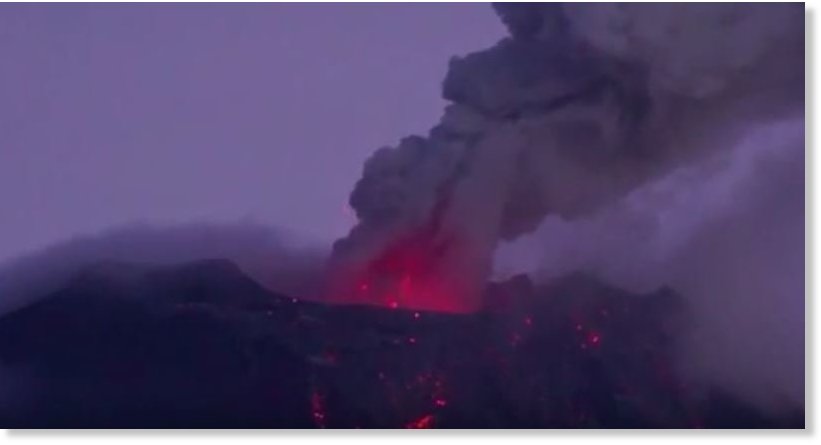
A new eruption started this week at the Zhupanovsky volcano, about 70 km northeast of the capital of Kamchatka, Petropavlovsk-Kamchatsky, which last erupted in 1959. It is a complex volcano composed of several overlapping cones aligned on a roughly east-west oriented axis. The new eruption comes from the same vent that has been also the site of all known historical eruptions, located west of the highest point of the volcanic massif.
The Chilean Fresh Fruit Exporters Association said that freezing temperatures throughout mid-September hit the country's fruit growers with the coldest frost since 1929.
Temperatures fell to an average of 19 degrees Fahrenheit for an average of seven hours in several of the Chile's growing regions, contributing to a huge drop-off in fruit exports.
Chilean growers exported about 282 million boxes of fruit last year, and experts believe that exports will fall short of that by about 50 million boxes for this year. However, when production increases are taken into account, the total frost damage to fruit production could be closer to 60 million or 65 million boxes.
The wine industry was hit hard by the frost as well.

A handout picture from the London Fire Brigade shows firefighters standing outside three houses collapsed in a gas explosion suspected to have been caused by a gas main damaged by a falling tree in Hounslow, west London, on October 28, 2013
Four people were killed in Britain and three in Germany as heavy rain and high winds battered the region. The storm also claimed two victims in The Netherlands, one in France and one in Denmark.
Rough conditions at sea also forced rescuers to abandon the search for a 14-year-old boy who disappeared while playing in the surf on a southern English beach on Sunday.
British Prime Minister David Cameron described the loss of life as "hugely regrettable".
Winds reached 99 miles (159 kilometres) per hour on the Isle of Wight off the southern English coast, according to Britain's Met Office national weather centre, while more than 500,000 homes in Britain and France were left without power.
Heavy rain and winds of 80 mph elsewhere brought down thousands of trees and left hundreds of passengers trapped in planes at Copenhagen airport.


Comment: This article adds one more piece to the newly emerging consensus on the direction that our climate seems to be heading. Those scientists who carefully observe the reality on the ground and scrutinize the available facts see what is coming our way in the not so distant future: the return to an Ice Age.