Around 50 white-throated laughingthrush birds died mysteriously in the forests of Berinag sub-division of Pithoragarh district in Uttarakhand.
Berinag forest range officer Manoj Sanwal confirmed the mass death, saying they were being sent for a postmortem to ascertain the cause of their death.
The birds were found dead on Tuesday, he said.
Eyewitnesses who reported the matter to forest authorities said the birds either fell dead from trees or died instantly after falling to the ground.
More than 1,000 dead birds found on the west side of Sikeston are believed to be from the weather.
The City of Sikeston posted a statement from Scott County Conservation Agent Andrew Mothershead.
In the statement, he said on Monday, March 2, he and a natural history biologist for the Missouri Department of Conservation responded to Wakefield Road west of Sikeston to investigate reports of a large number of dead birds in a general area north and west of the power plant.
The carcasses of red-winged blackbirds, brown-headed cowbirds, grackles and European starlings were found in the fields along Wakefield Road.
Mothershead said they also saw many birds showing signs of physical injury in areas near the road.
Comment: Similar incidents over the last 3 months:
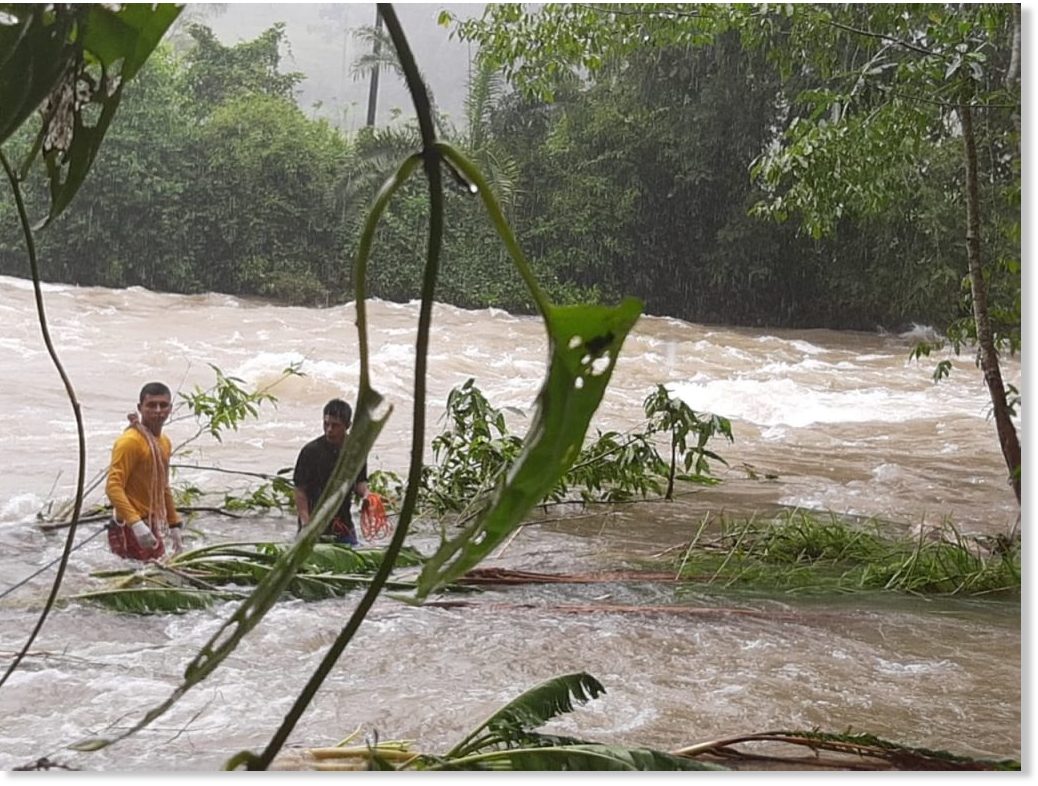
Disaster authorities in Honduras reported severe weather, including strong winds and heavy rain, affected northern departments of the country from 28 February, 2020.
The Office of Risk Management and National Contingencies (Copeco) almost 800 people hav been displaced as a result of the severe weather, mostly in the department of Cortés where3 shelters have been set up.
Overall 17,700 people were affected in the 6 northern departments of Gracias a Dios, Colón, Atlántida, Cortés, Yoro and Islas de la Bahía.
George Stephens Euro Weekly Sun, 16 Feb 2020 20:02 UTC
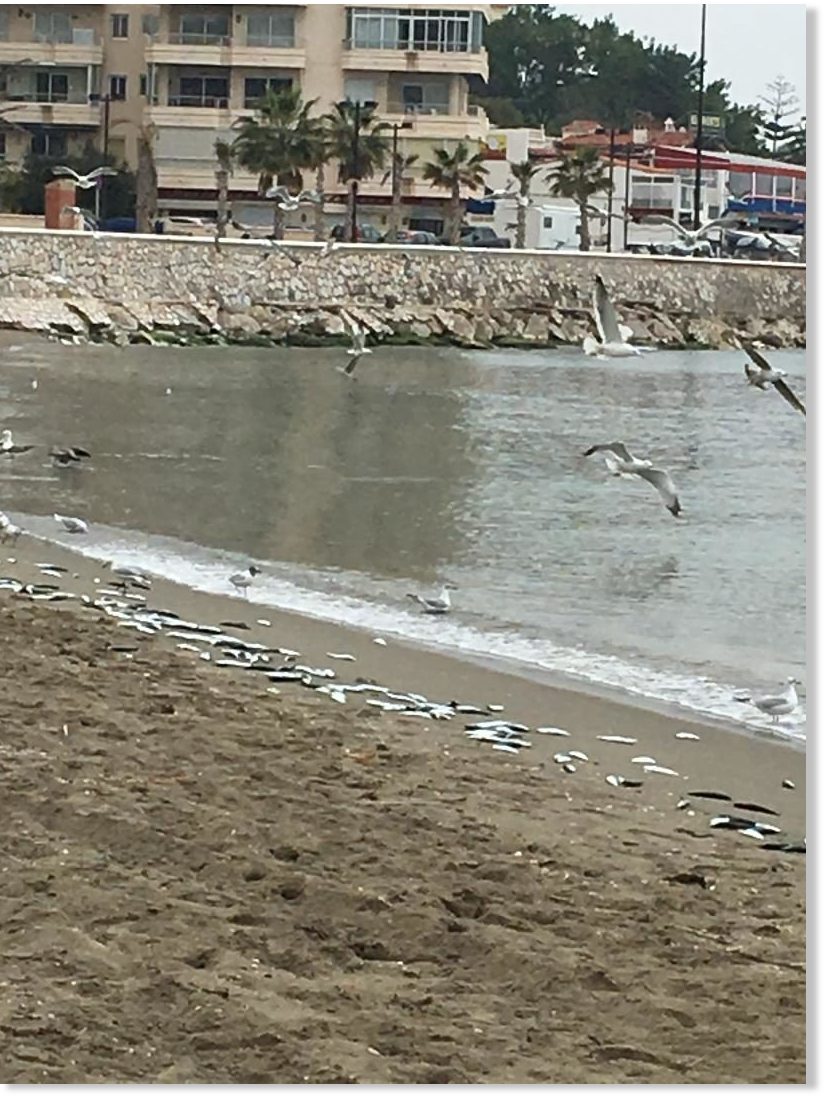
The beaches this morning in Spain's Fuengirola are littered with dead fish both on the beach and in the water under mysterious circumstances.
Thousands of dead fish are floating in the water and strewn across the beach with a warning going out from culinary experts not to be tempted to collect and take the fish home for consumption.
Fish specialist chef Jo Jo from the popular Luna Bar that hosts Friday fish nights warned "These fish could be contaminated and whilst the temptation could be to bag them up and take home for eating - it could have complications causing sickness"
Hundreds of vultures have been found dead in Guinea-Bissau over the past 10 days, according to the Vulture Conservation Foundation (VCF).
As of 28 February, the known death toll was placed at 648 - and this figure continues to rise in what represents a massive blow to the country's vulture populations.
Last week, an incident was reported in the eastern province of Bafatá, which was initially thought to have caused around 200 vulture deaths. However, the death toll subsequently increased substantially. Poisoning was initially thought to be the cause, given that this has become a frequent occurrence across Africa and is now recognised as posing the biggest threat to vultures around the continent.
André Botha, the Endangered Wildlife Trust Africa's Vultures for Africa Programme manager, said: "In recent years, we have unfortunately faced several incidents where hundreds of vultures died around a poisoned carcass, usually due to human-wildlife conflict with predators, we first thought this was such a case."
However, the situation has since become more confusing, with dead birds found across several areas within Bafatá province. Such dispersion of victims has complicated the case, as poisoning incidents are typically more concentrated. Therefore, the precise cause of death remains to be established.
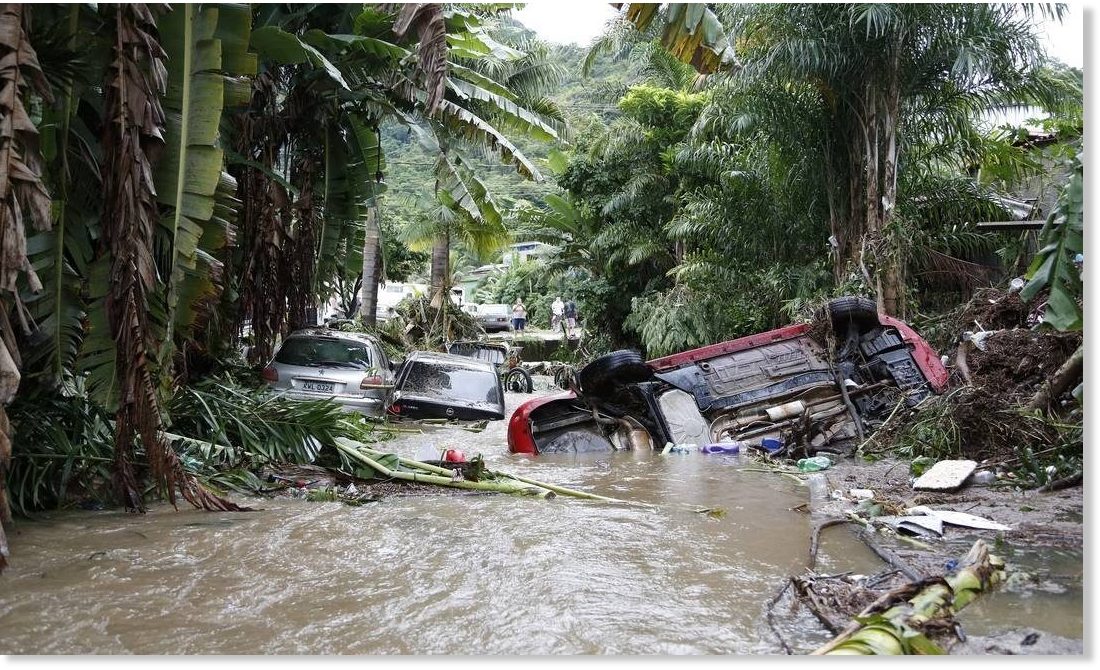
Heavy rain from 29 February triggered flooding and landslides in the state of Rio de Janeiro, Brazil, causing widespread damage and at least 3 deaths, according to local media.
Some areas recorded more than 180mm of rain from late 29 February to early 02 March. A weather station in Mendanha recorded 61.4mm of rain in 1 hour late on 29 February, with 17.6mm falling in 15 minutes.
The rain triggered flooding and landslides causing severe damage in the Metropolitan Region of Rio, particularly western areas, and also in the Baixada Fluminense region of the state.
Dozens of roads were flooded, cars swept away and houses damaged. Two people were injured when a house collapsed in Magé, in Baixada Fluminense. Rio Metroplitan Civil Defense responded to 161 calls in total, many of them for collapsed or damaged buildings.
Hannah Osbourne Newsweek Mon, 02 Mar 2020 14:29 UTC
Klyuchevskoy
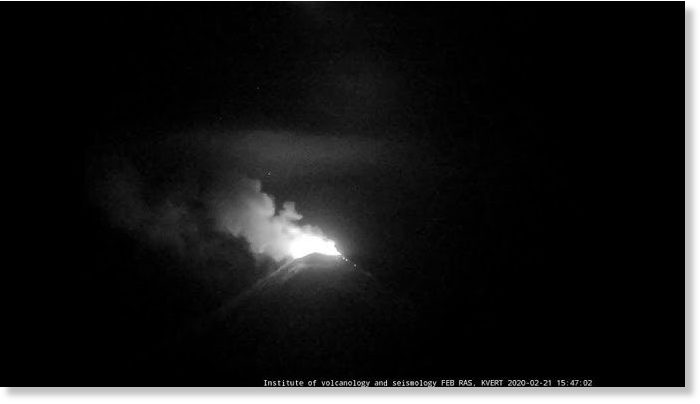
Russia's highest volcano, Klyuchevskoy, has erupted, sending ash and steam in a volcanic cloud up to 20,000 feet into the air.
On Monday, a report from the Kamchatka Volcanic Eruption Response Team (KVERT) said a "moderate explosive eruption" of Klyuchevskoy was ongoing, and that explosions of ash between 16,400 and 23,000 feet "could occur at any time."
The aviation code of the volcano, which informs of the risk posed to aircraft, was listed as orange, the second highest warning level. An orange code means the ash cloud produced by the eruption has the potential to impact flights. If volcanic ash gets into an aircraft it can lead to the failure of navigation instruments and engines. "Ash particles sucked into an engine can melt quickly and accumulate as re-solidified deposits in cooler parts, degrading engine performance even to the point of in-flight compressor stall and loss of thrust power," the United States Geological Survey (USGS) notes.
According to the KVERT report, the height of the volcanic cloud had reached between 18040 and 19680 feet. The cloud had traveled nine miles and was drifting westwards.
Perth's wild weather over the last week has broken records as the city experienced its first five consecutive days of thunder and lightning in the summer months.
A severe storm hit the metropolitan area on Tuesday afternoon, flooding roads, tearing roofs off homes, uprooting trees and trapping some people in their cars.
On Thursday night came another severe weather warning from Gingin to Mandurah as a freak electrical show filled Perth's skyline.
The Perth area today recorded its fifth consecutive day of thunderstorm activity, which the Bureau of Meteorology said was a record for the summer months.
On average, Perth has around two days of thunderstorms in February.
There's been a lot of talk about weather records being broken this winter, but it was only January's epic snowfall totals that have made it into the record books so far. In January 2017, the Central Sierra Snow Lab (CSSL) near Donner Pass and many Tahoe Sierra resorts set new monthly snowfall tallies ranging from 20 to 25 feet.
But the current seasonal snowfall total of about 42 feet at the CSSL means we still have a long way to go to reach Top 10 status at Donner Pass, let alone exceed the 68 feet that fell in 1938. We are, however, closing in on the wettest year in the precipitation category, currently holding at third place behind 1982 and 1995, the first- and second-ranked water years since 1871. Remember, precipitation is rain and the water content of snow combined.
The signature weather pattern of this winter has been a seemingly relentless series of atmospheric rivers that transported huge volumes of water vapor from the Pacific Ocean into the West Coast. At CSSL, resident scientist Randall Osterhuber has measured about 100 inches of precipitation so far — the annual average is 55 inches — but warmer temperatures due to the subtropical origin of many of the storms has limited snowfall totals at elevations below 7,000 feet.
Comment: That was California during the winter of 1861-1862. Further north in Washington and Oregon that winter, they experienced all that rain plus an intensely cold freeze. Speculating on what caused that extreme winter, John Caldbick at HistoryLink.org writes:
[...] the protracted and severe cold weather of the winter of 1861-1862 was seen throughout much of the Northern Hemisphere and was not merely a local phenomenon. Scientists also learned that in May of 1861, a large volcano named Dubbi in the northeast African country of Eritrea had erupted. It was the largest volcano recorded on that continent since records had been kept, and it spewed a "sulfate aerosol veil" into the sky.
Subsequent studies conclusively established a link between massive injections of sulfates into Earth's atmosphere by volcanoes and widespread, if temporary, global cooling. Today the scientific consensus is that this was the most likely cause of the Northwest's most severe winter on record...
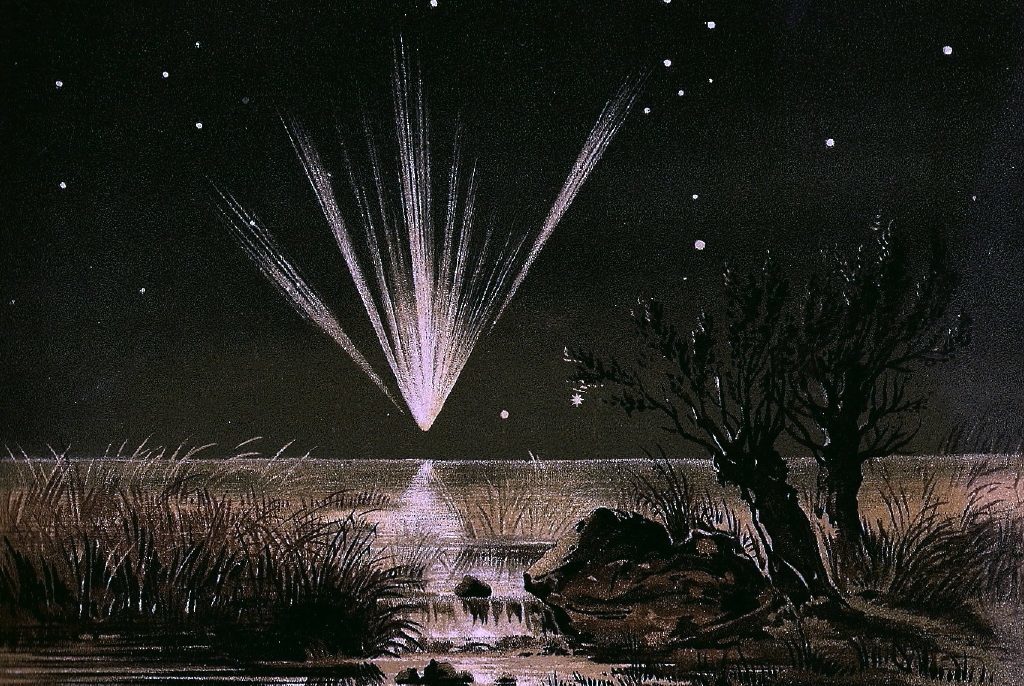
Indeed, this volcanic eruption on the African shore of the Red Sea occurred in May 1861. But just weeks later, the Great Comet of 1861 became visible to the naked eye...
For two days, when the comet was at its closest, the Earth was actually within the comet's tail, and streams of cometary material converging towards the distant nucleus could be seen. [...]
Emily Holder, wife of Joseph Bassett Holder, while stationed at Fort Jefferson, Florida:
"Its appearance was sublime, as it extended over nearly half of the heavens. Many wondered if the world was not coming to an end."
Great Comet of 1861, also known as C/1861 J1 or comet Tebbutt; drawing by E. Weiss
The US Civil War began in 1861, as did the Dungan Revolt in China, which left over 20 million dead in a decade-long inter-ethnic and religious war. There was also a major earthquake and tsunami off the Indian Ocean coast of Sumatra in 1861; the next most powerful and devastating of which would be the 2004 disaster at the same location.
According to censuses in Europe, populations there declined in numbers in the early 1860s, the first such declines since the early 1700s, suggesting that excess deaths occurred from cholera and plague outbreaks that overlapped with the above events.
1861-1862 seems then to have been something of a nexus point in the recurring rhythms of natural climate change. Today, the US isn't quite being torn apart by civil war, but the social climate is nevertheless being reflected in the natural climate.
Matthew Cappucci Yahoo! News Fri, 28 Feb 2020 12:44 UTC
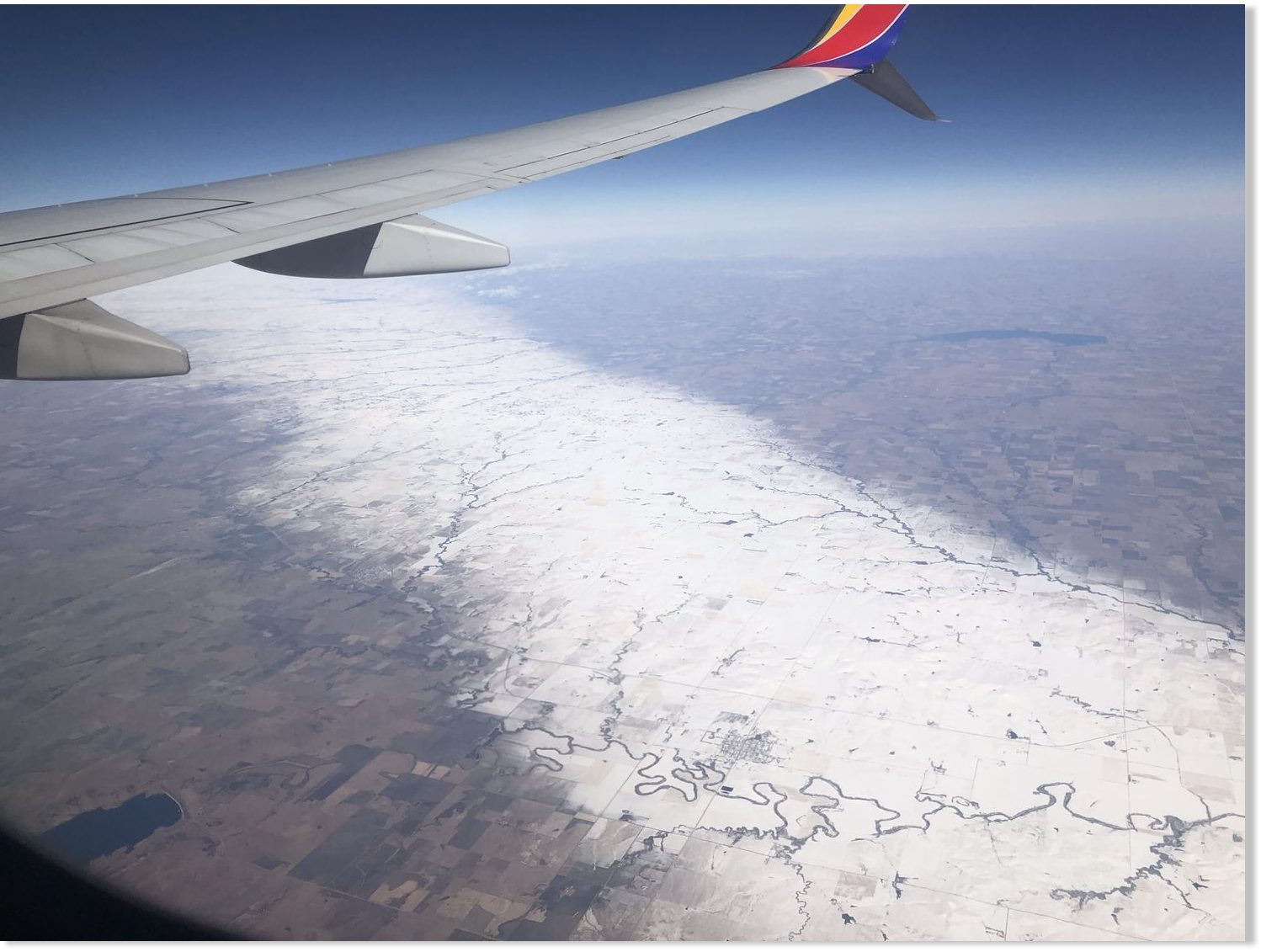
Rare narrow band of snow 150 miles long and 15 wide
Leigh Marts was on her way from St. Louis to Phoenix on Wednesday when she spotted something unusual out the window of her Southwest Airlines flight: a narrow strip of white, flanked by bare grass, lay painted across the Kansas prairie below.
A similar sight was seen above Hutchinson, Kansas.
Weather satellites confirmed the bizarre feature, which highlights the meteorological caprice that can give rise to such narrow swaths of snow. More than a foot of snow fell in the band, which was 10 to 15 miles wide in places. Just a few miles on either side, there were hardly flurries.
The thin stretch of intense snow was oriented northwest to southeast, passing through parts of Russell, Lincoln and Ellsworth counties in Kansas. The snow persisted toward Cottonwood Falls and Marion.
"The purpose of GLADIO was to attack civilians, the people - women, children, innocent people, unknown people, far removed from any political game. The reason was quite simple: to force the public to turn to the State and demand greater security. Under a strategy of tension, you 'destabilize in order to stabilize', to create tension within society and promote conservative, reactionary social and political tendencies."
~ Italian neo-fascist whose prosecution led to the discovery of NATO's 'Gladio' networks across Western Europe
- Vincenzo Vinciguerra
”
Recent Comments
Surely just a coincidence. Like the anti-terror exercises on 11th September 2001, and the "virus pandemic" exercises in September 2019 ... We are...















Comment: Similar incidents over the last 3 months: