Secret HistoryS


Meteor

On this day in 1954, Alabama woman struck by nine-pound meteorite

Ann Hodges
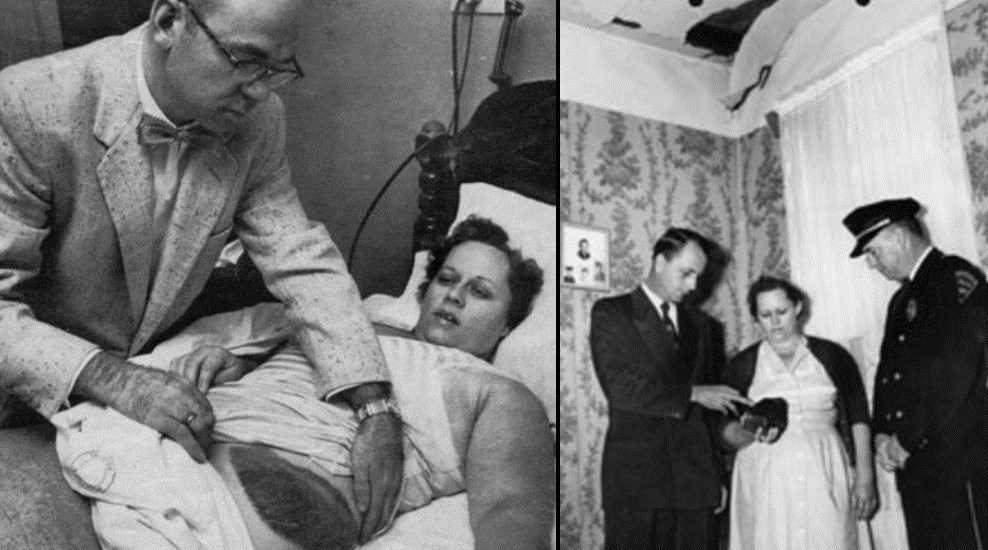
© Alabama Museum of Natural HistoryAnn Hodges was struck by a meteor in 1954 while she was inside her home in Sylacauga, Alabama.
The state of Alabama is known for many things; football and politics come immediately to mind.

Well, you can add another item to the state's unique history and that is, Alabama is the only place in the world where it's confirmed a person was struck and injured by a falling meteorite.

On this date in 1954, Mrs. Ann Hodges was lying on her couch in her Sylacauga home, when a nine-pound meteorite crashed through her roof.

The extra-terrestrial stone struck her hip and created a football sized bruise.

Both state and national scientists examined the fragment.

Propaganda

A German Mata Hari and a fascist Father - The Profumo affair revisited

The Profumo Affair: A German Mata Hari and a Fascist Father
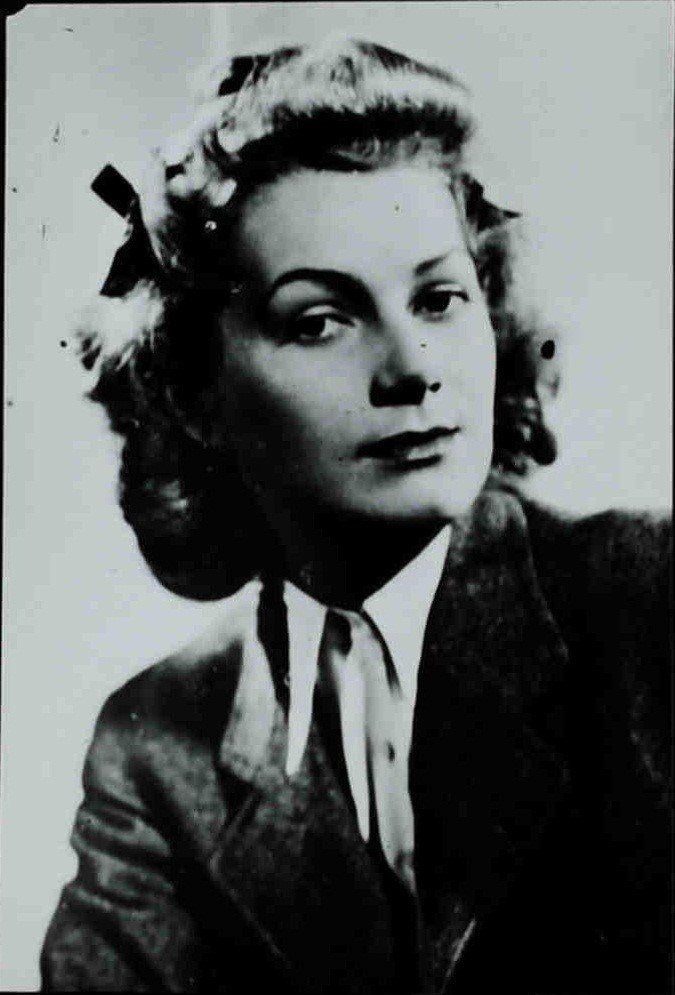
© Crown Copyright National ArchivesModel Gisela Klein
A British Security Service file released by the National Archives suggests there was more to the infamous Profumo scandal of 1963 than met the eye of the press. John Profumo, Secretary of State for War in the Conservative Government of Harold MacMillan, resigned in disgrace after revelations that he shared a mistress with a Soviet spy.

In 1963 Christine Keeler, a young part-time topless dancer aspiring to be a model, claimed that she was intimate both with Profumo and Soviet Assistant Military Attaché Evgeny Ivanov, presumed to be an officer of the GRU (Soviet military intelligence). Amid huge media frenzy Profumo resigned and the Conservative government fell.

Had the media been aware of another modelling acquaintance of Profumo, the German-born Gisela Winegard-Klein, the frenzy would have most definitely reached even higher fever pitch.

Star of David

British Cold War documents reveal forgotten radical Zionist attempt to attack UK government

Palestine partition zionism
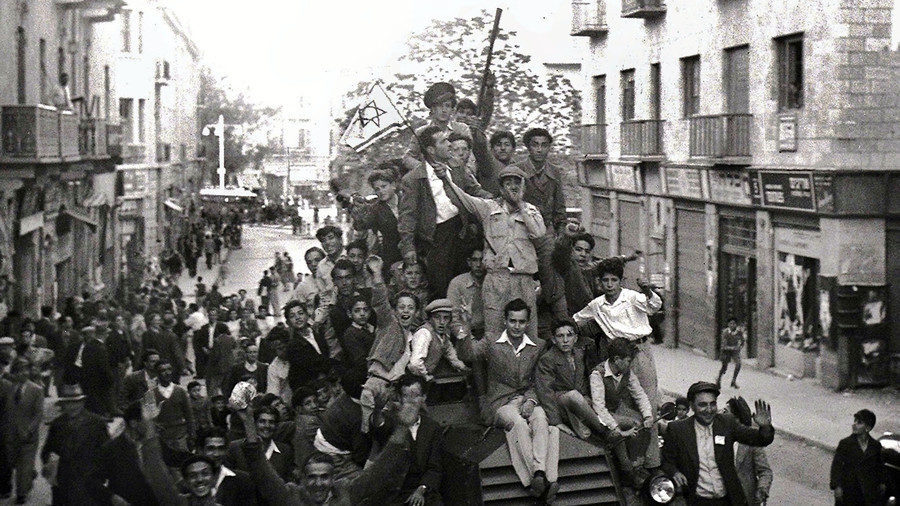
© ReutersNOV 1947 FILE PHOTO - Jews crowd onto a British army armoured car as they celebrate in downtown Jerusalem the morning after the United Nations voted on November 29, 1947 to partition Palestine.
In and amongst the trove of Cold War-era archives released by MI5 this week, between documents on John Profumo and Kingsley Amis, was a file on two radical Zionists and their thwarted attempt to carry out a letter-bombing campaign targeting the British government.

Ms Gilberte Elizabeth Lazarus, also known as Betty Knout, and Mr Yaacov Levstein were two members of the Stern Group, also known as the Lehi, militant Zionists intent on the violent removal of the British from Palestine.

The released documents detail how, on June 2, 1947, the pair were arrested on the French-Belgian border carrying envelopes addressed to leading British officials; Sir Alan Cunningham, the Palestine high commissioner, and General G. H. A. MacMillan, commander of the British troops in Palestine, among others. Inside the envelopes, and behind the false bottom of Lazarus' suitcase, was gelignite, detonators, batteries and timed-fuses. Lazarus was sentenced to a year in prison, Levstein to eight months.

Cross

Age of Christ's alleged tomb revealed

tomb of Jesus
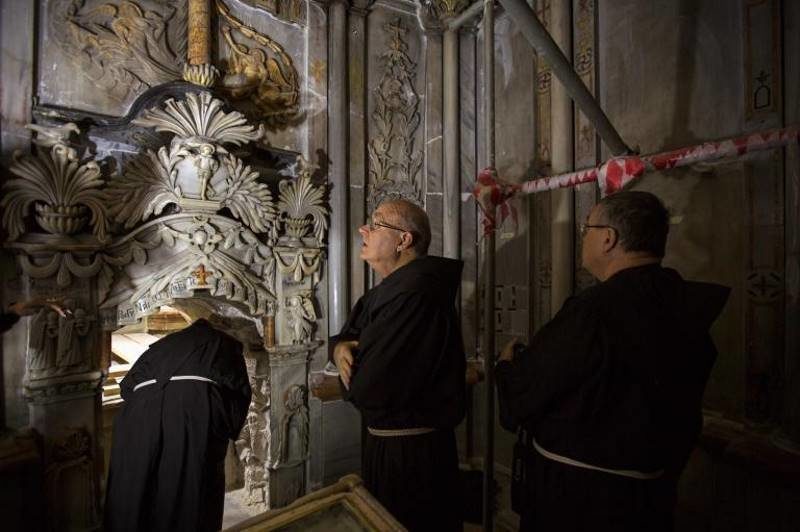
© Oded Balilty, Associated Press for National GeographicFranciscan priests visit the traditional site of Jesus' tomb during its renovation in the Church of the Holy Sepulchre.
Construction materials date to Roman times, suggesting the original holy site's legacy has survived despite its destruction 1,000 years ago

Over the centuries, Jerusalem's Church of the Holy Sepulchre has suffered violent attacks, fires, and earthquakes. It was totally destroyed in 1009 and subsequently rebuilt, leading modern scholars to question whether it could possibly be the site identified as the burial place of Christ by a delegation sent from Rome some 17 centuries ago.

Now the results of scientific tests provided to National Geographic appear to confirm that the remains of a limestone cave enshrined within the church are remnants of the tomb located by the ancient Romans.

Mortar sampled from between the original limestone surface of the tomb and a marble slab that covers it has been dated to around A.D. 345. According to historical accounts, the tomb was discovered by the Romans and enshrined around 326.

Caesar

First archaeological evidence discovered of Julius Caesar's UK landing

Ebbsfleet
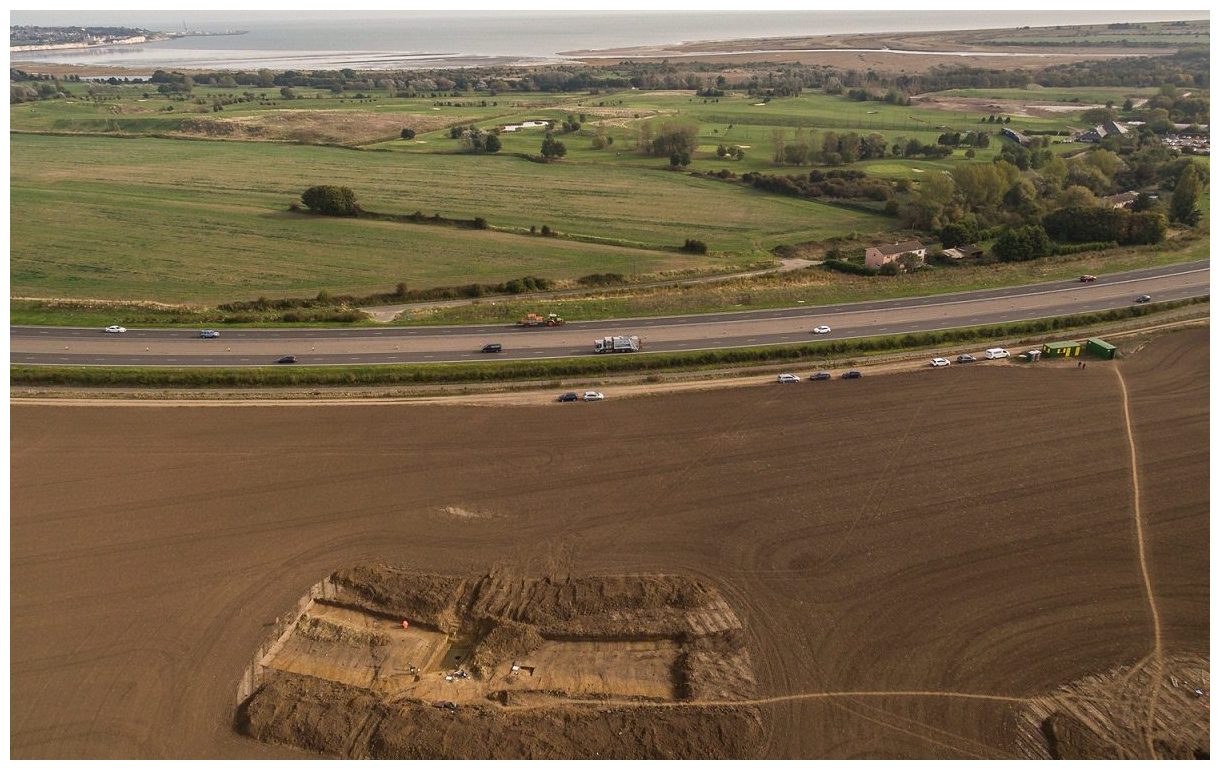
© University of LeicesterView of the University of Leicester excavations at Ebbsfleet in 2016 showing Pegwell Bay and the cliffs at Ramsgate.
The first Roman invasion of Britain by Julius Caesar in 55BC is a historical fact, with vivid accounts passed down by Tacitus, Cicero and Caesar himself.

Yet, despite a huge landing force of legionaries from 800 ships, no archaeological evidence for the attack or any physical remains of encampments have ever been found.

But now a chance excavation carried out ahead of a road-building project in Kent has uncovered what is thought to be the first solid proof for the invasion.

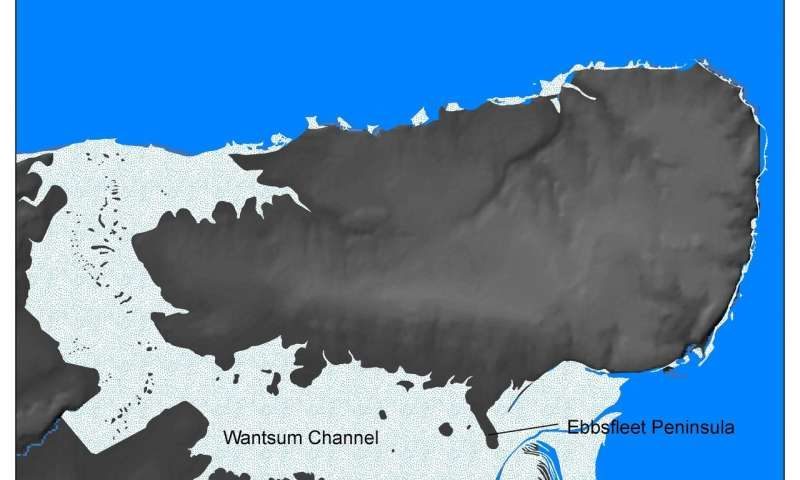
Archaeologists from the University of Leicester and Kent County Council have found a defensive ditch and javelin spear at Ebbsfleet, a hamlet on the Isle of Thanet.
Caesar landing uk
© University of Leicester3 Lidar model of topography of Thanet showing Ebbsfleet.

Treasure Chest

Hidden jewelry stash hints at how ancient elites protected the family treasures

ancient jewelry
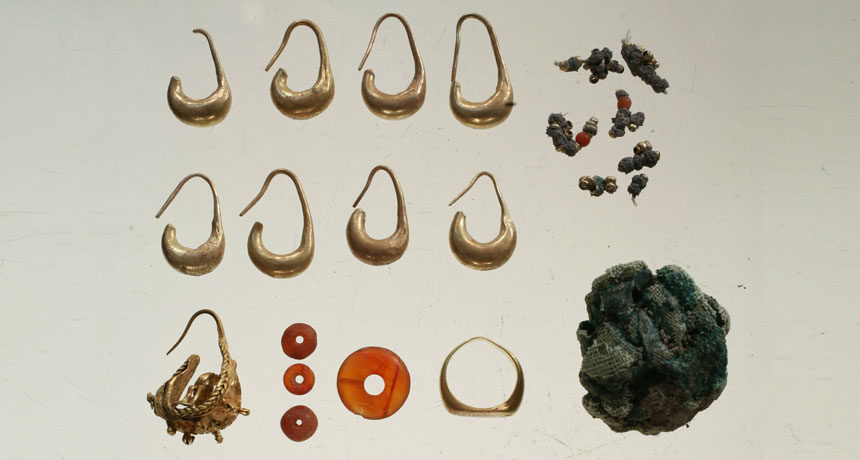
© Megiddo expeditin, Tel-Aviv UniversityHARD CACHE: A 3,100-year-old jewelry hoard previously discovered at a site in Israel includes earrings, beads, a ring and two linen cloths used as a wrapping for 35 pieces of silver jewelry.
Long before anyone opened a bank account or rented a safe deposit box, wealth protection demanded a bit of guile and a broken beer jug. A 3,100-year-old jewelry stash was discovered in just such a vessel, unearthed from an ancient settlement in Israel called Megiddo in 2010. Now the find is providing clues to how affluent folk hoarded their valuables at a time when fortunes rested on fancy metalwork, not money.

At the fortress city of Megiddo, a high-ranking Canaanite family stashed jewelry in a beer jug and hid it in a courtyard's corner under a bowl, possibly under a veil of cloth, Eran Arie of the Israel Museum in Jerusalem, said November 17 at the annual meeting of the American Schools of Oriental Research.

Snowflake

Little Ice Age foiled Europeans' early exploration of North America

1609 America Explorer Ice Age Little
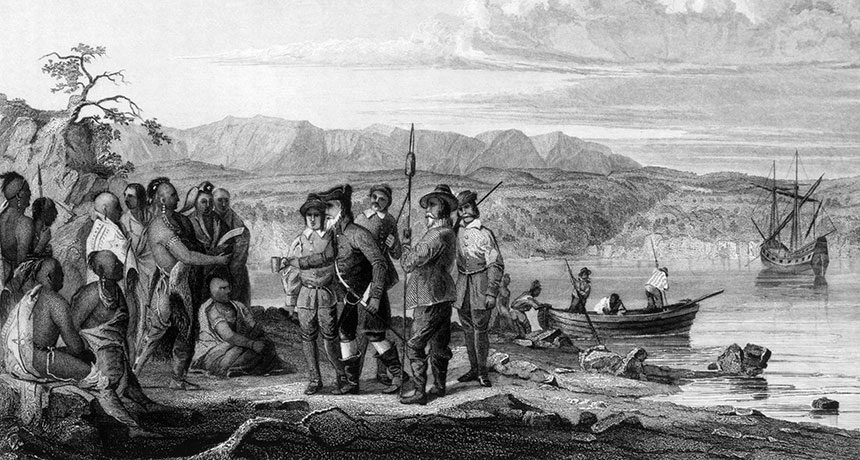
LOOKING FOR NEW LANDS A historian argues that climate, along with other factors, impeded Europeans early attempts at colonizing North America. English explorer Henry Hudson is depicted here meeting Native Americans in 1609 in what’s now New York.
Many people may be fuzzy on the details of North America's colonial history between Columbus' arrival in 1492 and the Pilgrims' landing on Plymouth Rock in 1620. But Europeans were actively attempting to colonize North America from the early 16th century onward, even though few colonies survived.

As historian Sam White explains in A Cold Welcome, most early attempts were doomed by fatally incorrect assumptions about geography and climate, poor planning and bad timing.

White weaves together evidence of past climates and written historical records in a comprehensive narrative of these failures. One contributing factor: Explorers assumed climates at the same latitude were the same worldwide. But in fact, ocean currents play a huge role in moderating land temperatures, which means Western Europe is warmer and less variable in temperature from season to season than eastern North America at the same latitude.

Comment: With studies like these it is a wonder that mainstream science can't let go of what was labelled 'manmade global warming'. Clearly our planet's climate is cyclical in nature and humanity's impact is rather negligible. We see what was reported to be happening to the weather back then is happening to us now:


Black Magic

Russian investigators to conduct analysis to verify theory that 1918 murder of Romanov family was a Bolshevik ritual sacrifice

romanovs
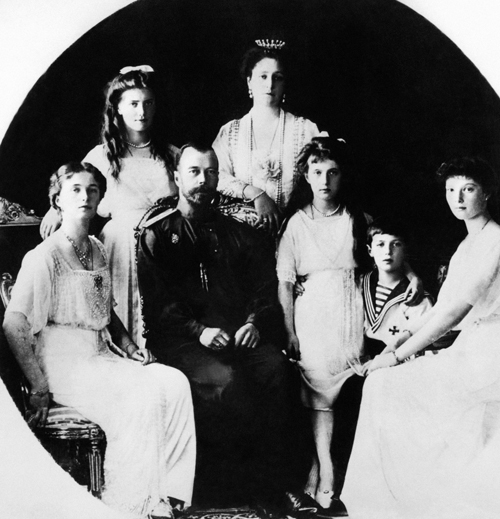
© AFP/Getty ImagesPicture taken in 1917 shows Nicholas II, Czar of Russia, and his family, in one of the latest pictures taken before the Revolution. From Left: Princesses Olga and Maria, Nicholas II, Czarine Alexandra, Princess Anatasia, Czarevitch Alexei and Princess Tatiana.
Investigators plan to conduct "psychological and historical analysis" to verify a theory that the killing of last Russian Tsar Nicholas II and his family in 1918 was a sacrifice made by the Bolsheviks in a bid for global domination.

"Investigators plan to undertake psychological and historical analysis to establish if the shooting of the Russian royal family was a ritual killing," a spokesperson for the Russian Investigative Committee - the agency dealing with especially important and resonant crimes - announced at a Moscow conference dedicated to the probe of the killing of the Romanovs.

Svetlana Molodtsova announced that the Investigative Committee plans to form a special panel of experts comprising representatives from the Russian Academy of Sciences, Moscow and St. Petersburg Universities and the Russian Orthodox Church. She added that the experts would start working after the completion of a major archive research project that was underway at the moment of the conference.

Comment: See also: Did Lenin really order the execution of the Romanovs?


Boat

Loch Ness monster: Those 1975 underwater photos

Nessie
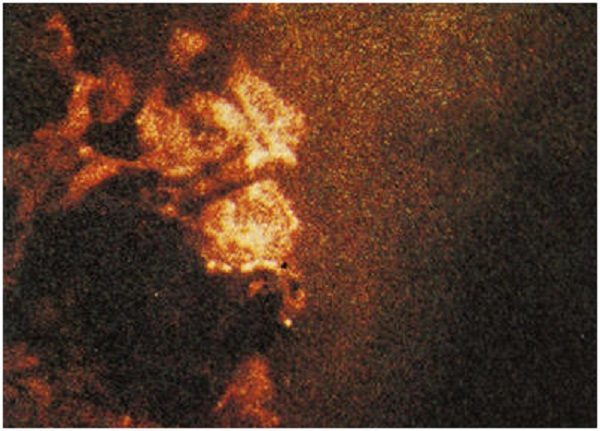
Just before 7 o'clock on the evening of Friday 29 August 1975 the telephone at my home in Leeds rang. An American voice inquired: 'Mr Nick Witchell? Transatlantic call for you from the United States.' After a short pause Bob Rines came on the line to announce news that meant the search for the 'Monster' of Loch Ness was finally over. 'Nick,' his voice came clearly and steadily over the thousands of miles, 'we've got it, we've hit the jackpot. We have detailed close-up colour photographs of the head, neck and body of one of the animals.'

Thus spoke Robert Rines to Nicholas Witchell as found in Witchell's "The Loch Ness Story". It is what I would call the summit of Monster Fever or perhaps we could call it "Peak Nessie". It was back in 1975 when rumours began to appear on the TV and newspapers that ground breaking photographs of the Loch Ness Monster were about to be revealed to the world.

Nicholas Witchell had already published the first edition in hardback of his book the year before and this news made it easy for Penguin Books to go to paperback with a new and final chapter entitled "The Solution". Reading that postscript gives one the impression that this was the last cryptozoological book on the creature. The next one would be zoological. Clearly that never happened, so what went wrong?

Bad Guys

The ugly truths of the first World War and how colonial violence and imperialism have come home to roost

Colonial violence
The Great War is often depicted as an unexpected catastrophe. But for millions who had been living under imperialist rule, terror and degradation were nothing new.

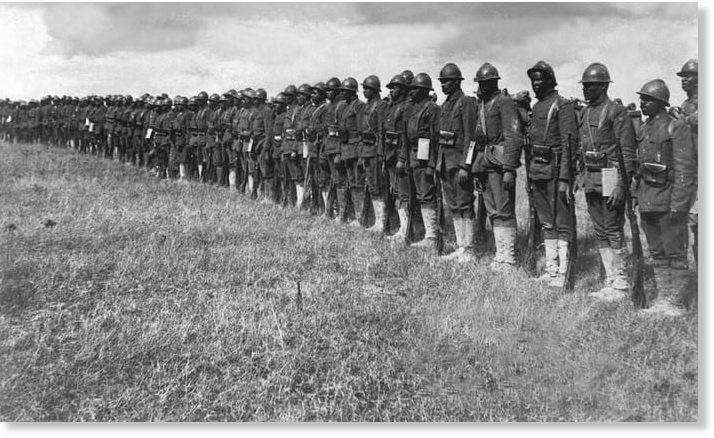
Today on the "Western Front," the German sociologist Max Weber wrote in September 1917, there "stands a dross of African and Asiatic savages and all the world's rabble of thieves and lumpens." Weber was referring to the millions of Indian, African, Arab, Chinese and Vietnamese soldiers and laborers, who were then fighting with British and French forces in Europe, as well as in several ancillary theatres of the first world war.

Faced with manpower shortages, British imperialists had recruited up to 1.4 million Indian soldiers. France enlisted nearly 500,000 troops from its colonies in Africa and Indochina. Nearly 400,000 African Americans were also inducted into US forces. The first world war's truly unknown soldiers are these non-white combatants.

Ho Chi Minh, who spent much of the war in Europe, denounced what he saw as the press-ganging of subordinate peoples. Before the start of the Great War, Ho wrote, they were seen as "nothing but dirty Negroes ... good for no more than pulling rickshaws". But when Europe's slaughter machines needed "human fodder", they were called into service. Other anti-imperialists, such as Mohandas Gandhi and WEB Du Bois, vigorously supported the war aims of their white overlords, hoping to secure dignity for their compatriots in the aftermath. But they did not realize what Weber's remarks revealed: that Europeans had quickly come to fear and hate physical proximity to their non-white subjects - their "new-caught sullen peoples", as Kipling called colonized Asians and Africans in his 1899 poem The White Man's Burden.