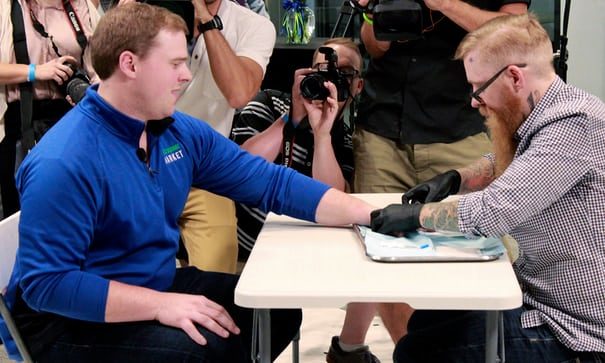
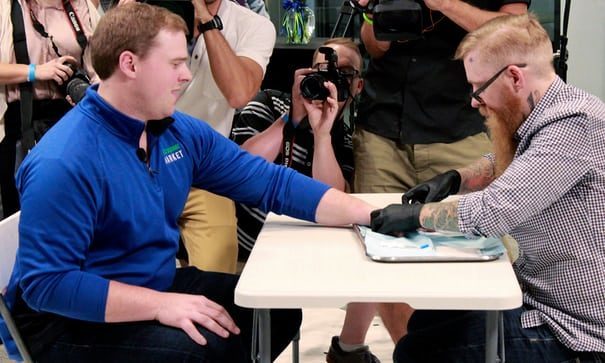
© Jeff BaenenTony Danna, vice-president at Three Square Market, gets his microchip implant.
Last year an American company microchipped dozens of its workers. In a "chip party" that made headlines around the world, employees lined up to have a device the size of a grain of rice implanted under the skin between their thumb and forefinger. At first, Todd Westby, the CEO of Three Square Market, thought only about five or six people - him and a couple of directors, some of the people who worked in the IT department - would volunteer. But of the 90 people who work at the headquarters, 72 are now chipped; Westby has a chip in each hand. They can be used to open security doors, log on to computers and make payments at the company's vending machines.
Can he see it taking off at lots of other companies? "Not necessarily," he says. Or at least not yet. It's partly a generational thing, he believes. "You may never want to be chipped but if you're a millennial, you have no problems. They think it's cool." There are other uses for it - two months ago, the company (whose core business is selling vending machines and kiosks) started chipping people with dementia in Puerto Rico. If someone wanders off and gets lost, police can scan the chip "and they will know all their medical information, what drugs they can and can't have, they'll know their identity." So far, Three Square Market has chipped 100 people,
but plans to do 10,000.




















Comment: The Guardian seems to be subtly attempting to condition people to think that a heavily surveilled society, where everyone would be tracked and monitored, is becoming the new normal and we should just accept it. George Orwell must be turning in his grave.