OF THE
TIMES


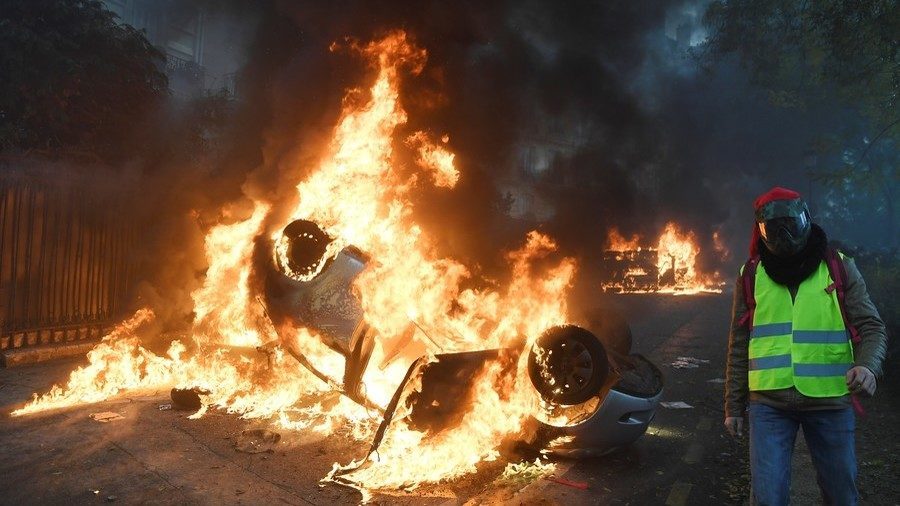
The third consecutive weekend of anti-government demonstrations in France were marred by intensive clashes with police, who used water cannons and tear gas to disperse the protesting crowds.Ironically, most of the police force support the protesters:
Officials say that at least 90 people, among them 16 police officers, were injured in violent protests in the French capital, and over 260 have been arrested. Thousands of police were deployed in Paris to try to contain the protests.
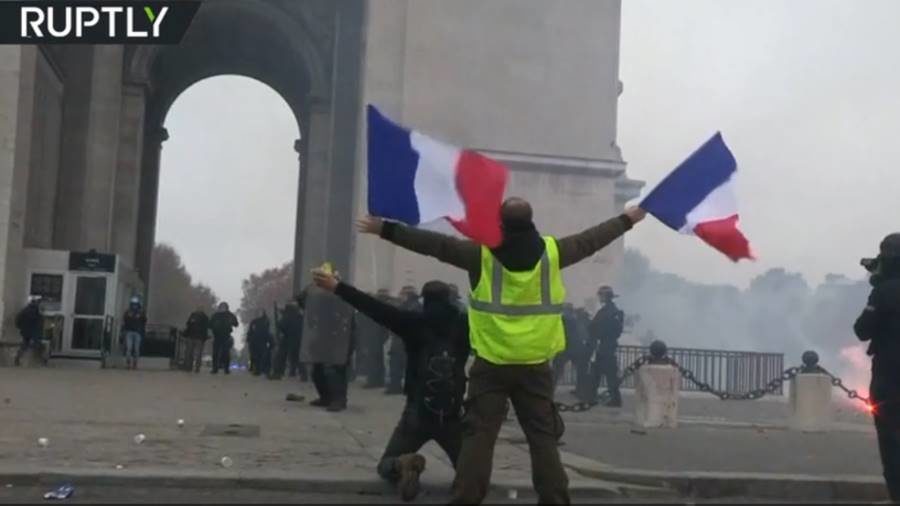
"Most of us back the Gilets Jaunes (Yellow Vests), because we will be directly affected by any rise in fuel prices," Alexandre Langlois, the secretary-general of the VIGI police union told RT France from their studio in Paris. "Most of us can't live where we work, because it is either too expensive, or we would be arresting our next-door neighbors, so we drive significant distances."The Gilets Jaunes protests have many evoking the centuries-old French revolutionary spirit:
Langlois agrees that the movement has been exploited by more radical elements, but says that cops are still reluctant to be sent out against the Yellow Vests, who took their name from the hi-visibility road workers' jackets they have chosen as their symbol.
"It is difficult, because in our heart we support the protesters," said Langlois. "The assigned cops tell themselves: 'We will again look like villains, like attack dogs for the ministry and the government.'"
While Langlois is clear that some areas, such as the heart of the French capital are volatile and dangerous arenas for demonstrations, he also blames the higher-ups for repeatedly mishandling the response.
"Our colleagues on the ground have no operational freedom, they are merely following orders issued by those sitting somewhere else in police headquarters. At least once it would be right if the blame was assigned to the bosses, not those on the streets, who are doing what they can," said Langlois.
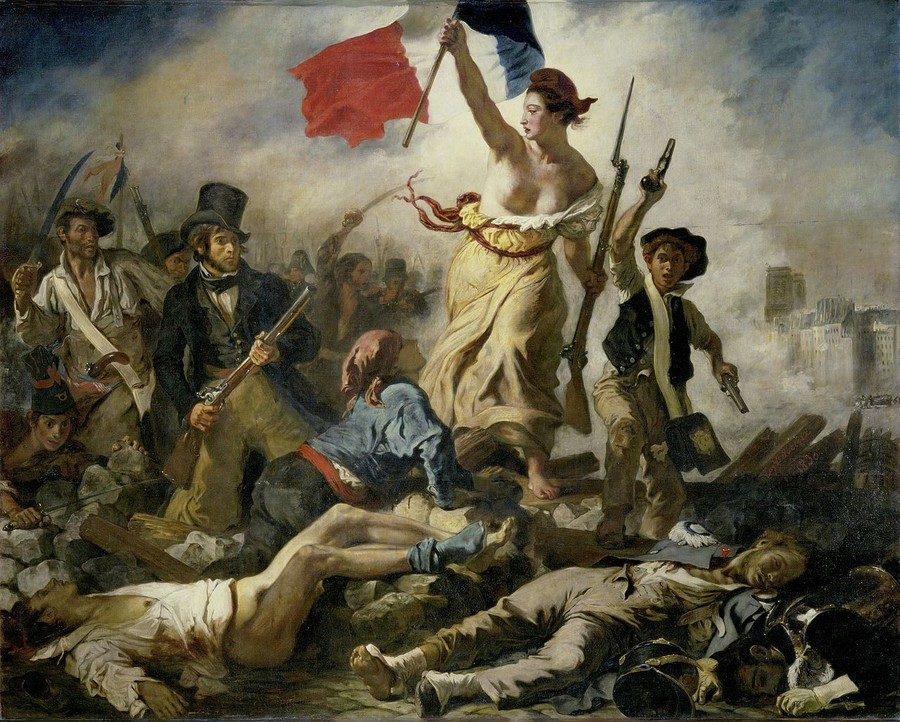
Intentionally or not, the poignant image evoked the innately French revolutionary symbolism, inherited from past upheavals. Like the world-famous painting by Eugene Delacroix, which depicts Marianne - the embodiment of liberty and one of the symbols of France - leading the people over the barricades.Update: December 2nd: Violence across France is spreading:The Yellow Vest protests erupted after President Emmanuel Macron introduced a controversial fuel tax. The anti-government rallies were spearheaded by the nation's leading trade unions.
More than 50 people, most of them police officers, were injured in Toulouse during protests against fuel price hikes. Yellow Vest demonstrations turned into riots, making the southern French city and Paris look like battlefields.
As France struggles to come to grips with the intensity of widespread protests against increasing fuel prices, which have grown violent over the past weeks, authorities in Toulouse said on Sunday that 57 people, including 48 police officers, had been injured in clashes during Saturday's riots. Five police officers were hospitalized.
Sixteen people were arrested following the disturbances, four of them for "looting two shops in the city center" during the demonstration, a statement said. France's southwestern city was the scene of unabated violence for hours on Saturday as angry Yellow Vest protesters, who are opposing the French government's plans to impose new fuel taxes, scuffled with police forces deployed to the area.

The lenders' weapon of choice is an arcane legal document called a confession of judgment. Before borrowers get a loan, they have to sign a statement giving up their right to defend themselves if the lender takes them to court. It's like an arbitration agreement, except the borrower always loses. Armed with a confession, a lender can, without proof, accuse borrowers of not paying and legally seize their assets before they know what's happened. Not surprisingly, some lenders have abused this power. In dozens of interviews and court pleadings, borrowers describe lenders who've forged documents, lied about how much they were owed, or fabricated defaults out of thin air.
Confessions of judgment have been part of English common law since the Middle Ages, intended as a way to enforce debts without the fuss and expense of trial. Concerns about their potential abuse are almost as old. In Charles Dickens's 1837 novel The Pickwick Papers, a landlady who's tricked into signing one ends up in debtors' prison. Some U.S. states outlawed confessions in the middle of the 20th century, and federal regulators banned them for consumer loans in 1985. But New York still allows them for business loans.
[...]
New York's courts are especially friendly to confessions and will accept them from anywhere, so lenders require customers to sign documents allowing them to file there. That's turned the state into the industry's collections department. Cash-advance companies have secured more than 25,000 judgments in New York since 2012, mostly in the past two years, according to data on more than 350 lenders compiled by Bloomberg Businessweek. Those judgments are worth an estimated $1.5 billion. The biggest filer by far, with a quarter of the cases: Yellowstone Capital.
Comment: When will people learn that the average person does not like being told what they can and can't say? What's much more likely to happen than the scenario put forth above is that people will resent vegans trying to police their language and the existing expressions will become even more popular. Or perhaps new ones will emerge. How about, "There's more than one way to eat a pig"?
See also: