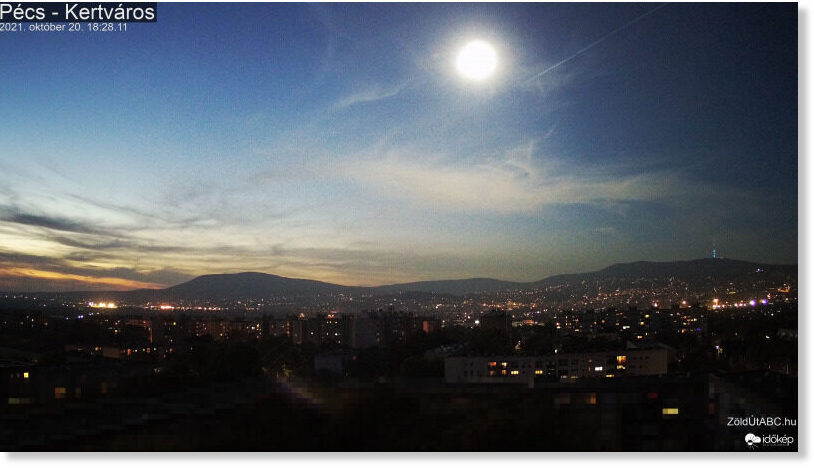
The fireball on our webcam in the garden city of Pécs
It was visible to the southwest at 6:28 p.m. We are waiting for your photos!
Based on the comments on our Facebook post, hundreds of our readers saw the event. As it did not darken completely after sunset, relatively few recordings were made of the otherwise spectacular phenomenon.
Admission of Orsolya Bernáth from Martonvásár, thank you!
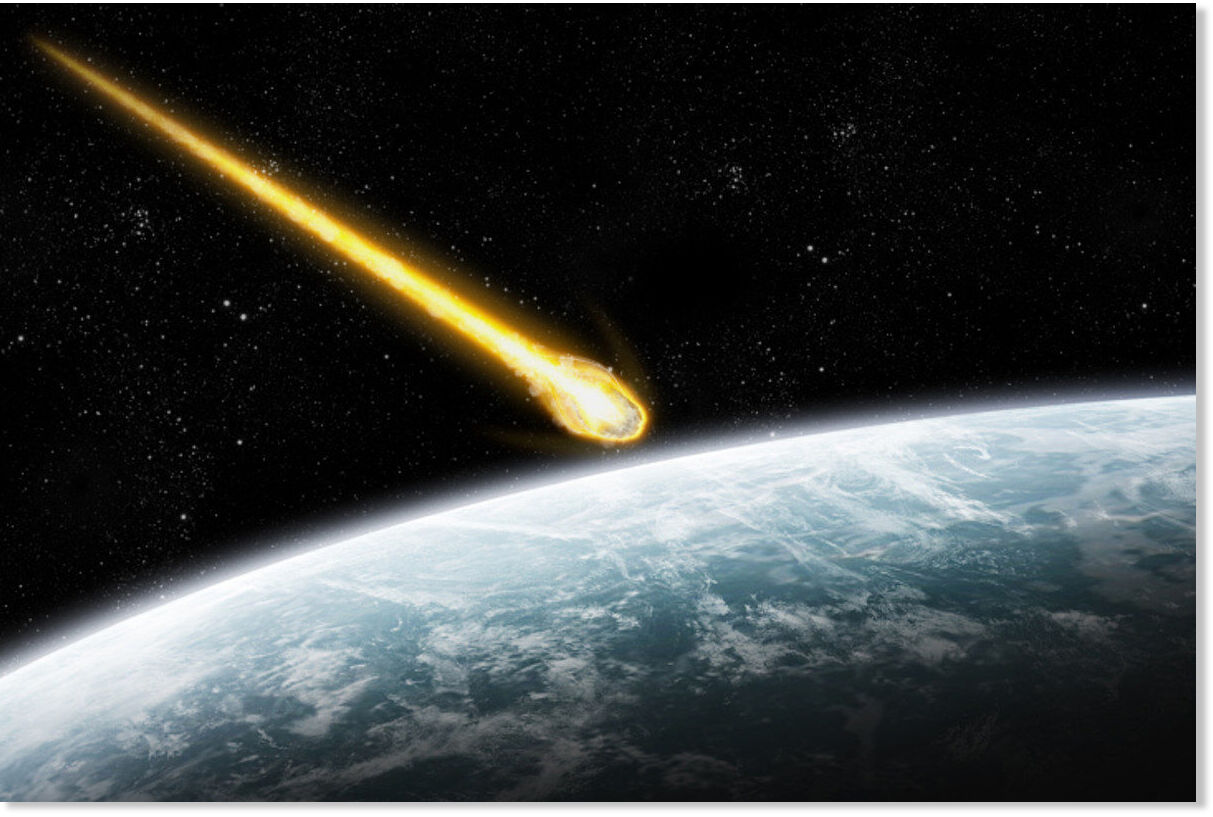
This stunning bolide was recorded over Spain on 2021 October 21, at 1:16h local time (which is equivalent to 23:16 universal time on October 20). It was produced by a fragment (a meteoroid) from a comet. This fragment impacted the atmosphere at about 237.000 km/h. The fireball began at a height of about 137 km over the northeast of the province of Segovia, and ended at an altitude of around 75 km over the north of the province of Ávila.
The event was recorded in the framework of the SMART project, operated by the Southwestern Europe Meteor Network (SWEMN), from the meteor-observing stations located at La Hita (Toledo), La Sagra (Granada), Sevilla, Sierra Nevada (Granada), Huelva, El Guijo (Madrid), and Calar Alto (Almería). The event has been analyzed by the principal investigator of the SMART project: Dr. Jose M. Madiedo, from the Institute of Astrophysics of Andalusia (IAA-CSIC).
Ruth Hamilton was sound asleep last week when she was awoken by her dog barking, the sound of a crash through her ceiling and the feeling of debris on her face, the resident of Golden, B.C., said Monday.
She said she jumped out of bed and turned on the light to figure out what had happened, and discovered a hole in her ceiling.
"I've never been so scared in my life," she said of the Oct. 3 incident. "I wasn't sure what to do so I called 911 and, when I was speaking with the operator, I flipped over my pillow and saw that a rock had slipped between two pillows."
Comment: See also the following series of articles from author, Pierre Lescaudron:
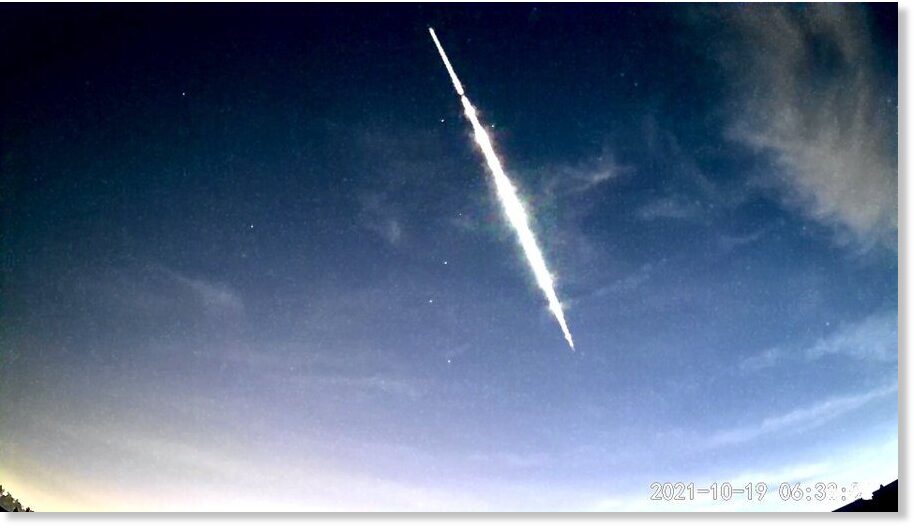
This fireball was spotted over Spain on 19 October 2021, at 7:11 local time (equivalent to 5:11 universal time). The bolide was generated by a rock (a meteoroid) from a comet that hit the atmosphere at about 90,000 km/h. The fireball began at an altitude of about 93 km over the center of the province of Cuenca (region of Castilla-La Mancha), and ended at a height of around 51 km over the northwest of the province of Valencia (Valencian Community).
This meteor was recorded in the framework of the SMART project, operated by the Southwestern Europe Meteor Network (SWEMN) from the meteor-observing stations located at La Hita (Toledo), Sierra Nevada, La Sagra (Granada), Calar Alto (Almería), and Sevilla. The event has been analyzed by the principal investigator of the SMART project: Dr. Jose M. Madiedo, from the Institute of Astrophysics of Andalusia (IAA-CSIC).






Comment: See also the following series of articles from author, Pierre Lescaudron:
Of Flash Frozen Mammoths and Cosmic Catastrophes
Did Earth 'Steal' Martian Water?
Volcanoes, Earthquakes And The 3,600 Year Comet Cycle
The Seven Destructive Earth Passes of Comet Venus