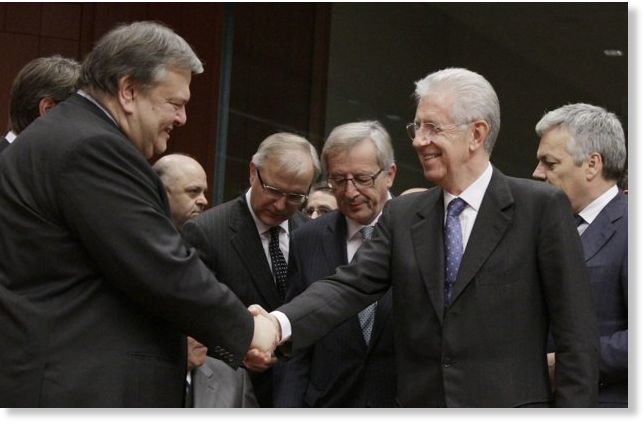
© The Associated Press/Virginia MayoGreek Finance Minister Evangelos Venizelos, left, shakes hands with Italian Prime Minister and Finance Minister Mario Monti during a round table meeting of the eurogroup at the EU Council building in Brussels on Tuesday, Nov. 29, 2011. The 17 finance ministers of countries that use the euro converged on EU headquarters Tuesday in a desperate bid to save their currency and to protect Europe, the United States, Asia and the rest of the global economy from a debt-induced financial tsunami.
Stock markets had risen hoping that intense bond market pressure would finally force the 17-nation eurozone into quicker and more robust action - but that was not to be.
Even as Italy's borrowing costs skyrocketed to a euro-era record, the finance ministers failed to increase the European bailout fund to match earlier predictions and kicked other major financial issues - like a closer fiscal union - over to their bosses, the EU leaders meeting next week in Brussels.
The ministers did agree to use the fund to offer financial protection of 20 to 30 percent to investors who bought new bonds from troubled eurozone nations.
"We made important progress on a number of fronts," Jean-Claude Juncker, the eurozone chief, insisted late Tuesday. "This shows our complete determination to do whatever it takes to safeguard the financial stability of the euro."