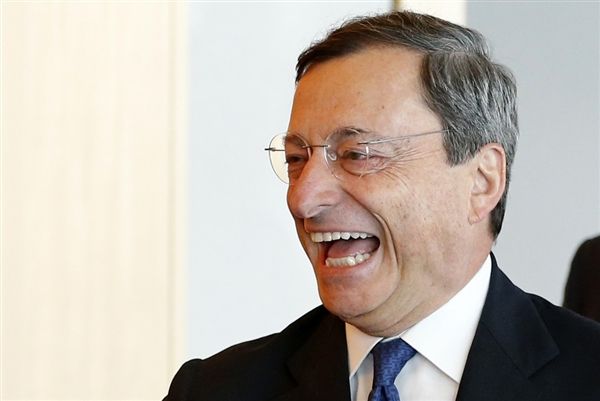
© Francois Lenoir/ReutersLet's hope he'll be this happy later this week. European Central Bank (ECB) President Mario Draghi, pictured above, is expected to unveil a new plan Thursday to tackle the eurozone's nagging debt crisis.
But the plan, similar to the massive bond-buying undertaken by U.S. central bankers four years ago, may be too little, too late.
"It's going to take a lot more than a few rate cuts here and there to give us a lift," said Peter Dixon, a senior economist at Commerzbank Securities. "Monetary policy is effectively running out of options."
Europe is also running out of time. Manufacturing across the continent contracted faster than previously thought last month, according to the latest data released Monday. The recession sparked by a crushing debt hangover in a few smaller members of the 17-nation bloc is now sweeping through Germany and France. The financial turmoil that sank Greece as investors and depositors fled now threatens the much larger economies of Spain and Italy.
European Central Bank President Mario Draghi bought some time last month, calming markets somewhat with a pledge to do "whatever it takes" to save the euro. Now, he has to deliver. On Thursday, the ECB is set to unveil details of a new bond-buying plan that has re-opened long-standing fault lines in Europe's experiment with a common currency.