
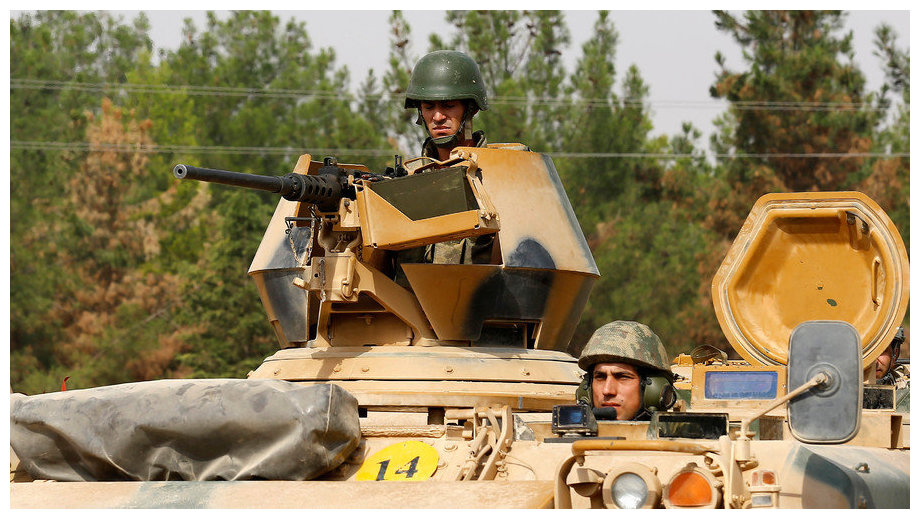
© Umit Bektas/Reuters Turkish soldiers on an armoured vehicle are seen in Karkamis on the Turkish-Syrian border in the southeastern Gaziantep province, Turkey, August 25, 2016.
Anyone as much as hinting at such a massive geopolitical tectonic shift a few weeks ago would be branded a madman. So how did the impossible happen?
A major strategic game-changer- Russia using an airfield in Iran to send bombers against jihadis in Syria - had already taken place, with its aftermath spectacularly misreported by the usual, clueless US corporate media suspects.
Then, there's what Turkey's Prime Minister, Binali Yildirim, said last Saturday in Istanbul: "The most important priority for us is to stop the bloodshed [in Syria] as soon as possible." The rest are irrelevant "details."
Yildirim added Ankara now agrees with Moscow that Bashar al-Assad "could" - and that's the operative word - stay in power during a political transition (although that's still highly debatable). Ankara's drive to normalize relations with Moscow had an 'important share' in this 'policy shift'.
The 'policy shift' is a direct consequence of the failed military coup in Turkey. Russian cyber-surveillance aces - in action 24/7 after the downing of the Su-24 last November - reportedly informed Turkish intelligence a few hours before the fact. NATO, as the record shows, was mum.
Even minimalist optics suggests 'Sultan' Erdogan was extremely upset that Washington was not exactly displeased with the coup. He knows how vast swathes of the Beltway despise him - blaming him for not being serious in the fight against ISIS and for bombing the YPG Kurds - Pentagon allies - in Syria. The record does show Erdogan has mostly ignored ISIS - allowing non-stop free border crossing for ISIS goons as well as letting Turkish business interests (if not his own family) profit from ISIS' stolen Syrian oil.
Compared to Washington's attitude Moscow, on the other hand, warning Erdogan about serious, concrete facts on the ground in the nick of time. And for Erdogan, that was highly personal; the putschists reportedly sent a commando to kill him when he was still in Marmaris.
Fast forward to Iranian Foreign Minister Mohammad Zarif's surprise visit two weeks ago to Ankara. Zarif and his counterpart Mevlut Cavusoglu did discuss serious options by which the budding ATM coalition could come up with a viable exit strategy in Syria. One week later Cavusoglu went to Tehran and talked again to Zarif for five hours.
It's an uphill battle - but doable. Tehran knows very well IRGC officers as well as Hezbollah, Iraqi and Afghan fighters were killed in the Syrian war theater, and that shall not be in vain. Ankara for its part knows it cannot afford to remain forever trapped in an ideological dead end.






Comment: UPDATE Aug. 30, 2016: The European Commission ruled on Tuesday that "selective treatment" by Ireland allowed Apple to pay a tax rate of one percent on EU profits in 2003 down to 0.005 percent in 2014. The US company has been ordered to pay up to €13 billion to cover the unpaid tax.
Member States cannot give tax benefits to selected companies - this is illegal under EU state aid rules. The Commission's investigation concluded that Ireland granted illegal tax benefits to Apple, which enabled it to pay substantially less tax than other businesses over many years. Apple was attributing its profits to a "head office" in Cork that had no employees, premises or any economic activity, and paid almost no tax. The 130-page ruling on Apple's Irish operations was published on Tuesday following a three-year investigation.