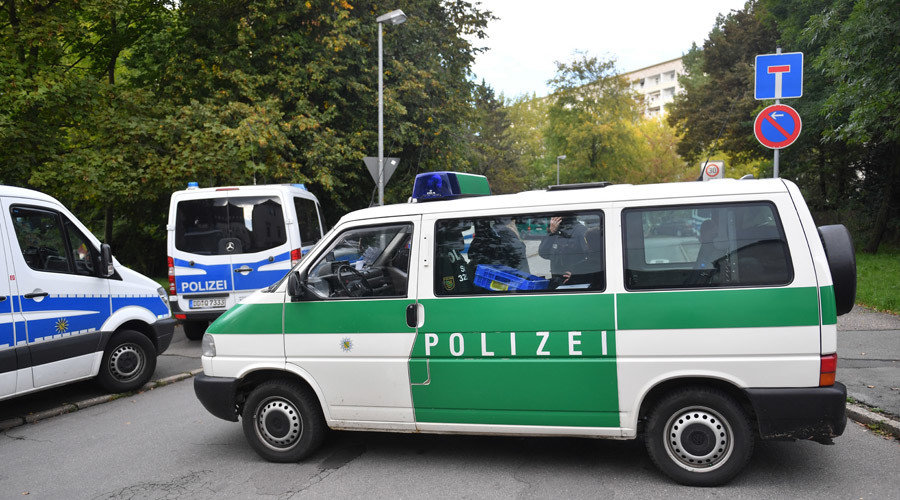
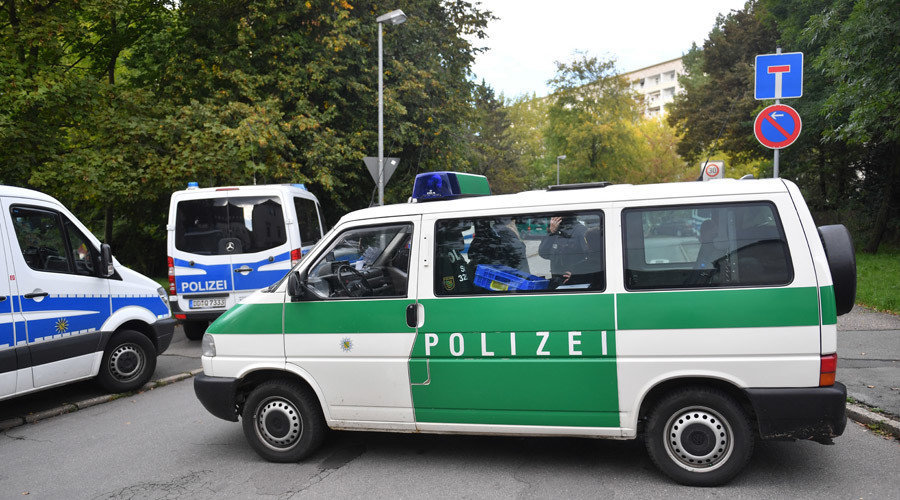
© Hendrik Schmidt/AFPPolice cars stand near a residential area in Chemnitz, eastern Germany, where German police commandos hunting a fugitive Syrian bomb plot suspect raided a flat on October 9, 2016.
A large-scale police anti-terrorist operation in the eastern German city of Chemnitz aimed at detaining a 22-year-old Syrian suspected of plotting a bomb attack was a failure, a security source told Germany's
Focus magazine as the manhunt continues.
Police admitted that Jaber Albakr managed to escape from police despite the fact that a large-scale operation was launched to detain him after "highly sensitive explosives" were discovered in his apartment, German media report.
Albakr was put on the German federal wanted list. Police also warns that he is "dangerous" and could have explosives with him.
An "insider" source
told Focus that the operation aimed at arresting Albakr was a failure due to the inaction of the federal police and the Prosecutor's Office as well as due to the lack of cooperation between various police units.
Comment: What an utterly weird series of events.
How did the police know he had 'bombs with intent to explode'?
How did he know to flee before they got there?
If German intel has been so hot on his heels throughout... why can't they locate him now?
Update (Oct. 10): Albakr was
turned in to authorities today after three Syrians in Leipzig discovered who he was, overpowered him, and tied him up. Albakr had asked them if he could stay the night at their place.
So there you have it. Syrian refugees are a more effective anti-terror force than the German security services. And that's assuming Albakr is guilty. The questions above still stand. Authorities say he was making an explosive device, "possibly" a suicide belt; that his behavior "suggests" links to Daesh; that it "appears" he was planning an attack similar to Brussels. Was the bomb even his? It was found "hidden" in the house. How did they find it?
Aside from the presence of the explosive material, the only other suggestive piece of possible evidence provided so far is that Albakr "conducted an online search for instructions on making explosive devices and 'equipment for jihad' since the beginning of the month."
Update 2 (Oct. 11): Authorities and media have released slightly more information on how they determined that Albakr was a threat, vaguely
saying it resulted from "vigorous surveillance and counterterrorism work after covert agents reportedly identified the suspect in the eastern state of Saxony on Thursday and began round-the-clock observation."
"We found out that he then bought hot glue in a discount shop on the following day. And then we immediately pull all measures into place to start a raid because
we assumed this can basically be the last missing chemical for him to build a bomb," said intelligence chief Hans-Georg Maasen.
German public prosecutor Peter Frank said, "The danger is mainly characterized by the fact that
he developed a very high explosive for which special expertise was needed, and he made it in a very large quantity."
Update 3 (Oct. 12):And the suspect is dead. RT
reports:
A Syrian migrant suspected of planning a terror attack on a German airport has reportedly committed suicide while in custody. The 22yo suspect was under heavy police guard following his capture after a two-day manhunt.
Jaber Albakr was found dead in his prison cell in Leipzig according to Der Spiegel. The suspect had been on hunger strike and was under round the clock surveillance according to the publication.
He died from hunger after just 24 hours? Under round the clock surveillance?
This story stinks to high heaven. No doubt answers from German (American) intelligence will not be forthcoming.
Update 4 (Oct. 13):
Albakr's alleged suicide has German politicians
up in arms. Green Party MPs say it's a "fiasco" and casts a "dark shadow" on the Saxon justice system and is calling for an independent investigation. Saxony's Justice Minister Sebastian Gemkow said Albakr strangled himself by tying his shirt to the bars of his jail cell. At 7:45pm on Wednesday, he was apparently found by a guard, who tried but failed to resuscitate him. According to prison head Rolf Jacob, he had been assessed by authorities as a suicide risk, and was given pants without a belt as a precaution. On Tuesday, he had destroyed a lighting fixture in his cell, but "it was not interpreted as a suicide attempt."
Wolfgang Bosbach, a senior member of Chancellor Angela Merkel's CDF party, told N-TV that given his behavior, Albakr should have been under constant observation.
...
"We don't know yet if there were people pulling the strings," Klaus Fleischmann, chief public prosecutor in the state of Saxony, told a news conference on Thursday. German media had earlier quoted investigation sources as saying that Albakr told investigators shortly before his suicide that three Syrians who handed him over to police were his accomplices. Interior Minister Thomas de Maiziere said Albakr's death would make the investigation into whether he had accomplices in the thwarted plot far more difficult.
...
Though not accusing officials of any deliberate wrongdoing, [Al-Bakr's lawyer, Alexander] Huebner pointed out at numerous signs of the upcoming suicide. "You know, I am no psychiatrist or psychologist, but for me there were enough indications that there was a self-endangering situation. There were the criminal charges, there was a hunger strike which lasted - it was not a-24 hour action - it lasted over several days. Then there were the events in the jail, where he manipulated a socket and ... what other indications do you need? I don't know."
...
Albakr was arrested on Monday in Leipzig after three fellow Syrians tied him up and alerted police. He had been under surveillance by German domestic intelligence since last month. De Maiziere said that the Syrian man had undergone a security check last year, but it did not turn up anything suspicious. "There was a check against security authorities' data in 2015, but without any hits," he said on Wednesday. "It's not clear when he was radicalized."
So he apparently hanged himself. Was he under round-the-clock surveillance in his cell or not?
Update 5 (Oct. 16):It's been
revealed (sort of) that an "unnamed" US intelligence agency was responsible for the tip about the planned attack. The alleged plans for the possible attack allegedly changed from targeting a bus to a "big airport in Berlin." Authorities are still seeking connections to ISIS while Jaber al-Bakr's brother told Reuters that he was working for the White Helmets. Oops!
An unnamed US intelligence agency allegedly provided a tip-off about the planned attack after intercepting several phone calls from al-Bakr to IS terrorists in Syria, according to a source in investigation team, cited by Germany's Welt am Sonntag.
The suspect allegedly told his contact on October 7 that 2kg of explosives were ready, but he decided to change his target, stating that a "big airport in Berlin" was "better than trains."
Investigators assumed al-Bakr to have been connected with IS and to be planning an attack comparable to those in Paris and Brussels. However, despite mounting evidence, there were not yet "enough links to IS that could be used in court," according to a spokesman for the federal prosecutor's office cited by FAS.











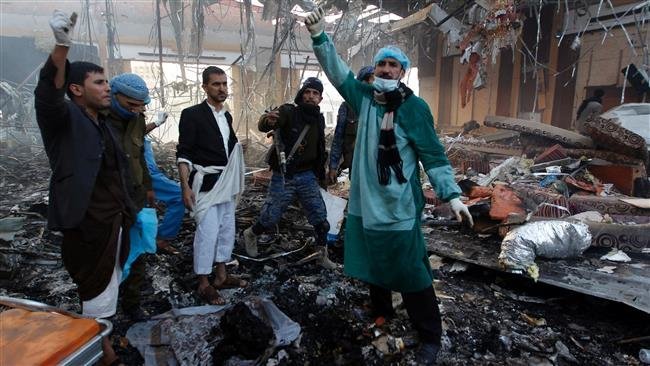




Comment: If Jaber Albakr's brother is looking for a hidden influence, he might start by looking at who the White Helmets really are. While this group is lauded by the mainstream media and even nominated for a Nobel Peace Prize, their 'humanitarian' work has been thoroughly exposed as an al-Sham.
See: