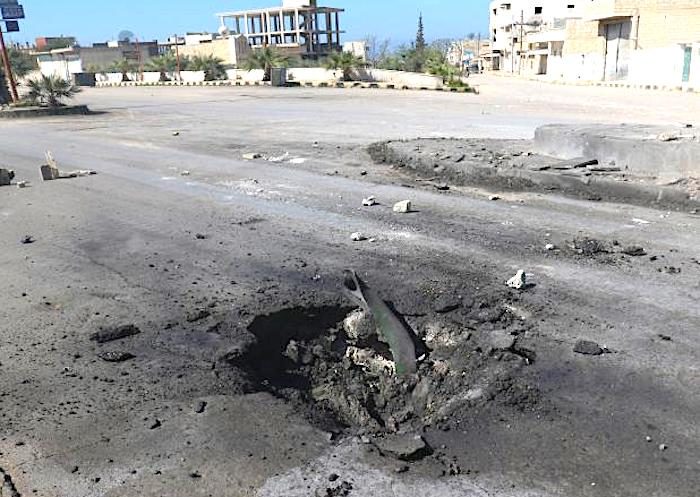
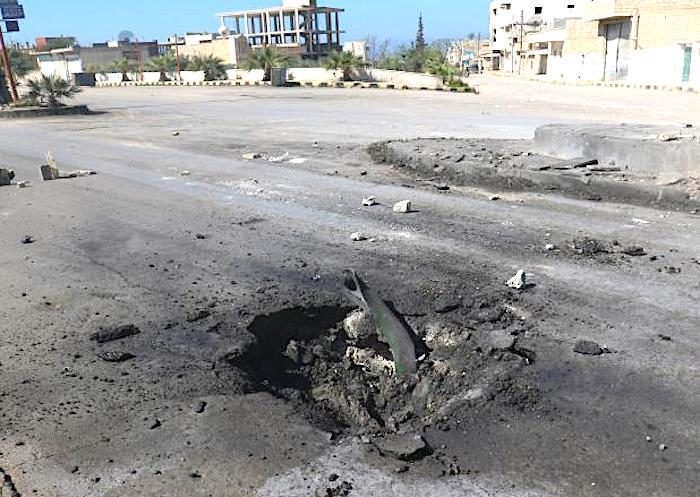
© The IndependentSite of chemical attack according to Dr. Postal, MIT, shows collapsed metal tube dispersal device from a delivery vehicle.
The Trump administration officials dismissed the Russian claim that the
Syrian airstrike had targeted a munitions warehouse controlled by Islamic extremists as an afterthought to cover up the Syrian government's culpability for the chemical attack. Moreover, the Trump officials claimed that US intelligence had located the site where the Syrian regime had dropped the chemical weapon.
However,
two new revelations contradict the Trump administration's line on the April 4 attack. A former US official knowledgeable about the episode told Truthout that the Russians had actually informed their US counterparts in Syria of the Syrian military's plan to strike the warehouse in Khan Sheikhoun 24 hours before the strike.And a leading analyst on military technology, Dr. Theodore Postol of MIT, has concluded that
the alleged device for a sarin attack could not have been delivered from the air but only from the ground, meaning that the chemical attack may not have been the result of the Syrian airstrike.The Trump administration is pushing the accusation that the Assad regime was the force that carried out the highly lethal chemical attack on April 4 very hard, perhaps not so much to justify the already politically popular US strike against the Shayrat airbase on April 6, but rather to buttress a new hardline policy against the Syrian regime.
The two unnamed senior Trump officials who briefed journalists Tuesday
sought to discredit the Russian claim that the Syrian airstrike had hit a warehouse in Khan Sheikhoun that was believed to hold weapons including toxic chemicals. One of the two unnamed officials said that a Syrian military source had "told Russian state media on April 4 that regime forces had not carried out any strike in Khan Sheikhoun,which contradicted Russia's claim directly."
This Trump administration official appeared to be suggesting that there was no evidence that a weapons storage site had been hit by a Syrian airstrike. But an internal administration paper on the issue now circulating in Washington, a copy of which Truthout obtained,
clearly refers to "a regime airstrike on a terrorist ammunition dump in the eastern suburbs of Khan Sheikhoun."More importantly, the US military allegedly knew in advance that the strike was coming: Russian military officers informed their American counterparts of the Syrian military's plan to strike the warehouse in Khan Sheikhoun city 24 hours before the planned airstrike, according to the former US official who spoke with Truthout. The official is in direct contact with a US military intelligence officer with access to information about the US-Russian communications. The military intelligence officer reported to his associate that the Russians provided the information about the strike to the Americans through the normal US-Russian Syria deconfliction telephone line, which was established after the Russian intervention in 2015 to prevent any accidental clash between the two powers.
The officer said that Russia communicated to the US the fact that the Syrians believed that the warehouse held toxic chemicals.



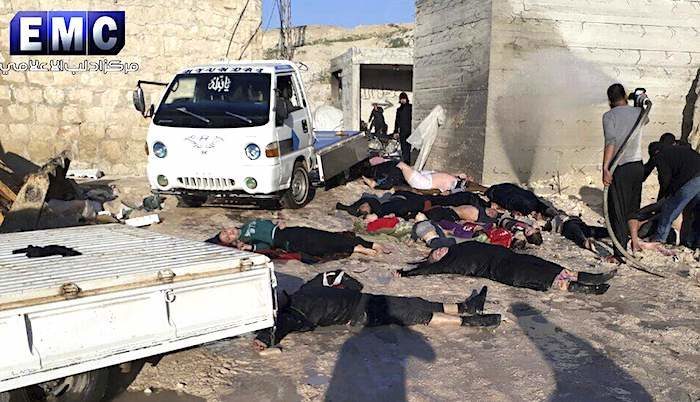










Comment: The problem with Syrians and Russians both knowing that Syria was going to airstrike a terrorist munitions dump/warehouse (should this be true) is that, without verification of the contents as to specific substances, it would be hard to predict an outcome completely without toxicity or civilian casualties, given the location. The fact that toxic substances were a part of this scenario, and the "Syrians believed that the warehouse held toxic chemicals," should have given all parties pause. Terrorists may have produced 'the stick of dynamite,' but the Syrian air force provided 'the match.'
Should Dr. Postal's theory be the only one correct, that it was all the result of a ground-based chemical attack, why then the pre-airstrike cover story?
The third plausibility is that a 24-hour notice to the US of the airstrike gave time to coordinate a couple other ground-based, false flag gas attacks to coincide with the Syrian air force strike.
With three recorded 'mushroom cloud' explosions, all scenarios could be true -- meaning there was more than one source/location of land-based toxic gas. No one, in this case, gets off unscathed. Regardless the mechanics or the forensics, all parties are using this tragedy to build their cases for political reasons resulting, so far, in accusatory confusion and a dysfunctional stalemate. Perhaps as intended.