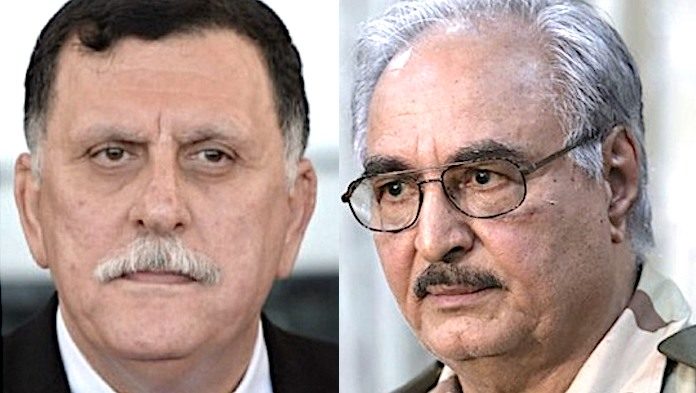
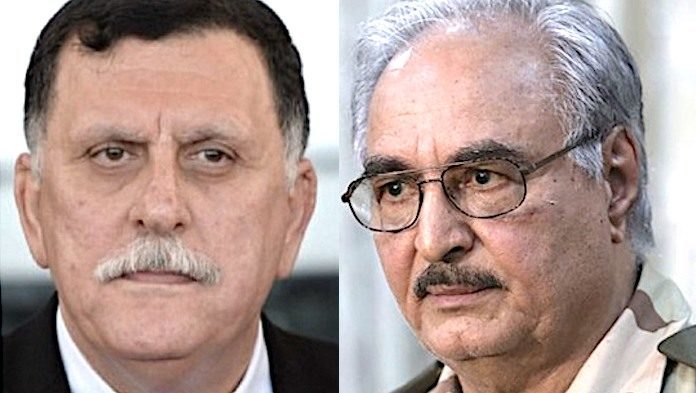
© Pars Today/Gulf TimesPrime Minister Fayez al-Sarraj • General Khalifa Hifter (Haftar)
The flurry of international activity involving Libya in recent weeks raises questions of whether
more confrontation between Moscow and the West is coming for the country or if some cooperation is possible.
On April 20, US President Donald Trump and Italian Prime Minister Paolo Gentiloni held a joint press conference in Washington.
The American leader stated that the only US role in the region is "getting rid of ISIS [the Islamic State]." Trump's statement, to some extent, threw light on America's strategy and confirmed that
the administration is reluctant to adopt a hands-on role in Libya. In fact, he seemed to be delegating the responsibility for conflict settlement to regional and, above all, European players.Libya has been politically and militarily ruptured since President Moammar Gadhafi was ousted and killed in 2011. IS has taken advantage of the chaos, capturing some coastal cities. Meanwhile, two rival governments are struggling for power: that of Prime Minister Fayez al-Sarraj in Tobruk, and that of Tripoli in the east under the military control of Gen. Khalifa Hifter [Haftar]. Sarraj is backed by the United Nations and, at least nominally, the Misrata Brigades. Hifter has the support of Russia, Egypt, France, the United Arab Emirates and the Libyan National Army.
Efforts to bring the two sides together have produced very mixed results.




Comment: The only thing Russia's 'interfered with' has been the US destroying foreign countries