
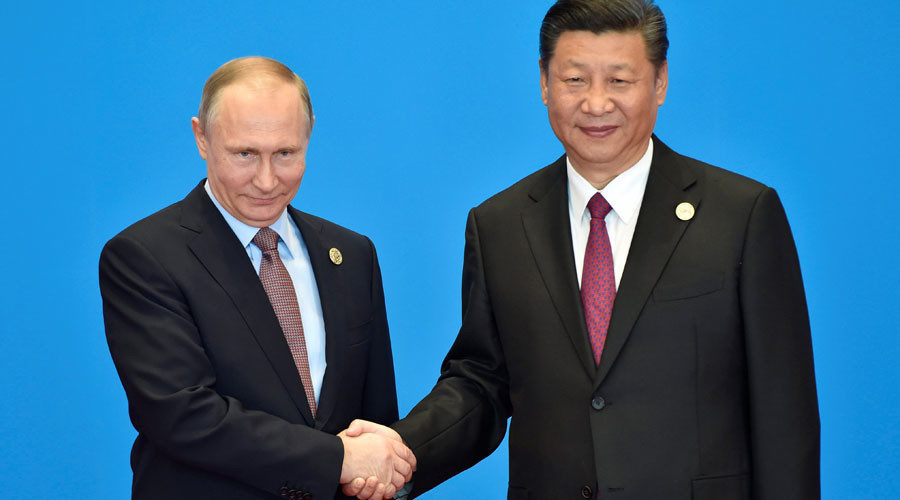
© Kenzaburo Fukuhara / ReutersRussian President Vladimir Putin (L) and Chinese President Xi Jinping
I have dealt with the monumental stakes here and here. Terminology, of course, remains a minor problem. What was once defined as One Belt, One Road (OBOR) is now promoted as the Belt and Road Initiative (BRI). Much is still somewhat lost in translation in English, what matters is that Xi has managed to imprint the myriad possibilities inbuilt in the concept especially across the Global South.
An amiable host, Xi in Beijing went 'no holds barred' extolling the inclusive integration merits of OBOR/BRI. It also helps that along the way, this being China, his spin doctors came up with a lovely metaphor to illustrate how OBOR/BRI should find its force as a common, pan-Eurasian effort; "Wild Swan geese [found across Asia but not in Europe] are able to fly far and safely through winds and storms because they move in flocks and help each other as a team."
And arguably the key member of this flock of wild swan geese happens to be Russia.
Follow the geese
President Putin and Foreign Minister Sergey Lavrov were guests of honor at the forum - alongside leaders such as Kazakhstan's Nazarbayev and Turkey's Erdogan. At a business breakfast discussion, Xi seated Putin to his right and Lavrov to his left.










Comment: Further reading: