Puppet MastersS


Info

Turkey ending support for Syrian rebels a 'goodwill gesture towards Damascus'

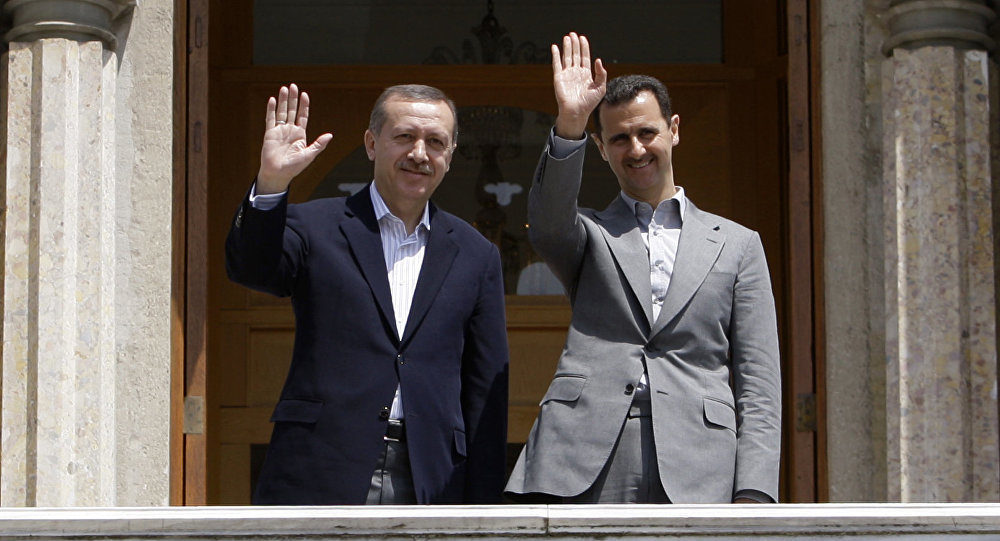
Erdogan and Assad
© AFP 2017/ IBRAHIM USTA / POOL
Turkey has stopped supporting the Syrian coalition of opposition forces. According to analyst and journalist Musa Özuğurlu, this decision is likely to contribute to normalization between Ankara and Damascus.

Turkey has decided to end its support for the National Coalition for Syrian Revolutionary and Opposition Forces (aka the Syrian National Coalition), which encompasses various opposition groups fighting in the Syrian conflict, the Syrian news outlet Zaman el-Vasl reported citing a source in the coalition.

Founded in November 2012, the Syrian National Coalition received $320,000 in annual support from Turkey.

According to Turkish political analyst and journalist Musa Özuğurlu, the decision to stop this support was prompted by Ankara's unwillingness to give funds to an opposition organization "capable only of talking at press conferences and useless in combat actions on the ground."

Comment: More analysis from The Duran:
This represents Turkey's position on Syria going full circle since Ankara entered the conflict in the year 2012.

Prior to 2012, Turkey and Syria enjoyed normal relations. As part of Turkish President Recep Tayyip Erdogan's pivot to the Arab world, a policy some had called neo-Ottomanism, Ankara increasingly saw itself as a key king-maker in Arab affairs, in spite of the fact that few Arab countries sought Turkey's alliance with the exception of Qatar. In this sense, Turkey's move to support anti-government forces in Syria was more about opportunism than ideology. Although Erdogan had since his early political career advocated for what many call a Muslim Brotherhood style of Islamist politics, this had never previously prohibited him from having normal relations with Syrian President Bashar al-Assad prior to 2011.

Put another way, Turkey wanted to join the winning side and until Russia's intervention in Syria at the behest of the Syrian government, many speculated that various anti-government forces which were heavily backed by Barack Obama's government, would win.

Russia's intervention combined with the incredible endurance and steadfast patriotism of the Syrian Arab Army has changed this and now both conventional wisdom and battlefield intelligence would point to a victory for the legitimate forces in Syria.

In this sense, Turkey's exit from its political and apparently military support for anti-government forces in Syria is motivated by pragmatism just as sure as Turkey's initial entrance into the conflict was motivated by opportunism.

Beyond this however, there are several other motivating factors.

Ever since Donald Trump took office, the United States began gradually pulling its support away from jihadist fighters in Syria while throwing the weight of US military and political power behind the Kurds who have also historically been supported by Israel.

This development his infuriated Erdogan as it would have done with any Turkish leader whether Kemalist or Islamist. While Turkey has expressed its frustrations at the US over the Kudish issue, the US seems to be complete ignoring Turkey and doing precisely the opposite of that which would make its NATO 'ally' contented. Turkey has stated that it will not tolerate a Kurdish state on its borders and the US has done precious little to assure Ankara that such a state will not foment.

With the possibility of increased Kurdish autonomy in Syria now increasingly probable and with the prospect of a Kurdish state in either Syria or Iraq more likely than at any time since the end of the Second World War, Turkey has reason to fear that an incredibly hostile force which has been heavily armed by the United States may spring up on its doorstep and more importantly, the doorstep of Turkey's Kurdish regions which are a hotbed of the PKK (Kurdish Workers Party), a group Turkey labels as a terrorist group.

Secondly, in ending support for anti-government forces in Syria, Turkey is also easing latent tensions in the last remaining Middle Eastern conflict Ankara has had with Moscow. While Russia and Turkey have cooperated economically in spite of being on different sides of the Syrian conflict and while Turkey continues to participate in the Astana Peace Process with Syria's partners Russia and Iran, Turkey was always viewed with suspicion by many throughout the process because of Ankara's position in respect of anti-government forces.

It would appear that this is no longer the case as Turkey is now, at least from a legal and technical point of view, de-facto recognizing the Syrian government as the only legitimate political force in Syria.

In the longer term, this will help Turkey in its pivot away from the US and EU and towards Russia and Russia's regional partner Iran. President Erdogan has in recent months been cultivating increasingly good relations with Iran and as Iran is, like Turkey, on China's economically crucial One Belt-One Road. In this sense, Turkey would need to have cooperated with Iran sooner or later and for the sake of good will in the service of pragmatism, Turkey has decided to do it sooner.

The message to Russia and Iran also sends a strong message to the United States. Turkey now has increasingly little in common with America in spite of maintaining the second largest army in NATO. Turkey is conducing commerce with Russia more vigorously than with any western state, Turkey is buying missile defense systems from Russia and not NATO and Turkey has strongly condemned the latest round of anti-Russian sanctions from the west in a statement filled with words designed to show solidarity with Moscow's position. Turkey's position on the Qatar-crisis further puts Ankara in a position which is slightly closer to Iran and much further from that of the United States as President Trump has openly taken the Saudi position in spite of official US neutrality on the matter.

Turkey has in this sense, turned 180 degrees since 2015 when Turkish forces shot down a Russian jet over the Syria-Turkey border. The situation may well have led to a 21st century Russo-Turkish war, but due to President Vladimir Putin's supreme patience, Turkey and Russia reconciled their relations which continue to grow. Some may point to the 2015 shooting down of the Russian fighter jet and the political fallout resulting from the event as a sign of Turkey's unreliability as a Russian partner. There may be some truth to this. However, what seems more important is that while Turkey's aggressive stance towards Russia in 2015 was born out of ambition and supreme arrogance, today's revised Turkish position is born out of not only pragmatism but the long, some would say very long term needs of the Turkish state.

Finally, some are speculating that Turkey's move to withdraw support for Syria's anti-government forces is designed to pave the way for eventual reconciliation with the Syrian government. The Syrian government and moreover many Syrian civilians will not be quick to forgive Turkey for a role in the Syrian conflict viewed as destructive. Because it is now a certainty that the Arab Socialist Ba'ath Party will remain in power in Damascus, Turkey will likely eventually have to engage in a thaw with the Syrian government simply because Syria is a neighbor to Turkey, but this road may be long.

In this respect, a lot depends on the Kurds. Once the last vestiges of terrorist fighters are defeated in Syria, whether the Kurds take a cooperative political approach or a hostile approach to the Syrian government will be a key factor in determining Syria-Turkish relations. Should the Kurds grow increasingly hostile to the Syrian government, Damascus may forge some sort of unspoken pact with Turkey to contain what would be a mutual enemy.

Overall though, the move from Turkey is more geo-strategic than it is regionally motivated. The clear winner in this is President Putin. His style of diplomacy which has been patient with Turkey's frivolity in Syria for years seems to have finally paid off. Turkey is now closer to leaving NATO than one could have ever imagined. In many ways, Turkey has already left NATO in all but name. Russia's historic nemesis is no longer a problem for Russia, but it may become a big problem for the United States.


Laptop

The history Google doesn't want you to know

Evil google logo
[NOTE: This video was produced for BoilingFrogsPost.com on June 19, 2012. It is being made available in its entirety here for the first time.]

Google Inc. is back in the news this week, with a fresh round of headlines about the search giant and government censorship. Ironically-though perhaps not surprisingly for the corporate media-the stories are not about Google's admitted but classified relationship with government agencies like the NSA, though. Instead, they portray the internet company as a protagonist sticking up for users' privacy rights against governments that are increasingly interested in blocking, scrubbing or banning links, search results, and online videos that those governments want to suppress.

Under headlines like "Google reports 'alarming' rise in government censorship requests" and "Google Sees Surge in Censorship Demands," writers for mainstream publications are dutifully outlining the results of a new Google Inc. transparency report detailing precisely how many times they have been petitioned by governments around the world to censor, block, or scrub material that they find unlawful or objectionable.


Roses

Key Syrian town liberated from ISIS: Opening the road to Deir ez-Zor

As-Sukhnah Syria
© SANA
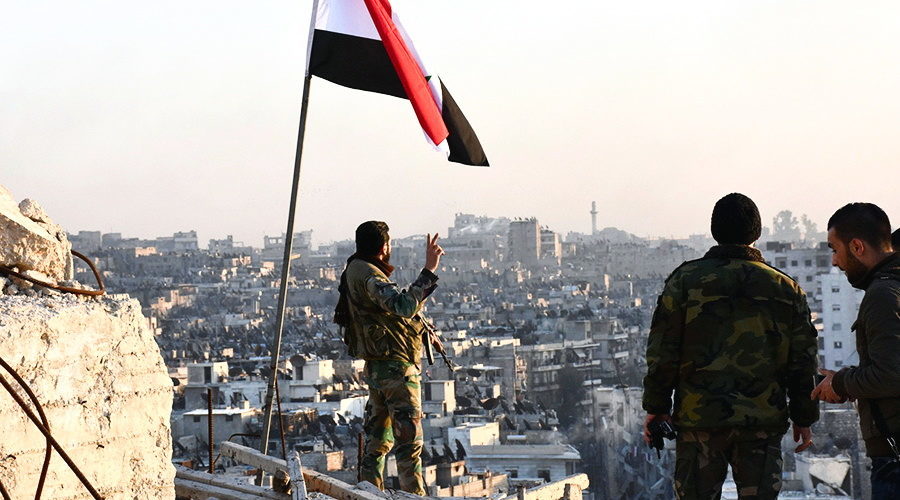
The Syrian Army, supported by the Russian Air Force, has fully liberated the city of as-Sukhnah (al-Sukhneh) from Islamic State (IS, formerly ISIS), opening the road to the besieged enclave of Deir ez-Zor, says the Russian Defense Ministry.
As-Sukhnah, liberated on Sunday, was the last major city held by IS in the Syrian province of Homs. "The liberation of As-Sukhnah from IS opens possibilities for Syrian government forces to advance and unblock the city of Deir ez-Zor," the ministry said. The final push to liberate the city began on Tuesday, when Syrian troops recaptured strategic heights in the vicinity of as-Sukhnah and blocked the city, according to the Russian MoD.

Over the following two days, Syrian troops pushed IS out of western and northern parts of the city, and early in the morning on Sunday other parts of as-Sukhnah were liberated. The liberation of as-Sukhnah opens the road to the key Euphrates city of Deir ez-Zor, which has been under IS siege after being cut off from the other government-controlled areas during the May 2015 terrorist offensive on Palmyra. "Today we can say that everyone is focused, set up for the fight against IS. Today there are such key points, like Deir ez-Zor - I would say, first and foremost Deir-ez-Zor... It's such a basic point on the Euphrates River, which would largely, if not ultimately, tell about the end of the fight against IS," Russian Minister of Defense Sergey Shoigu told Rossiya 24 broadcaster.

Comment: Latest Russian MOD briefing shows dramatic impact of Russian intervention in Syria.
See also:


Document

Watchdog sues FBI for failure to turn over Comey "exit papers"

comey
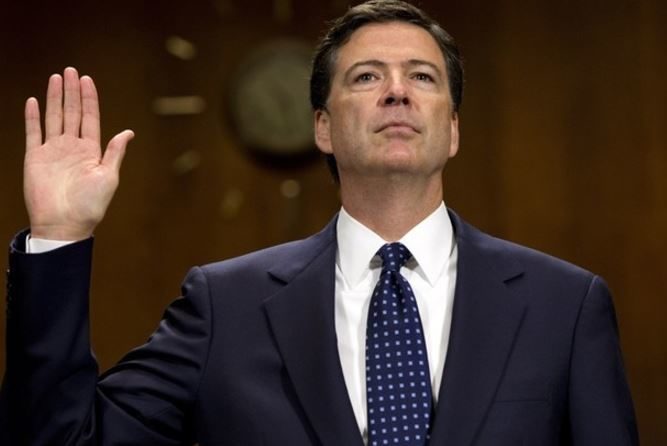
After scoring a major court victory on Thursday in its years-long pursuit of any and all emails sent by former Secretary of State Hillary Clinton pertaining to the Sept.11, 2012 attack in Benghazi, watchdog group Judicial Watch has announced that it's suing the Department of Justice for failure to turn over records pertaining to former FBI James Comey's handling of the infamous "Comey memo."

The group is escalating its fight to learn everything it can about the memo that Comey allegedly wrote following a meeting with President Donald Trump where, Comey claims, the president improperly pressured him to drop the bureau's investigation into former National Security Adviser Michael Flynn. Specifically, Judicial Watch would like to know how Comey was allowed to walk out the door with a copy of this memo. There's a strong legal argument that the document, because it was written in his official capacity as FBI director, belongs to the Justice Department and unlawfully taking it would be a felony offense.
Judicial Watch announced today that it filed a Freedom of Information Act (FOIA) lawsuit against the Department of Justice for all non-disclosure agreements pertaining to the handling, storage, protection, dissemination, and/or return of classified information that were signed by or on behalf of former FBI Director James Comey (Judicial Watch v. U.S. Department of Justice (No. 1:17-cv-01624)).

"The suit was filed in the U.S. District Court for the District of Columbia after the Justice Department failed to respond to a June 13, 2017, FOIA request seeking "any and all non-disclosure agreements pertaining in full or in part to the handling, storage, protection, dissemination, and/or return of classified and/or sensitive information that were signed by or on behalf of former FBI Director James Comey." Such records would include:
  • All SF-312 (Classified Information Nondisclosure Agreement) forms
  • All FD-857 (Sensitive Information Nondisclosure Agreement) forms
  • All FD-597 (Receipt for Property Received/Returned/Released or Seized) forms
  • All FD-291 (FBI Employment Agreement) forms
  • All Case Briefing Acknowledgement forms"

Eye 1

Trump isn't going to invade Venezuela, but what he's planning could be just as bad

Venezuelan government rally
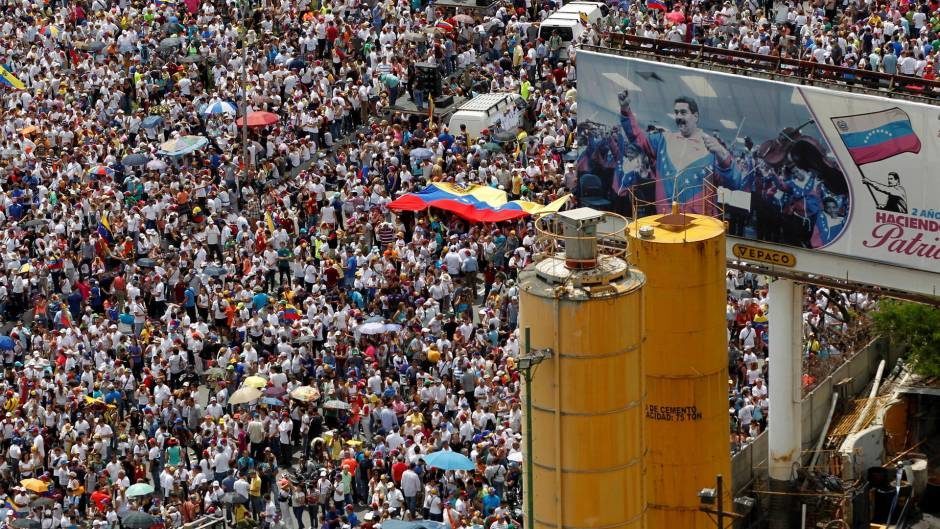
The President's war-mongering comments were designed to put pressure on his embattled Venezuelan counterpart, which is consistent with the US' escalating hostility towards his multipolar Chavismo government.

Trump was more aggressive than usual yesterday when he said that he's not ruling out a "military option" in Venezuela, and the international media went haywire speculating that the President was considering an invasion. Nothing justifies what Trump said, but taking aside all moral considerations, his statement shouldn't have been surprising, and interestingly enough, it might even backfire on him.

All US Presidents routinely restate the rhetoric that "all options are on the table" when dealing with the crises that their country provoked abroad, which in this case is the Hybrid War on Venezuela that seeks to attain proxy control over the world's largest oil reserves in the Orinoco River Belt and smash the socialist-multipolar ALBA grouping.

Quenelle

Lessons from Norman Finkelstein: International law and equal rights should be the focus for Palestine solidarity

Norman Finkelstein
Norman Finkelstein
Zionism is racism', 'Israel is a settler colonialist state', 'a settler colonialist project needs to be decolonized'. If you're a left-leaning person and you are working for justice in Palestine, you have probably come across statements like these. And as true as they may be, we have to ask ourselves a fundamental question: "Who are we talking to?"

As Norman Finkelstein put it: "Zionism for most people is a hairspray, a cologne [..]" And I think he has a point. The broad public has no idea what we are talking about. I realized it the other day when I was selling a book to a man at my university, and he asked me about my bachelor thesis. I told him I was writing on Zionism, and he had absolutely no idea what I was talking about.

As a solidarity movement who is working for justice in Palestine from the outside, we have to ask ourselves first of all, what our goal is, our purpose. One obvious goal that most people can agree to, is to create a broad public opinion in favour of the Palestinian cause. If this is our goal, we have to be pragmatic about the tools we choose to pursue this goal. A good place to start is our vocabulary.

Telephone

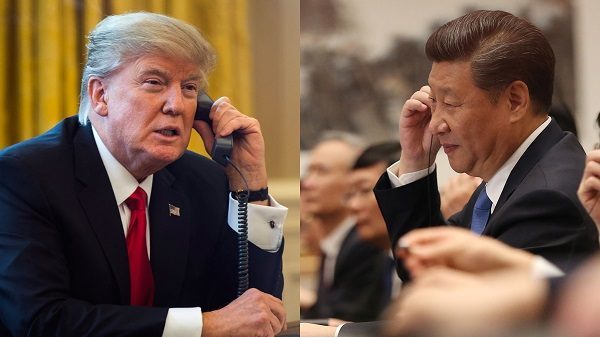
Xi Jinping in phone call to Trump: Calm down on North Korea and work with China

Donald Trump and Xi Jinping
Chinese President Xi Jinping follows up China's warning it will defend North Korea from US attack by telling US President Trump to calm down and work with China to achieve a peaceful solution to the crisis.

In typical Chinese fashion, after the mailed fist comes the velvet glove.

Having warned the US via an editorial in Global Times yesterday that it will defend North Korea if the US invades North Korea and seeks to overthrow Kim Jong-un's government, the Chinese government followed this up today with a telephone call to US President Trump by Chinese President Xi Jinping.


Comment: Global Times:
"If North Korea launches missiles that threaten US soil first and the US retaliates, China will stay neutral," the Global Times wrote.

But should the US and its allies attempt to "overthrow the North Korean regime and change the political pattern of the Korean Peninsula," Beijing would "prevent them from doing so".


Attention

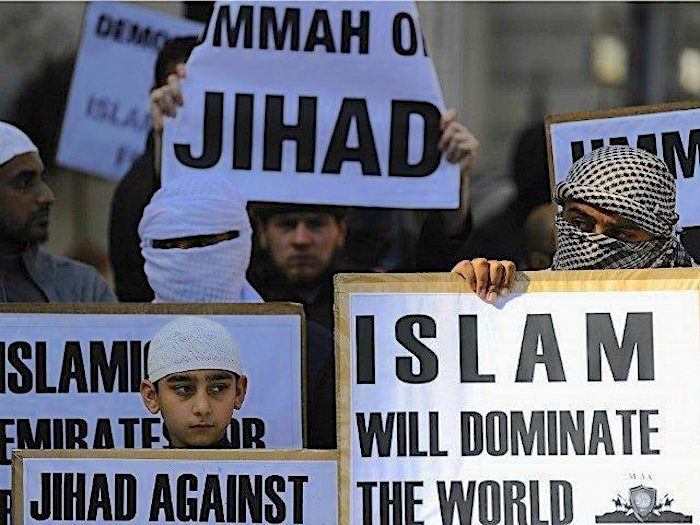
Who are the Islamic Supremacists of North America?

Islam signs crowd
© Reuters/Breitbart
There has been a shift in the jihad that is waged today, it is called STEALTH JIHAD. It is weaving in Islamic extremism, using the cover of free speech.

The Islamic Society of North America, or as it should be called: the Islamic Supremacists of North America, is a very dangerous group in the United States of America. They have been intimately connected with several Islamic Fundamentalists such as Anwar Awlaki. The Islamic Society of North America was founded in 1982, in Plainfield, Indiana well before the Muslim Brotherhood's plan know as: "The Project" was discovered by our country's intelligence apparatus.

The plan lists in detail the ways that Muslims can commence stealth jihad. A sister-organization of CAIR (Council on American-Islamic Relations), ISNA's official mission statement is: "To foster the development of the Muslim community, interfaith relations, civic engagement, and better understanding of Islam." Their vision is: "To be an exemplary and unifying Islamic organization in North America that contributes to the betterment of the Muslim community and society at large." Note the word: "unifying", do not be deceived.

The goal of this radical Islamic organization is to resurrect the Caliphate, the Caliphate that existing as it was in the seventh century. It is also no surprise that in the 1980s, terrorism began to take root in the West. ISNA was the organization that held a conference where Anwar al-Awlaki spoke; the radical imam from New Mexico. ISNA hosted the radical imam on September 1, 2001, just ten days before 9/11.

Comment: "...weaving in Islamic extremism, using the cover of free speech." Is this author suggesting free speech is only for some and not others? Then it isn't free. Is he advocating putting a pressure lid on some organizations due to interpretation of message? Pressure lids lead to explosions. Should the government and public take notice of Islamic agendas that have the potential to disrupt society for idyllic fanaticism? Absolutely. But it calls for discernment. We live deceptively within shifting shades of gray and, unfortunately, there is very little purity left.


Snakes in Suits

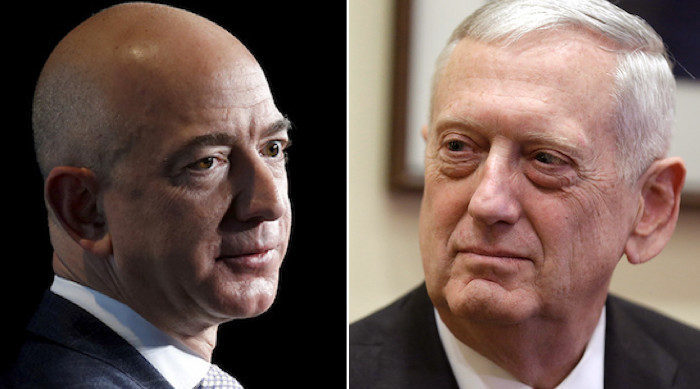
Defense Sec. Mattis meets with Amazon's Bezos

BezosMattis
© Market Watch/ReutersAmazon CEO Jeff Bezos • US Sec of Defense James Mattis
As part of US Secretary of Defense James Mattis' two-day trip to visit the giants of the tech industry, he has met with Amazon CEO Jeff Bezos, whom President Donald Trump has accused of running the Washington Post as a tax shelter.

Mattis met with Bezos on Thursday, and toured the Amazon facilities in Seattle, Washington. This trip was also scheduled to include a stop in Mountain View, California, later in the day, according to Reuters. "A pleasure to host #SecDef James Mattis at Amazon HQ in Seattle today," Bezos wrote on Twitter on Thursday.

While in Mountain View, Mattis will tour the Pentagon's Defense Innovation Experimental Unit (DIUx), a post set up in 2015 by Mattis' predecessor, Ash Carter. The unit is being used as a way to funnel civilian technology to the Defense Department for military use.

When Mattis was asked if he saw the value in DIUx, he said, "I want to see results. I want to see what they're doing with their location and the ideas that they're bringing, they're harvesting - what are we getting out of it?" The Hill reported. "I'm not coming out here questioning the mission, I think, is what - is what you're asking, though," Mattis added.


Comment: Amazon, the 4th most valuable company in the world with a mouthpiece (WaPo) and now with ties to CIA, puts Bezos (recently, but fleetingly, the most wealthiest man in the world) in a unique position for what and to whose advantage? Mattis is making the rounds including Google. Friendly informational check ups? Or should we contemplate connecting the dots.

See also:


Rocket

Could N. Korea be a Cuban missile crisis or WMD deja-vu?

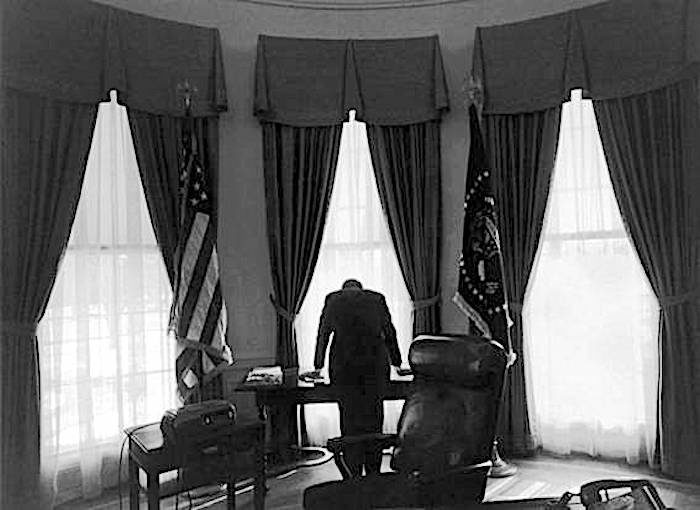
KennedyOvalOffice
© World Politics News ReviewJFK: The Dilemma, The Decision
In 2016 the Clinton campaign ran a TV ad a retired nuclear missile launch officer opined, "The thought of Donald Trump with nuclear weapons scares me to death." At the time I couldn't help but recall it was Hillary's husband who "misplaced" the nuclear codes, unable to say where in the White House he'd last seen them. We understand at the time corkscrew Willy probably knew where all his cigars were, and had been.

Now according to the Smithsonian Institute, what we know as the "Football" is officially termed the "president's emergency satchel," made of an aluminum frame wrapped in black leather. No, there is no red button inside. Nor does it contain any sci-fi like countdown clocks accompanied by a disembodied airy female voice.

Instead, the package is devised to confirm the president's identity when he contacts National Military Command Center in the Pentagon, and provides a shorthand list of nuclear attack options.

When Bill Clinton lost his nuclear code card dubbed "the Biscuit", allegedly for several months, former chairman of the Joint Chiefs of Staff, Gen. Hugh Shelton was concerned. I guess! Shelton wrote in his autobiography, "This is a gargantuan deal."

Now that President Trump has the "Football"-it is carried by an attaché who goes where the president goes -- it's fair, in my opinion, to suggest Trump is unlikely to misplace either the personal attaché or any such seriously important card. Say what you will, but the guy seems pretty darn organized, detail wise. And oh, he isn't distracted with an intern with a blue dress.

Comment: Despite pokes in the sides of Hill, Bill, Barry and China, the question of triggering the nuclear option always lurks in the background. Is there enough trust left in the world that this option will never be activated? Or are we one step away from entering the twilight zone where rationality evaporates and the ultimate gratification -- for one degenerate, non-human moment in time -- becomes our final and irreversible destination? For today, we still get to choose...