
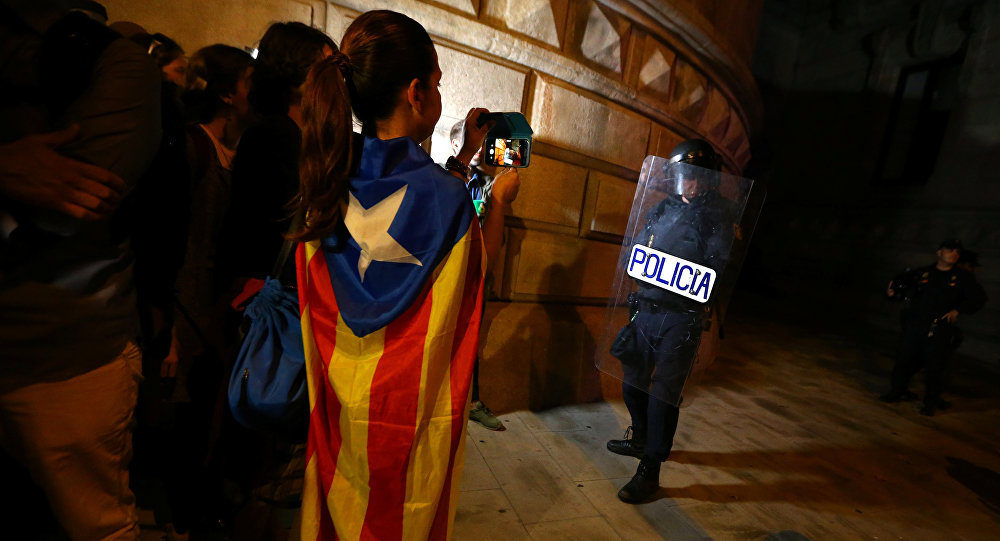
© REUTERS/ Ivan Alvarado
In a televised address on Saturday, Puigdemont said Madrid's decision to suspend the autonomy of the province and appoint Spanish Deputy Prime Minister Soraya Saenz de Santamaria as Catalonia's provisionary head goes against the will of the people.
"It's very clear that the best form of defending the gains made up until now is democratic opposition to article 155," Puigdemont said in a brief statement aired on public regional TV3 broadcaster. He further pledged to "continue working to build a free country".
Madrid's move came after the Catalan Parliament voted to declare the region independent from the Spanish government on Friday.
Spanish Prime Minister Rajoy announced the dismissal of Puigdemont and his cabinet, as well as the head of the regional police force, the Mossos d'Esquadra. He also dissolved the Catalan parliament and announced a snap election will be held in the region on December 21.













Comment: The sticking point in Spain's plans is that Article 155 does not explicitly allow for the Madrid government to take control of an autonomous region and rule it directly, but instead specifies that 'the [Madrid] government can take the necessary steps to oblige the autonomous region to comply with orders from the government'. By dissolving the Catalan government and, effectively, ruling directly until new elections in December, the Madrid government is breaking its own laws.
What kind of elections does Madrid think it can organize in December whereby there will be a majority of anti-independence members of the Catalan parliament, unlike the current parliament configuration? Are mass arrests of pro-independence MPs in Cataluña coming? Will pro-independence parties be banned? How else can Madrid prevent the MPs it has just 'fired' from running again for election?
See also: