Puppet MastersS


Chess

James Howard Kunstler: March will disappoint those 'Wokesters' awaiting the Mueller report

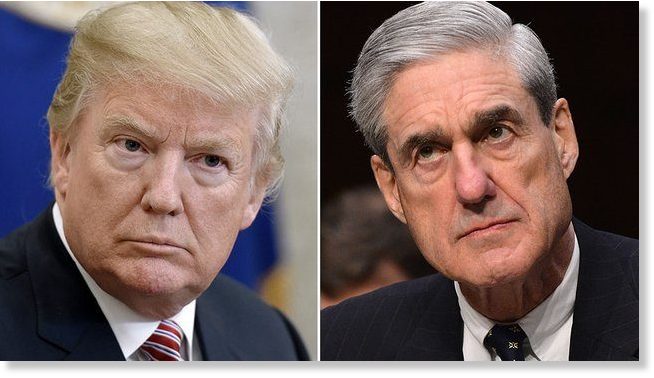
trump and mueller
I suppose Mr. Trump dangled visions of North Korea's future as a Buick showroom and the mysterious Kim Jong Un detected some kind of trap there. A correspondent with military intel credentials writes:
"[Eric] Hoffer's observation that people only revolt when things are getting better seems applicable to DPRK. I can only assume that Kim and his cabal in NK know this or somehow instinctively understand it. In short, as I see it, he can't afford to let things get really better for North Korean people. So, I believe Trump's carrot of great economic success for DPRK's people probably scares Kim badly."
It was certainly hard to imagine the two leaders in conversation: The President with his larval vocabulary and Mr. Kim in his life-long solipsistic haze. Perhaps they compared hair-dos, both equally strange, would you not admit? Something tells me that Mr. Kim is not a golfer, so that was out as an icebreaker, though it's said he does enjoy firing artillery at human targets - one thing that Mr. Trump has not been accused of by former consiglieri-turned-pagliaccio Michael Cohen. Perhaps Mr. Trump let Mr. Kim in on the glorious beauty of an American Cheeseburger, a sure-nuff wonder of the world!

Ladybug

Pakistan to charge India with 'eco-terrorism' at UN after 'anti-jihadi' assault destroys part of alleged 'forest preserve'

pakistan india attack eco preserve park
© Reuters/Asif Shahzad
While New Delhi claims to have killed a large number of militants in anti-terrorist strikes Tuesday, Islamabad says the bombs hit a remote forest and injured one old man, now they plan to file Eco-terrorism charges with the UN.

The Jihadi training camp which India claims to have destroyed was actually a forest preserve, Pakistan's Climate Change Minister Malik Amin Aslam said in a conversation with Reuters.

He claims the bombs had done "serious environmental damage," bowling over a number of defenseless pine trees in a hilly forest area of Kashmir not far from the Indian border.
What happened over there is environmental terrorism.

Light Sabers

Surgical Strikes 2.0? India bombs Pakistan, saying it targeted terrorist camps in cross-border air raid - UPDATES

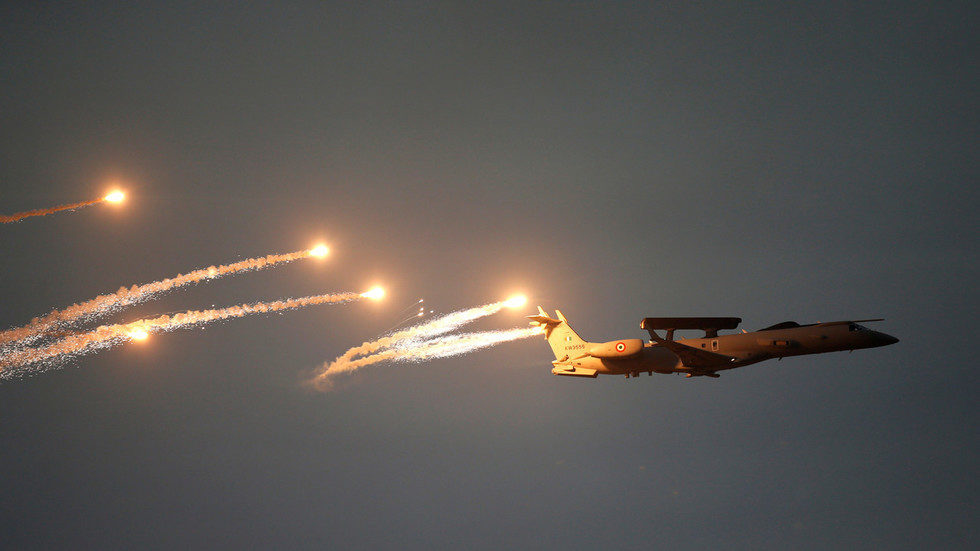
Indian Air Force's plane military drill
© Amit Dave / ReutersIndian Air Force's plane takes flight during military drills on February 16, 2019.
An Indian minister claimed that the country's aircraft made a successful bombing run against terrorists on the Pakistani-controlled side of Kashmir. Pakistan said the Indian jets "released a payload" while fleeing.

"Air Force carried out aerial strike early morning today at terror camps across the LoC [Line of Control] and Completely destroyed it," the minister of state of agriculture, Gajendra Singh Shekhawat, tweeted on Tuesday.

Comment: See also: Indian Foreign Secretary said the airstrike was necessary "due to Pakistan's inaction":
"India has given proof many times seeking action against Jaish-e-Mohammed and others at terror camps so big, that they can train hundreds of jihadis and terrorists at any given time," Foreign Secretary Vijay Gokhale told reporters on Tuesday after Indian jets carried out a "preemptive" bombing raid across its neighbor's border, targeting the Jaish-e-Mohammed (JeM) jihadist group.

The minister said the jets successfully destroyed the "biggest" JeM training camp near the city of Balakot in Pakistan's northeastern Khyber Pakhtunkhwa Province.

The government received "very credible intelligence info" that JeM was planning terrorist attacks in India, which made the airstrike "absolutely necessary," Gokhale stated.
Pakistan's FM says they are "ready to respond to any Indian misadventure":
Pakistani Prime Minister Imran Khan convened an emergency meeting in Islamabad to review the developing situation, Radio Pakistan reported.

Foreign Minister Shah Mehmood Qureshi accused India of causing a deterioration of the situation in the region, saying that Pakistan reserves the right to respond to India's actions.

The minister stated that the people of Pakistan are supporting the national armed forces, which are capable of responding to any "misadventures" by it eastern neighbor. The minister said he hopes that "better sense" will prevail in India.

The country's national security committee later in the day said Pakistan will respond to the incident at the "time and place of its choosing."

The prime minister's office said that Imran Khan will "engage global leadership to expose irresponsible Indian policy" in a statement condemning the incursion.

The Pakistani military downplayed the importance of the rare cross-border air incursion, saying Indian warplanes dropped their payload while being chased away by Pakistani fighter jets and that the munitions caused no casualties or damage on the ground.
The Chinese government commented:
"India and Pakistan are both important countries in South Asia. Sound relations and cooperation serve the interest of both countries for peace and stability in South Asia," Chinese Foreign Ministry spokesperson Lu Kang said at a briefing in Beijing Tuesday.

"We hope the two countries can keep restraint and do more to improve bilateral relations," he added.
UPDATES: India confirms shooting down Pakistani jet.
The Indian Air Force has confirmed that one of its MIG-21 Bison aircraft has shot down a Pakistan Air Force F-16. The news comes two days after the PAF claimed it shot down two Indian planes over the disputed territory of Kashmir.

IAF Air Vice Marshal RGK Kapoor told reporters on Thursday that the Pakistani aircraft was downed after intruding into Indian territory. Kapoor said that the plane was one of several Pakistani aircraft that dropped bombs in Indian territory, but caused no damage.

Indian jets bombed targets in the Pakistani-controlled part of Kashmir, claiming that Islamabad had done nothing to crack down on the terrorist group had carried out the Pulwama suicide attack killing 42 Indian security officers earlier this month.

Pakistan responded by shooting down at least one Indian bomber and capturing its pilot. India acknowledged the loss but said it had shot down a Pakistani aircraft as well.

Pakistan had previously denied using any of its F-16 aircraft in the attack, but the IAF displayed the twisted remnants of a US-made AMRAAM missile it says "conclusively shows" an F-16 was used.
India justified its air strike citing the US raid to capture bin Laden:
Recalling the 2011 US operation to kill Osama bin Laden in Pakistan, an Indian minister said New Delhi is able to carry out a similar raid. The statement comes amid a simmering conflict that saw tit-for-tat action over Kashmir.

"I remember when US Navy Seals went to Abbottabad [Pakistan] to kill [Al-Qaeda leader] Osama bin Laden, then why can't India?" Arun Jaitley, India's finance minister was quoted as saying by local media. He said such a raid "used to be only an imagination, a wish, a frustration and disappointment,"adding, "but it's possible today."

Jaitley, who was defense minister until late 2017, was speaking just a day after a series of artillery shellings and air encounters over contested Kashmir. New Delhi said its Air Force engaged and shot down a Pakistani aircraft (presumably an F-16) but lost their own MiG-21 fighter as well. Pakistan, in turn captured an ejected MiG pilot, posting a photo of him in custody.
Captured Indian Pilot Abhinandan
© Government of PakistanCaptured Indian pilot Abhi Nandan
India and Pakistan attempt to defuse the situation while saving face:
A major showdown between the two states risks bringing the world on the brink of a destructive nuclear war, a dire perspective even if limited to the densely populated South Asia. Understandably, both sides want each other to show restraint, - but neither is willing to make the first move.

"Pakistan doesn't have a desire for war, but when it is imposed there is no choice left for the Muslims," Masood said, arguing that it is India's call to diffuse the tensions.

Sikri said that India, which is a far superior power militarily, does not want war either, but said that he believes Islamabad should take the first step to resolving the dispute - in the form of the "immediate return" of the captured Indian pilot.

"India's response has been restrained but if provocations continue I think it may become difficult," Sikri admitted, noting that while he hopes that "cooler heads will prevail" the situation can as well "go out of hand."
Pakistan makes a gesture towards deconfliction, offering to release a captured pilot on Friday:
Islamabad is ready to hand over a pilot captured after an Indian jet was downed over Kashmir if the move will help defuse tensions which have pushed the neighbors close to war, Pakistan's Foreign Minister has said.


"If there is de-escalation with the return of this [Indian] pilot, Pakistan is willing to consider this. We are ready for all positive engagement," Foreign Minister Shah Mahmood Qureshi was quoted by Pakistani Geo TV on Thursday.

Pakistan's Prime Minister Imran Khan is also willing to talk to Indian premier Narendra Modi "to extend an invitation of peace," the top diplomat said. The Indian side is yet to respond to the offer. Claiming Islamabad has been calling for peace since the outbreak of hostilities, Qureshi said, "If India wants to talk about terrorism then we are ready."
The US is caught in the middle of the dispute, and China doesn't need another conflict near its borders:
Beijing and Delhi have frequently butted heads in the past, among other things about the Aksai Chin region of Kashmir claimed by India but controlled by China since 1962. China has developed a military alliance with Pakistan since the 1970s, with Beijing currently one of Islamabad's major trading partners and the largest supplier of weapons.

This has led some Russian scholars to speculate that the US might tacitly approve of the current conflict as a way to keep China away from building up its maritime strength in the Pacific.

"The US is interested to have China get involved in a maximum number of conflicts," Aleksey Kupriyanov, a researcher at the Moscow-based Institute of World Economy and International Relations, told RT. "Any conflict would slow down Chinese economic growth, which would mean less danger for the US hegemony in the Pacific."

Kupriyanov believes China will try not to interfere in the dispute, balancing the relations with its old ally Pakistan and India, seen as an important new trade partner.

Smruti S. Pattanaik, research fellow at the Institute for Defence Studies and Analyses in New Delhi, also believes China will not meddle, but said Beijing could use its influence to make it clear to Islamabad that terrorism will not be tolerated.

"At the moment de-escalation is not plausible. For any de-escalation Pakistan has to take visible action against terror groups,"Pattanaik told RT, referring to the jihadist Jaish-e-Mohammed (JeM), which India accuses Pakistan of harboring.

US can't afford to take sides

The rapidly escalating conflict has raised alarm in the US, coming just as the Trump administration was focusing on the second summit with North Korean leader Kim Jong-un in Hanoi.

"[US] foreign policy leaders are very much focused on what's happening in Vietnam and we don't know if there is enough attention being put on the India-Pakistan issue, which in my view presents a real risk of a crisis right now," Manpreet Singh Anand, former deputy assistant secretary for South Asia in the State Department, told CNBC.

Washington has been wooing New Delhi for the past several years, going so far as to rename its Pacific Command to "Indo-Pacific" and signing weapons deals with Prime Minister Narendra Modi's government, hoping to use India as a regional counterweight to China.

"If India gets bogged down by South Asian conflict, then it cannot participate in broader foreign policy matters. With the rise of China, the US wants India to play a bigger role in Asian policy," said Rick Rossow of the Center for Strategic & International Studies (CSIS).

However, if Washington backs India, Pakistan could retaliate against US interests - such as continued supply of US troops in Afghanistan, Rossow pointed out.

Further complicating things is the fact that both the US and Saudi Arabia have courted Pakistan as a launching pad for hostilities against the neighboring Iran, but neither country wants a conflict with India at the moment.
Russia offers to mediate:
Moscow would be ready to host negotiations between New Delhi and Islamabad, Russian Foreign Minister Sergey Lavrov said as tensions flare in the contested region of Kashmir.

The top diplomat made it clear that the Kremlin will not hesitate to help ease hostilities between the perennial rivals amid the latest escalation.

"If they [India and Pakistan] wish to, then certainly yes," Russian FM said, after being asked whether Russia is ready to provide a place for talks.

Lavrov's words were elaborated by Russian FM spokeswoman Maria Zakharova, who said the standoff involving two nuclear-armed nations needs a political and diplomatical solution. The Russian FM representative also urged both parties to show restraint.

India launched an air raid on the Pakistani-controlled territory on Tuesday. New Delhi said the strikes targeted a terrorist camp of the Jaish-e-Mohammed militant group, which claimed responsibility for the February 14 suicide bombings that killed over 40 Indian police officers.
UPDATE 1/3/2019: Pakistan partially reopens its air space
Pakistan has resumed commercial flights from major cities including Karachi, Islamabad, Quetta, and Peshawar, the Civil Aviation Authority tweeted on Friday.


However certain restrictions will remain in place until March 4, officials warned in a separate tweet.

Pakistan closed its airspace on February 27 following the aerial encounters between Islamabad and New Delhi in the disputed region of Kashmir. India also shut down airports on its side of the UN-mandated Line of Control.

The flight ban closed an important air route from Europe to Asia, leaving thousands of people stranded in airports across the world as major airlines had to reroute, delay, or cancel their flights.


Arrow Up

Putin's approval rating reaches new 2019 heights following annual address

putin hockey
© Sputnik / Valery Melnikov
Russian President Vladimir Putin's approval rating has risen to 64.8 percent - the highest so far in 2019 - after his annual address to the Russian parliament.

The Russian president boasts the highest approval rating among the nation's politicians, while 36.8 percent and 40 percent of Russians approve of the work of the prime minister and the government respectively, according to the Russian Public Opinion Research Center (VTsIOM).

Sociologists attribute the recent increase in Putin's ratings to his annual address to parliament on February 20, which was focused on social and economic issues in Russia. In his speech, Putin pledged more support to families, including real estate tax breaks for families with many children, as well as increasing benefits for vulnerable groups like elderly people and single parents. Among other issues, Putin called for improved availability of healthcare, especially in rural areas.

Comment: Unlike (most) politicians in the West, Putin listens to the concerns of Russians and tends to follow through on his pledges. It's notable that, according to some of the most recent polls, the approval rating of France's Macron limps in at around 30%, and that of Britain's May scrapes by at 33%:


Chess

Pakistan says it's 'ready to come to the table' after Russia offers mediation over Kashmir crisis

pakistan soldier border india
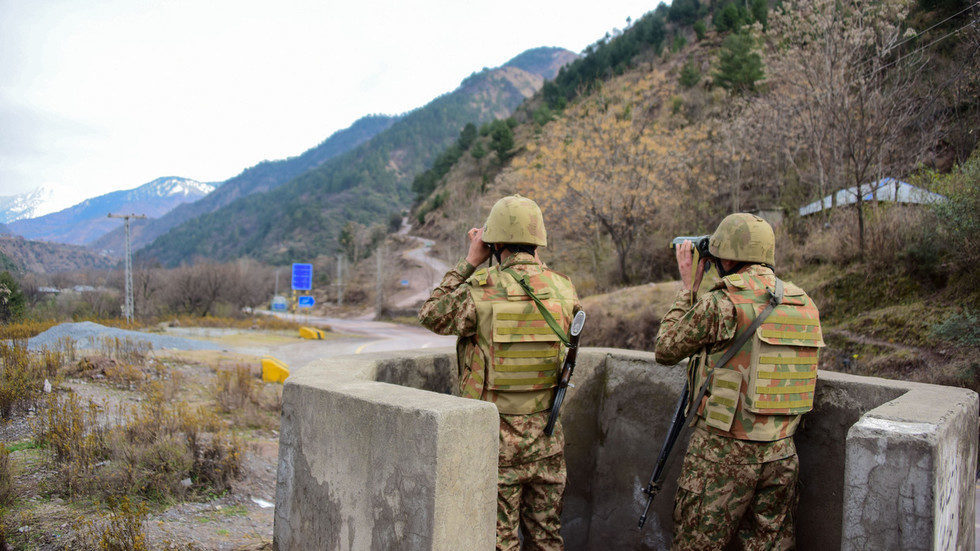
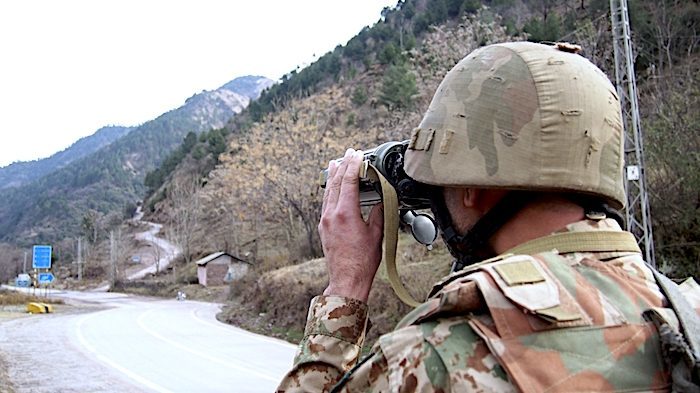
© Agence France-Presse/Sajad QayyumPakistani soldiers watch over potential Indian troop movements with binoculars at the Chakothi post near Pakistan-India border on February 23, 2019.
Islamabad is ready to hold talks with New Delhi after Russia offers mediation help, the Pakistani foreign minister said as cited by local media. It comes as tensions between the two nuclear-armed nations are running high.

Russia expressed its willingness to help ease hostilities between the two arch rivals on Thursday. Foreign Minister Sergey Lavrov said Moscow will provide a place for Indo-Pakistani talks "if they wish to." Tipping his hat to the Kremlin, Shah Mahmood Qureshi announced his country is ready to talk.

"Lavrov has offered to mediate. I don't know about India but I want to say this to Russia that Pakistan is ready to come to the table and de-escalate tensions," Qureshi said.

Comment: Shah Mehmood Qureshi at least, seems to understand the seriousness of the situation, saying that all-out war with India would be 'mutual suicide':
Shah Mehmood Qureshi was quizzed by CNN's Christiane Amanpour about rising tensions between Pakistan and India, following a cross-border aerial operation launched by New Delhi aimed at eradicating a terrorist cell.

Shah Mehmood Qureshi Pakistan
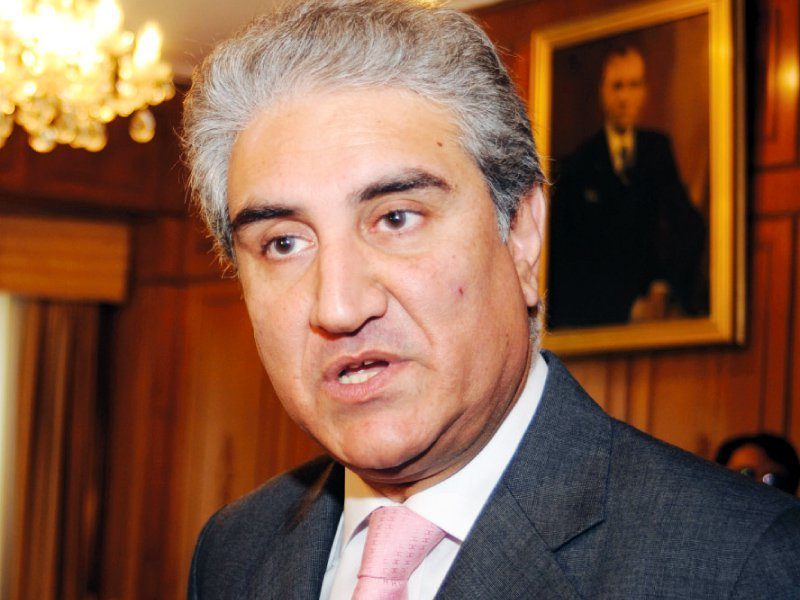
© Agence France-PressePakistan's Foreign MinisterShah Mehmood Qureshi
"Is this the kind of situation that, had it not de-escalated, could have tipped you both over the brink? Could you envision all-out war between India and Pakistan?" Amanpour asked.

"I hope not. That would be mutual suicide. Pakistan never wants to escalate, Pakistan never wants to be in a hostile position," Qureshi replied.

He said that Pakistan's new government under Prime Minister Imran Khan has offered to India that "if you take one step towards peace, we will take two." Pakistan, Qureshi stressed, "wants to live in peace, we have a people-centric agenda."

As a "peace gesture," Islamabad announced that an Indian Air Force Pilot shot down over Pakistani airspace will be released on Friday. The captured pilot was part of an Indian operation targeting Pakistani-based militants accused of attacking and killing over 40 Indian police officers in mid-February.

Despite claims by Islamabad that terrorists aren't welcome on its soil, India insists that Pakistan is not doing enough to contain the danger, promising to stand "like a rock to counter their evil designs."


Arrow Up

BRICS countries to create smartphone payment system to cut dependence on West

pay by phone
© Getty Images / Jasmin Merdan
The five major emerging economies - Brazil, Russia, India, China, and South Africa - are developing a joint new payment system called BRICS Pay, the Russian media has reported.

BRICS countries want to create a special online wallet to integrate the payment systems of its five member states, Izvestia said on Friday citing the Russian Direct Investment Fund (RDIF). Russia's wealth fund is reportedly working on the project alongside its partners from China and India, who have the necessary technologies to launch the system.

The service will be similar to existing Apple Pay and Samsung Pay, allowing users to pay with a smartphone app no matter what currency the customer's account is linked to. A special cloud platform is to be created to link BRICS countries' national payment systems.

Comment: See also:


People 2

Pakistan hands over captured air force pilot to India as promised

indian pilot returned pakistan
© Reuters/Francis MascarenhasChildren hold banners and Indian flags in Mumbai, India
Fulfilling the promise of Prime Minister Imran Khan, Pakistan has handed over an Indian pilot who was shot down and captured in an aerial skirmish between the two countries this week.

The pilot, Wing Commander Abhinandan Varthaman, was transported to the border crossing in a military convoy which set out from the eastern Pakistani city of Lahore.

Cheering crowds have gathered on the Indian side of the border near Attari-Wagah to welcome the captured pilot. Residents waving India's national flag and holding a huge garland of flowers lined the road.

The footage released by Pakistani media showed Varthaman walking across the border into India, near the town of Wagah, just before 9pm local time (1600 GMT).

Bad Guys

It's trendy now: Mysterious group declares itself N. Korean 'government-in-exile'

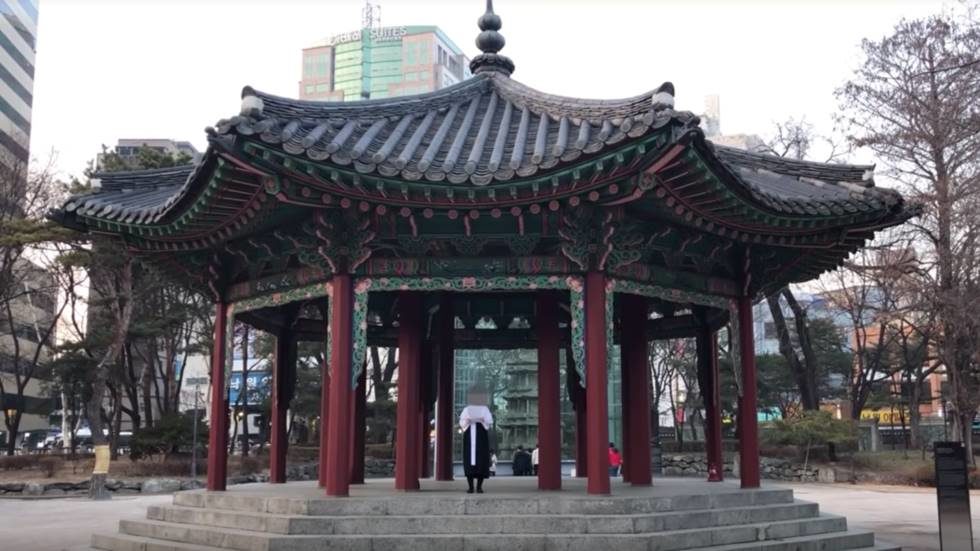
Korean pagoda
© YouTube / 자유조선 ("Free Joseon")
A shadowy group known as the Cheollima Civil Defense (CCD) has declared itself North Korea's "government-in-exile" while decrying the government of Kim Jong-un as an "immoral and illegitimate regime."

CCD released a statement Friday, declaring their government, which they have dubbed 'Free Joseon,' as "the sole legitimate representative of the Korean people of the north." A video of a woman dressed in a traditional black and white hanbok with her face blurred out reading out the group's manifesto was also released.

Joseon is an old name for Korea. The term is sometimes used by North Koreans and Koreans living in China based on a kingdom on the peninsula which lasted from 1392 - 1897. The group, named after a winged mythical horse, is believed to be harboring and protecting Kim Han-sol, the son of Kim Jong-un's assassinated brother, Kim Jong-nam, who was killed with VX nerve agent in Malaysia on February 7 2017.

An expert on the region told RT.com that he is highly skeptical of the group and suspects it is backed by South Korea or the USA.

Russian Flag

No de-escalation in sight! Russia and China warn India-Pakistan skirmishes can easily spiral into war

Soldier Kashmir
© Unknown
The Russian Federation in chorus with the People's Republic of China have again called on India and Pakistan to refrain from further escalating around the disputed Kashmir region, where in the last 48 hours the parties exchanged air strikes and artillery bombardment that resulted in human casualties for the first time since 1971.

Russia and China have seldom seen eye-to-eye during the course of the 20th century on the subject of India and Pakistan - with Russia historically favoring India, and China with Pakistan.

The Russian Federation and other external forces have concerns that the situation in the armed confrontation of two long-standing geopolitical opponents could get out of control. In India, the prime minister has nationalist views, and Narendra Modi is also soon awaiting parliamentary elections. Many pundits are explaining that India's moves are little more than a gambit to either distract from other issues where he is less popular, or to raise his support among his nationalist base which may have begun to question his commitment to nationalism in light of his previous inaction surrounding the February 14th terrorist attacks.

Comment: See also:


Footprints

Why is the Canadian military in Haiti?

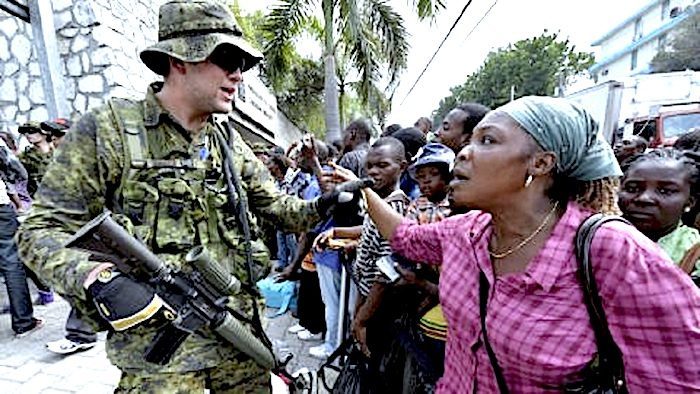
Canadian military Haiti
© UnknownCanadian military in Haiti
Canadian troops may have recently been deployed to Haiti, even though the government has not asked Parliament or consulted the public for approval to send soldiers to that country.

Last week the Haiti Information Project photographed heavily-armed Canadian troops patrolling the Port-au-Prince airport. According to a knowledgeable source I emailed the photos to, they were probably special forces. The individual in "uniform is (most likely) a member of the Canadian Special Operations Regiment (CSOR) from Petawawa", wrote the person who asked not to be named. "The plainclothes individuals are most likely members of JTF2. The uniformed individual could also be JTF2 but at times both JTF2 and CSOR work together." (CSOR is a sort of farm team for the ultra-elite Joint Task Force 2.)

What was the purpose of their mission? The Haiti Information Project reported that they may have helped family members of President Jovenel Moïse's unpopular government flee the country. HIP tweeted, "troops & plainclothes from Canada providing security at Toussaint Louverture airport in Port-au-Prince today as cars from Haiti's National Palace also drop off PHTK govt official's family to leave the country today."