OF THE
TIMES
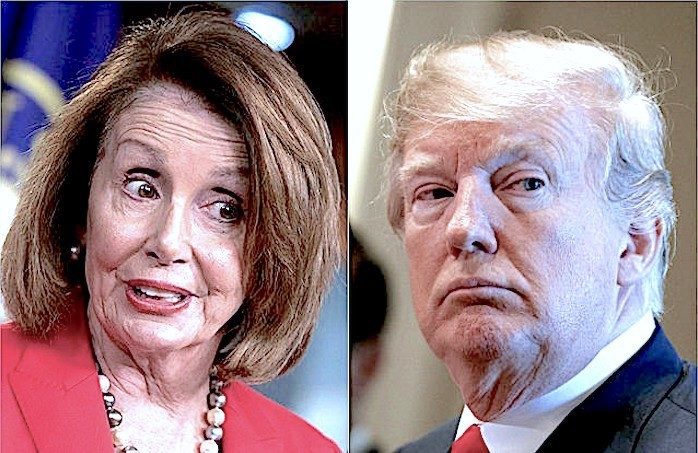
US President Donald Trump on Monday fired another round of shots at unnamed Democratic congresswomen for spewing racist hatred that has made Israel feel abandoned by the United States.See also:
"If Democrats want to unite around the foul language & racist hatred spewed from the mouths and actions of these very unpopular & unrepresentative Congresswomen, it will be interesting to see how it plays out. I can tell you that they have made Israel feel abandoned by the US," Trump in a statement on Twitter.
In a separate tweet, the president asked when the same congresswomen will apologize for their foul language and disgusting actions.
With Monday's renewed attacks on Democratic congresswomen representing the progressive left-wing of their party, Trump followed up on Sunday's Twitter rant in which he told those congresswomen to go back to the "broken and crime-infested" countries from where they "came from."
Democrats denounced Trump's tweet as racist and xenophobic.
Ocasio-Cortez, who was born in New York, described the president's remarks as "hallmark language of white supremacists."
House Speaker Nancy Pelosi said in a post on Twitter that Trump's xenophobic comments are meant to divide the country. She added that the comments reaffirmed the president's plan to "'Make America Great Again' has always been about making America white again."
Republicans, on the other hand, have remained silent following's Trump's rant.

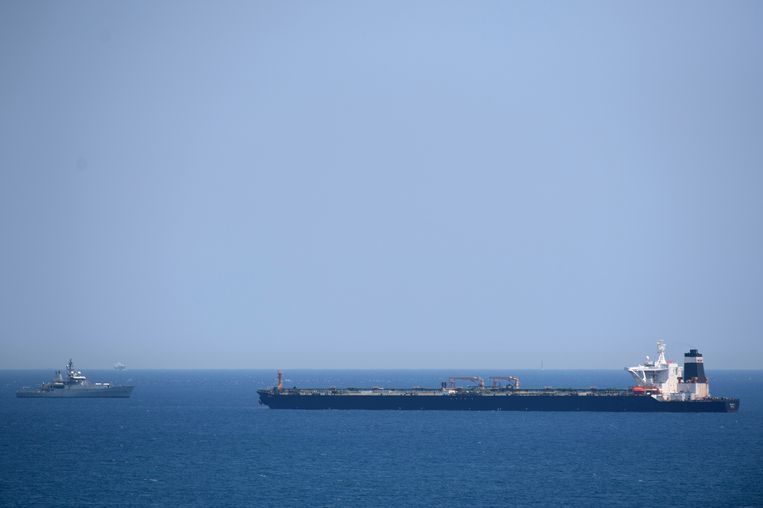
Oil tanker Riah, which, according to vessel location tracking websites, stopped transmitting signals on its location in the early hours of 14 July, didn't issue any emergency signals, a highly-profile Emirate official told Al-Arabiya on Tuesday.Almost as an afterthought, the Times of Israel mentions Iran's offer to put ballistic missiles up for negotiation:
"The oil tanker is not owned, and nor is used by the United Arab Emirates, it hasn't trasmitted any SOS signals," the speaker told the television channel, busting reports that the vessel had changed its course and got lost in the Strait of Hormuz off the Iranian coast.
Earlier in the day, an unnamed US defense official told The Associated Press that America "has suspicions" that Iran seized an oil tanker based in the UAE.
The 190-foot MT Riah, carrying the flag of Panama, was last mapped in the vicinity of Iran, near the island of Qeshm, which hosts a local Revolutionary Guard base, according to Haaretz.
According to Dr Ali Reza Rezahah, expert on US international politics, political observer and columnist for the Iranian Supreme Leader's Analytical and expert centre, it is necessary to understand where and where from the tanker was moving, why it disappeared and where it ended up.
"Another issue is that the vessel reportedly belongs to the UK, but has a flag of Panama and carried cargo for the Emirates. If the ship is really an Emirate one, why did they state that they have nothing to do with it?"
The analyst went on to say that whatever happens in the Strait of Hormuz, Americans always point a finger at Iran's "complicity," use Photoshop and photo editing.
Rezahah is certain the US is striving to make the Strait of Hormuz, which many lead to the creation of an anti-Iranian international coalition. "Unfortunately, they are creating such incidents themselves, in a bid to frighten Iran, but at the same time they are unable to ground not a single instance of the Islamic Republic having anything to do with the attacks."
Meanwhile, Iran's Foreign Minister Mohammad Javad Zarif suggested for the first time that the Islamic Republic's ballistic missile program could be up for negotiations with the US, a possible opening for talks as tensions remain high between Tehran and Washington.
Zarif offered an initially high price for such negotiations — the halt of American arms sales to both Saudi Arabia and the United Arab Emirates, two key U.S. allies in the Persian Gulf.
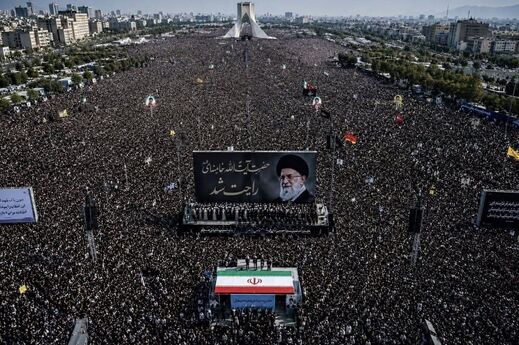
But the fact that he mentioned it at all potentially represents a change in policy. The country's ballistic missile program remains under control of the Iranian paramilitary Revolutionary Guard, which answers only to Khamenei.
Zarif brought up the ballistic missile offer during an interview with NBC News that aired Monday night as he's in New York for meetings at the United Nations. He mentioned the UAE spending $22 billion and Saudi Arabia spending $67 billion on weapons last year, many of them American-made, while Iran spent only $16 billion in comparison.
"These are American weaponry that is going into our region, making our region ready to explode," Zarif said. "So if they want to talk about our missiles, they need first to stop selling all these weapons, including missiles, to our region."
Trump during his time in the White House has pointed to arms sales to the Mideast as important to the American economy, so it remains unclear how he'd react to cutting into those purchases.
Zarif's comments marked the first time an Iranian official has mentioned even the possibility of talks on the Iranian missiles.
Since its 1979 Islamic Revolution and the takeover of the U.S. Embassy in Tehran, Iran has faced a variety of economic sanctions. That has cut into Iran's ability to buy advanced weaponry abroad. While Gulf Arab nations have purchased advanced fighter jets, Iran still relies on pre-1979 US fighter jets, as well as other aging Soviet MiGs and other planes.
Facing that shortfall, Iran instead invested heavily into its ballistic missile program. That's both due to sanctions and the memory of the missile attacks launched by Saddam Hussein during Iran's bloody 1980s war with Iraq.
Khamenei reportedly has restricted the range of ballistic missiles manufactured in Iran to 2,000 kilometers (1,240 miles).
While that keeps Europe out of range, it means the Iranian missiles can hit much of the Middle East, including Israel and American military bases in the region.
In pulling out of the deal, Trump in part blamed the accord not touching on Iran's ballistic missile program. The U.S. fears Iran could use its missile technology and space program to build nuclear-capable intercontinental ballistic missiles, something Tehran denies it wants to do.

Comment: See also: